AI translation: Five kinds, and when each one fits
A traveler in Lisbon asks her earbuds where the train station is and gets a clean, useful answer. An insulin company tests AI translation on its customer support. The English said “body.” The translation said “corpse.” Both are AI translations. Only one should keep a CX leader up at night.
AI translation is software that uses a trained model to turn text or speech from one language into another. The term now covers a free phone app and a translation platform built for regulated, high-volume support, and the differences between them only show up when a translation goes wrong.
This guide sorts AI translation tools into five categories and shows where each one fits. If you run support for a global brand, it also shows where the translation built into your CRM stops, and what to look for beyond it.
What AI translation actually is
AI translation is software that converts text or speech from one language to another using a trained model rather than a dictionary or a set of grammar rules. Almost every tool on the market runs on one of two kinds of engine.
The first is neural machine translation, or NMT. Google moved Google Translate to a neural system in 2016, and DeepL, Microsoft Translator and Amazon Translate work on the same basic principle. An NMT engine learns from millions of sentences that people have already translated, then predicts the most likely rendering of each new one. It’s fast and handles ordinary sentences well. It also reads each sentence more or less on its own, so a typo, an acronym or a half-finished thought gets translated exactly as typed.
The second is the large language model, the technology behind ChatGPT, Claude and Gemini. For an LLM, translation is one skill among many. Because it can read a whole conversation, it often works out that “acct” means account or that an agent’s sentence got cut off. It can be instructed on how to sound, formal or casual, with your product names spelled the way you spell them. That flexibility has a cost. An LLM will sometimes do something other than translate, like answering a question it was asked to translate, or smoothing a phrase into something the writer never said.
Many products now combine the two engines or wrap them in extra layers: glossaries, tone rules, quality checks, backup models that take over when one fails. Those layers are where tools differ most, and from the outside they’re mostly invisible.
That’s how one term ends up covering a pair of earbuds and an enterprise support platform. The engines underneath can be close cousins. What separates the tools is how much a mistake costs you and how much control you have when one happens.
What are the questions to determine which AI translation tool I need?
Before you compare products, it helps to know what you’re asking a tool to do. Four questions place almost any situation.
- What happens if a translation is wrong?
A tourist who gets odd directions asks someone else. A patient who misreads a dosage instruction may not get a second chance. Most business conversations fall somewhere between the two, and the cost of an error should set how much checking a translation needs. - How many conversations do you have?
One bilingual receptionist can cover a dozen Vietnamese-speaking patients a week. No team can hand-check a million support chats. Volume makes human review impractical, and it turns a one-in-a-thousand error into something that happens many times a day. - Does a law tell you which language to use?
In Quebec, Wales and parts of Spain, businesses and public bodies have regulatory mandates about the languages they serve customers in. When the requirement comes from a regulator, someone else decides what counts as good enough. - Does it need to sound like you?
A traveler doesn’t care whether a translation has a personality. A customer reading a support reply notices when it doesn’t sound like the company they chose. Brand voice, product names and the right level of formality all have to survive translation. In Korean and Japanese, formality is how respect is expressed, so getting it wrong reads as rude.
The more of these questions that come back serious, the more control you need over what the translation says. The five categories below run in that order, starting with the earbuds in your pocket.
Consumer tools for everyday conversations
A woman at a fruit stall in Seoul holds up her phone. The vendor speaks into it, the phone reads the price back in English, and she pays. Neither of them thinks of this as AI translation. It’s just how you buy peaches now.
Consumer translation tools have become very good at this kind of exchange. Google Translate covers more than 240 languages and can translate a live conversation or a menu through the phone’s camera. Apple added Live Translation to AirPods in 2025, so two people can talk while each hears the other in their own language. Travel apps and phone keyboards fill the gaps.
These tools do their best work when the conversation is predictable. Where is the airport? How much does this cost? The vocabulary is common, and if something comes out wrong, the person just asks again. Hotel desk staff and taxi drivers use them the same way, for exchanges that last a minute.
The limits show up in the details. In its hands-on test of AirPods Live Translation, the UK consumer group Which? found the translations generally accurate. Still, “British Airways” came out as “Briti shareway,” and a German sentence about a sister’s visit became “This time I have to work her.” Spanish output ran word for word, so the tone was off, and lag grew with background noise and long sentences. None of that matters much when you’re asking for directions. It matters a great deal in a conversation with consequences.
Consumer tools have also changed what customers expect from every company. Someone who bargained with a market vendor in Korean last month won’t understand why a software company can only help them in English. That expectation is good news for anyone building multilingual support. It also means plenty of brands are reaching for AI translation before deciding what kind they need.
Small practices with high-stakes conversations
A family doctor in Texas told us that a large share of his patients speak Vietnamese. That’s less unusual than it sounds. Vietnamese is the most common language spoken at home in Texas after English and Spanish, with about 255,000 speakers, according to the 2024 American Community Survey.
Practices like his are in an awkward spot. Each conversation carries real consequences, because a symptom described wrong or a dosage misread can hurt someone. But the volume is small: usually one or two languages and a few dozen conversations a week. A law office serving Spanish-speaking clients faces the same math.
Health care has a clear rule on this. Under the federal regulation implementing Section 1557 of the Affordable Care Act, when a covered provider uses machine translation for text that’s critical to a patient’s rights, benefits or access, or where accuracy is essential, “the translation must be reviewed by a qualified human translator.” The same regulation bars relying on an untrained adult companion to interpret, with narrow exceptions. It allows relying on a child only as a temporary measure in an emergency.
Lawyers have a parallel duty. The American Bar Association’s Model Rule 1.4 requires a lawyer to explain a matter well enough for the client to make informed decisions. A client who misunderstood a translated explanation wasn’t informed.
For most small practices, the best answer is people. A bilingual staff member who knows your patients or clients will catch what any tool misses, including hesitation, confusion and the question someone was too embarrassed to ask. For languages you can’t staff, phone and video interpreting services can usually connect you with a qualified interpreter in minutes. Certified translators handle documents like consent forms and intake packets.
AI translation still has a place in a small office: scheduling, directions, parking instructions, and other messages where a mistake costs a phone call. Keep it away from anything a person will act on for their health or their case unless a qualified person checks it first.
This is one category where a bigger translation platform isn’t the fix. The volume doesn’t justify one, and the stakes call for a human who can ask “did that make sense?” and mean it.
When the law sets the standard
Someone in North Wales writes to the police in Welsh about a stolen bike. Under the Welsh Language Standards, the force has to reply in Welsh. The regulations also say the Welsh version can’t be treated less favourably than the English one, and that covers how quickly it arrives as well as what it says. Police in Wales use Language IO to help meet these requirements.
Wales isn’t alone, and these rules reach well beyond government. In Quebec, the Charter of the French language, amended by Bill 96 in 2022, gives consumers the right to be informed and served in French. Contracts of adhesion must be offered in French first, and businesses aiming websites and social media at Quebec must make that content available in French. Fines for companies run from C3,000 to C30,000 per day for a first offence and up to C$90,000 per day for repeat offenses. Size doesn’t exempt anyone. The right to be served in French applies to a corner shop and a national bank alike.
In Spain, Law 10/2025 on customer service takes effect on December 28, 2026. Large companies (250 or more employees or more than €50 million in turnover, among other thresholds) and providers of essential services like energy, transport and telecoms must serve customers in the co-official language where they operate: Catalan, Valencian, Basque or Galician. The same law bars companies from running customer service only through bots. Customers can ask for a person.
A mandate changes what counts as good enough in two ways. A regulator or complaints process decides whether you met the standard, so a translation that’s understandable but clumsy can still fail. And the languages involved are often ones general-purpose engines handle less well. Welsh, Basque and Galician have a small fraction of the text available in French or Spanish to train on, and translation quality tends to follow the data. For organizations under these rules, the translation has to be something they can measure and document when a regulator asks.
How does built in AI translation work in a CRM?
Most enterprise support teams first meet AI translation inside the platform they already run. Salesforce offers real-time translation for its Enhanced Chat and Messaging channels, built on Amazon Translate, with more than 65 languages and the option to upload a company glossary. Zendesk added AI translation to email and web forms, then extended it to live chat and messaging in August 2026.
For plenty of teams, that’s a reasonable place to start. Say you handle a few hundred conversations a month in Spanish and French, the questions are routine, and a bilingual supervisor spot-checks the results. Built-in translation will likely cover you. It’s already in the contract, and agents never leave their console.
The trouble starts when conversations get harder, and at enterprise volume some of them always do.
Specialized terms show it first. Remember the insulin company: its test of a general-purpose LLM turned “body” into “corpse,” a word any dictionary accepts and no diabetes brand wants near its product. A glossary entry can fix that word once someone spots it, but a glossary only covers the words someone thought to add.
Some languages ask more of a translation than others. Korean has several speech levels, and the one you use tells the reader how you regard them. Customer service in Korea uses formal, deferential forms. The casual form people use with close friends reads as disrespect coming from a company. A translation layer with no instruction about speech level will pick one on its own, and nobody on your team may be able to tell which. Japanese works much the same way.
Brand voice runs into the same wall. If your English support sounds warm and plain-spoken, a literal engine will turn it into whatever its training data treats as normal, which is often stiff. In the documentation we reviewed, neither platform’s built-in translation offers controls for tone or formality.
At enterprise volume, the first person to notice a bad translation is usually the customer. The harder question is what happens next. When satisfaction scores slip in one language, or the same complaint keeps turning up in German tickets, someone has to work out whether the engine or the glossary is at fault, then fix it for that language without breaking the others. That’s computational linguistics work. CRM vendors build their support teams to help with the platform, and tuning translation for one language pair isn’t what those teams are set up to do. Before you rely on built-in translation, ask your vendor who would handle that diagnosis and how long a fix would take.
We’ve written about the specific ways default translation fails, and the questions to ask before relying on it, in “We support 100+ languages” is the most dangerous sentence in customer support.
Purpose-built AI translation for customer service at scale
Go back to the four questions. Suppose a wrong translation could hurt a customer or make the news, you handle thousands of conversations a day, a regulator cares which language you answer in, and every reply has to sound like your brand. Then you need more than an engine. You need the controls around it, and a team whose job is to keep them working.
Language IO was built for that situation. We’ve spent more than a decade on translation for customer support, and our customers push millions of chats through the platform every week.
The engine is where the work starts, and no single engine is best at everything. Each model learned from different training data, so one that excels at English to Spanish can be mediocre at Korean to German. In practice, each language pair behaves almost like its own product. Language IO’s Smart Model Selection sends each message to the model that performs best for that language pair and that kind of content, so a two-line chat and a long, HTML-heavy email may take different routes.
A second model judges every translation in real time. If a translation falls short, or a model goes down or starts returning gibberish, the system fails over to another model, and that commitment is written into our enterprise SLAs. Built-in translation usually runs on a single engine, so an outage there stops translation until the engine comes back.
Tone, honorifics and terminology are set by instruction for each language pair and direction, so your Korean replies use the speech level you chose and your product names come through intact. Those settings aren’t tied to any single model. When a new model is released, our team retests the instructions language pair by language pair before customers see any change.
Language IO Toxicity Shield sits on top of every engine. It stops offensive translations before they reach customers, and it protects agents from abusive messages. For the conversations that matter most, human review is available. Personal data is masked before translation, conversation data isn’t stored, and we only work with models that agree not to keep it. Language IO was one of the first translation technology providers to earn ISO 42001 certification for AI management.
When something does go wrong in one language, you call us. Working out why satisfaction scores are slipping in Japanese, then fixing it without disturbing French, is the work our language team does every day.
All of it runs inside Salesforce, Zendesk and the rest of your support stack, so agents stay in the console they know. Across languages, we hold 99% accuracy.
Book a demo to see Language IO working on your own conversations.
Which kind of AI translation do you need?
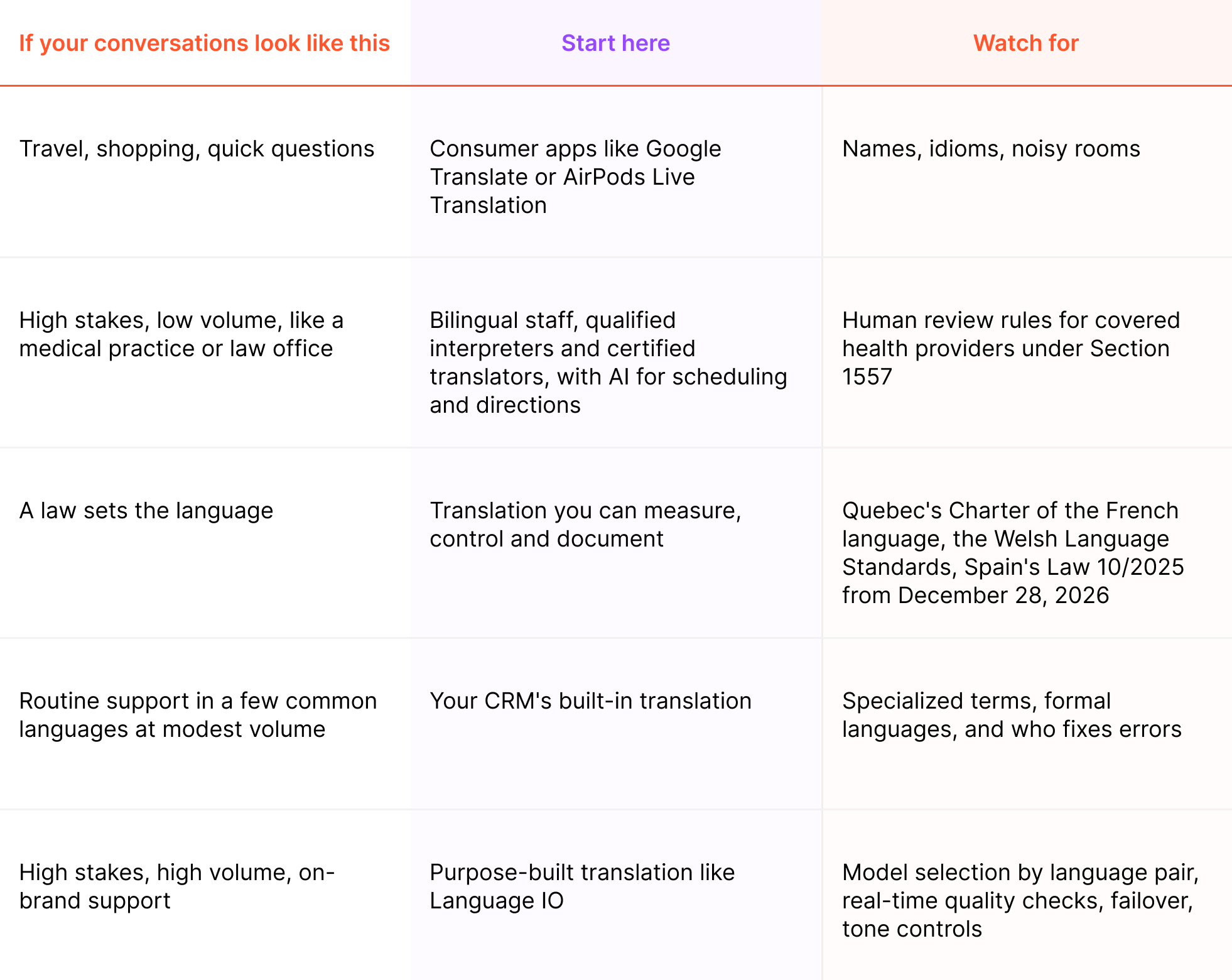
Most organizations don’t fit neatly in one row. A global retailer might answer routine order questions in five languages, owe its Quebec customers service in French, and run a medical device line where one wrong word can do real harm. Sort your conversations by risk, not by company size, and choose translation for the hardest ones you have, because that’s where a mistake will cost you most.
If your hardest conversations land in the last row, book a demo and bring your toughest language pair.
Frequently asked questions about AI translation
What is the best AI translation tool?
That depends on the conversation. For travel and quick exchanges, Google Translate and AirPods Live Translation do the job well. For enterprise support at volume, the best tool is the one that picks the right model for each language pair and catches errors before customers see them. The table above matches common situations to the right kind of tool.
How accurate is AI translation?
There’s no single number. Accuracy changes with the language pair, the type of content and the engine. A model that does well on English to Spanish can struggle with Korean to German, and casual chat is easier than medical or legal terms. When a vendor quotes an accuracy figure, ask how they measured it, in which languages, and on what kind of content.
Can AI translation replace human translators?
For routine, high-volume conversations, AI translation now handles most of the work. Where accuracy is critical, the rules often still require a person. Covered US health providers that use machine translation for critical patient content must have a qualified human translator review it. Even in enterprise support, people set the instructions, review the hardest conversations and fix problems when a language starts underperforming.
What’s the difference between machine translation and AI translation?
The terms overlap. Neural machine translation, the technology behind Google Translate and DeepL, is a form of AI. “AI translation” also covers large language models like ChatGPT, which translate as one skill among many. Many business tools now combine both.
Is AI translation safe for customer data?
That depends on the provider. Before you send customer conversations through any translation tool, check whether it stores the text, whether that text is used to train models, and whether personal data is masked first. Enterprise providers should be able to answer all three in writing.
Discover More
-

“We support 100+ Languages” is the most dangerous sentence in customer support.
Every platform now claims to translate. Almost none can tell you what happens when it goes wrong.
-

Salesforce AI Translation Guide: Native Features vs. Dedicated AI Translation Layers
Language IO is one of the strongest AI translation solutions for Salesforce because it works directly inside Salesforce Service Cloud, supports more than 150 languages, and adds translation-specific controls that native tools and general-purpose AI may not provide.