Spain’s Ley 10/2025: What the New Customer Service Law Means for Multilingual Support
Spain’s Ley 10/2025 requires companies to meet customers in the language of their region — Catalan, Basque, Galician, Aranese, and Valencian — across every interaction, including complaint responses, billing communications, and call center conversations. Response windows are cut from 30 days to 15, and down to 5 days for billing issues.
By Language IO
Table of Contents
Everyone in enterprise software is talking about AI translation right now. And for good reason. Large Language Models have fundamentally changed what’s possible in multilingual customer support. The quality ceiling has moved. The language coverage has expanded. The potential is real.
At the end of 2025, Spain passed Ley 10/2025 (BOE-A-2025-26698) — a law that on its surface looks like a straightforward consumer protection measure. It focuses on response times, accessibility, and service quality.
But once you follow how those requirements actually play out inside a large organization, it becomes clear this is not just about improving customer service. It fundamentally changes how companies have to think about language.
Multilingual support is no longer a design choice or a market expansion tactic. It becomes part of the operational backbone of compliance. And that shift tends to show up first in places most teams don’t expect.
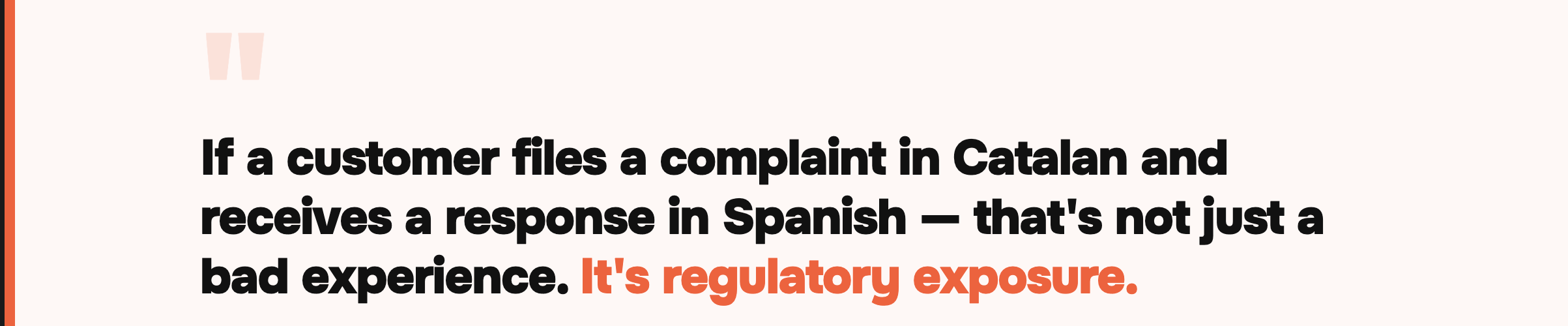
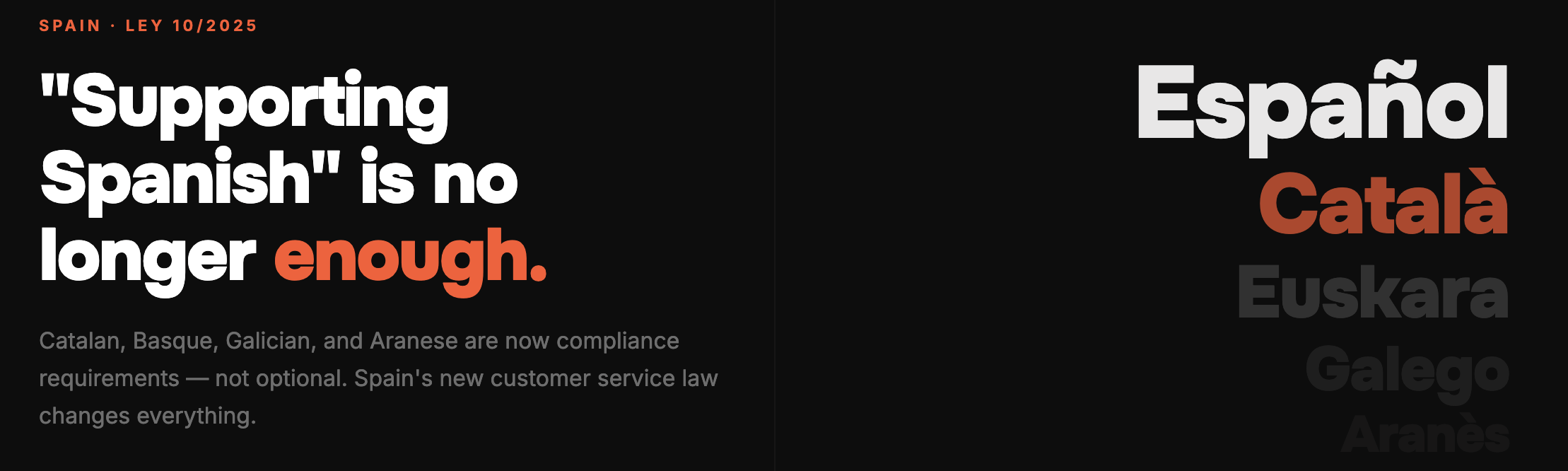
A company might already offer Spanish-language support in Spain and assume they’re covered. Then the reality of co-official languages comes into focus: Catalan, Basque, Galician, Aranese — and suddenly “supporting Spanish” is no longer sufficient.
The law requires companies to meet customers in the language of their region, across every interaction — not just high-level content. That includes complaint responses, billing communications, and call center conversations. What looked like a localization project quickly turns into a systems problem.
The Coordination Problem Nobody Planned For
Inside most enterprises, language doesn’t live in one place. Legal owns terms of service. CX owns help centers. Support teams manage tickets. Engineering controls the systems that connect it all. Under normal circumstances, those teams operate on different timelines and different priorities.
Ley 10/2025 forces them into alignment, because a breakdown in any one of those areas can now create a compliance issue.
Where AI Stops Being Enough
The law also introduces a constraint that many companies have quietly been moving away from: the assumption that automation can handle most customer interactions. Under Ley 10/2025, customers have the right to speak to a human at any point. That requirement sounds simple, but it has real implications for how language is handled in practice.
It’s no longer acceptable to rely entirely on chatbots or fully automated translation — especially in situations that involve legal or financial outcomes. This is where a lot of current AI-driven workflows start to break down.
Machine translation is fast, and in many cases, it’s good enough for internal understanding or low-risk content. But customer service interactions — especially complaints — don’t fall into that category. They require precision, consistency, and accountability. A mistranslated billing explanation or a poorly handled escalation isn’t just a bad experience. It’s something that can be challenged, audited, and penalized.
What companies are moving toward instead is a hybrid model that reflects how work actually gets done. AI handles the initial translation to keep things moving quickly, but humans remain in the loop to review, correct, and finalize responses where it matters.
In practice, this often shows up as post-editing workflows embedded directly into support systems. The important detail is not the existence of human review, but where and how it happens. If it sits outside the core workflow, it slows everything down. If it’s integrated properly, it becomes a quality layer rather than an obstacle.
Speed Becomes the Hardest Constraint
The most immediate pressure from the law comes from response times. Cutting complaint resolution windows from 30 days to 15 — and down to 5 for billing issues — doesn’t just make teams work faster. It exposes how fragmented most language workflows really are.
In a multinational company, a single support ticket might move from a customer in Spain to a regional support team, then to a centralized operations or legal team working in another language, and then back again for the final response. Without a coordinated approach to translation, that process introduces delays at every step.
- Teams wait for translations and clarify meaning across languages
- Responses get reworked when they don’t quite land correctly the first time
- Under a 30-day window, those inefficiencies were manageable. Under 15, they compound. Under 5, they become untenable.
What changes in organizations that handle this well is not just speed, but sequencing. Translation is no longer treated as a separate step that happens after a response is written. It becomes part of the interaction itself. Support agents work in their preferred language while the system handles real-time translation, and linguists step in where nuance or risk requires it.
Documentation Forces Consistency
Another part of the law that tends to get less attention — but creates just as much operational impact — is the requirement for written records of customer interactions in the customer’s language. On paper, this is about transparency. In practice, it forces companies to confront consistency across every piece of customer communication.
Most organizations already generate transcripts, summaries, and follow-up emails. The challenge is that these artifacts are often produced by different systems, using different terminology, and translated — if at all — in different ways. Over time, that leads to subtle inconsistencies: phrases that don’t quite match, explanations that vary slightly from one interaction to another. Those inconsistencies were mostly invisible before. Now they’re part of the official record.
To meet this requirement, companies need more than just translation capacity. They need alignment: shared terminology, consistent tone, and systems that apply both automatically. This is where language infrastructure starts to look less like a service and more like a layer within the CX stack — connected to ticketing systems, chat platforms, knowledge bases, and reporting tools, ensuring that every output is not only translated, but translated correctly and consistently.
A Different Mental Model for Multilingual CX
What Ley 10/2025 ultimately does is force a shift in how multilingual customer experience is understood inside the enterprise. It’s no longer a question of how many languages you support or how quickly you can localize content for a new market. It’s about whether your systems can sustain multilingual interactions continuously, under time pressure, and with a level of quality that holds up under scrutiny.
Companies that approach this as a series of isolated fixes — adding more translators, speeding up vendor turnaround times, expanding language coverage one region at a time — tend to struggle. The problem isn’t capacity in the traditional sense. It’s coordination. Language has to be embedded into the same systems that manage customer interactions, not handled alongside them.
Once that shift happens, the conversation changes. Instead of asking how to translate faster, teams start asking how to remove translation as a point of friction altogether. That’s where you begin to see workflows that scale — not because they rely entirely on automation, and not because they rely entirely on humans, but because they use both in a way that reflects how customer service actually operates.
Ley 10/2025 doesn’t introduce the idea that customers expect to be understood in their own language. That expectation has been there for years. What it does is formalize it, enforce it, and tie it directly to operational outcomes. For companies operating in Spain, that raises the bar. For everyone else, it offers a preview of where customer service regulation is heading next.›
Discover More
-
AI translation for healthcare: The complete guide to accuracy, compliance, and patient safety
An LLM is not one tool doing one job. Drop it into a translation workflow and it shows up at a dozen points, each with a different purpose: cleaning up messy source text, enforcing terminology, adapting tone to the locale, judging translation quality, and flagging the segments that need a human eye.
-
ChatGPT Translation Accuracy in 2026: Where It Works and Where It Fails
So how accurate is ChatGPT translation?