
Get started with Language IO
Book a Demo

Real-Time Translation for Salesforce

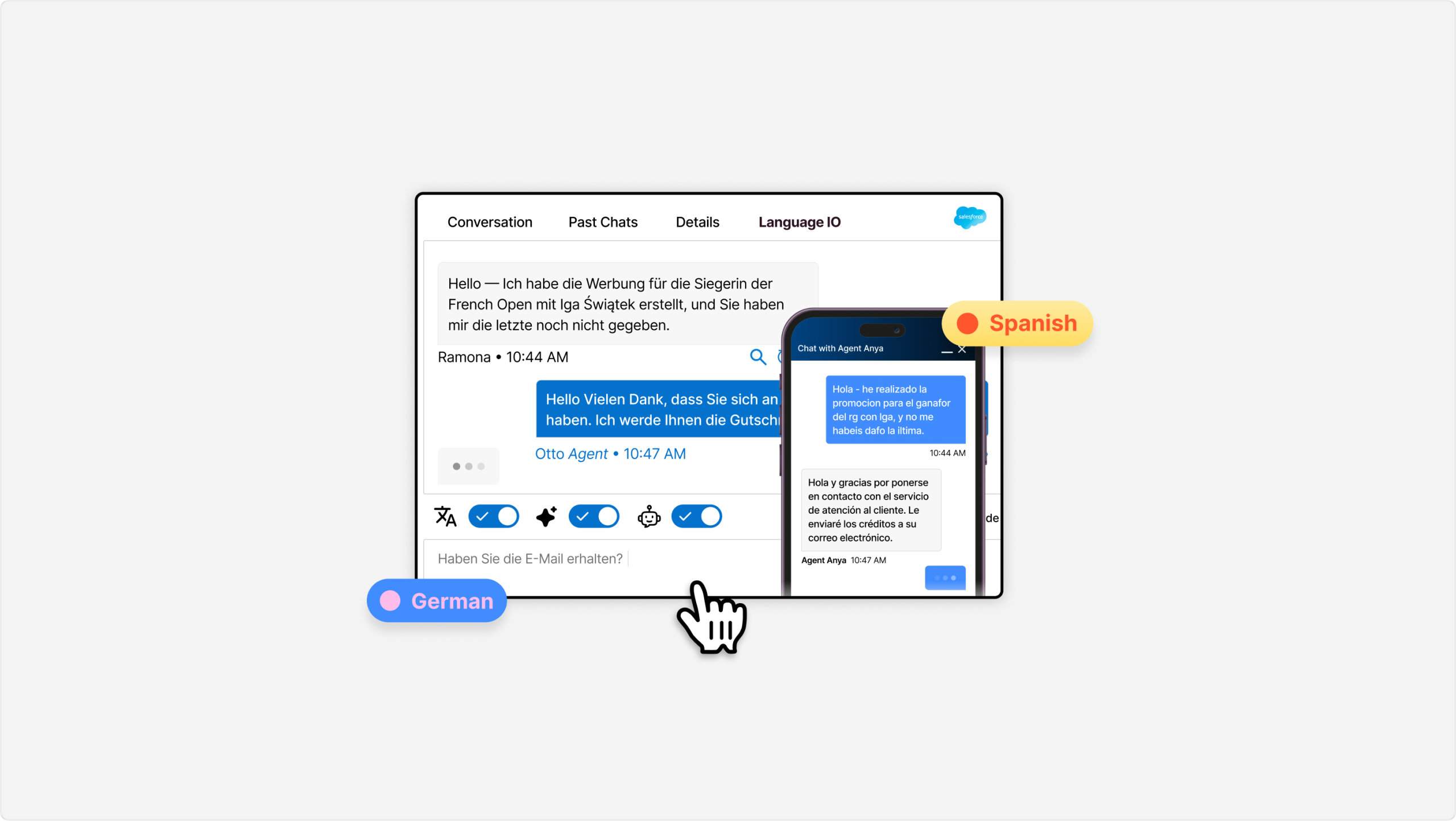
You chose Salesforce because best-of-breed matters. Language IO is the translation layer built to the same standard. Your agents work where they already work, your customers get answers in their language, and nothing about your workflow changes.

Schedule your free demo today →

Overview


The Best Translation Solution

More Than a Generic Translation Engine

Precision Translation for Critical Conversation

Language Regulation

Smart Model Selection

Boost Efficiency

Certified Secure

Seamless Integration

Engage Customers Where You Already Work

What to Look for in an Enterprise Translation Partner

FAQ

Book a demo →

Leading global enterprises use Language IO for Salesforce

You Chose a Powerful CRM. Now Choose the Best Translation.

Salesforce set the standard for enterprise CRM because it was built with one thing in mind: managing customer relationships at scale with the sophistication that large enterprises require. It does that exceptionally well. Translation is a different discipline entirely. It requires deep linguistic expertise, a multi-model approach, real-time quality monitoring, and a team of language specialists who can intervene when something goes wrong. That is not what CRM platforms are designed to do, and it is not where they invest.

The companies that get this right treat translation the same way they treat every other critical infrastructure decision. They find the best solution for the job and integrate it into the platforms they already use. Language IO is the best solution for Salesforce translation.

Get a demo →

Your Customer Conversations Deserve More Than a Generic Translation Engine.

Not all translations are equal, and not all conversations carry the same weight. A casual inquiry handled imprecisely costs you little. A high-stakes support conversation handled imprecisely costs you a customer, a renewal, or worse. Some languages compound this challenge significantly. Japanese and Korean have grammatical structures that diverge sharply from English. Formality is built into the grammar itself, not layered on top. Idiomatic phrases do not map. Getting these languages right requires more than a capable model. It requires linguistic expertise and the ability to monitor quality in real time.

Language IO brings all three: the right model, linguistic expertise, and a commitment to quality. Our platform includes a team of language specialists who are available when something goes wrong in a language your team does not speak. That is not a capability CRM vendors can offer, and it is the difference between a translation problem caught early and one that compounds across hundreds of conversations before anyone notices.

Build, Buy, or Best-of-Breed: The Ultimate Guide to AI Tooling: 
A Decision Framework for Salesforce & AI Teams

Learn how to evaluate AI solutions for your Salesforce ecosystem with a practical framework that covers native tools, custom builds, and best-of-breed platforms- plus real-world insights from Checkr’s implementation journey.

On-Demand Webinar →

When the Conversation Has Consequences, Precision Is Not Optional.

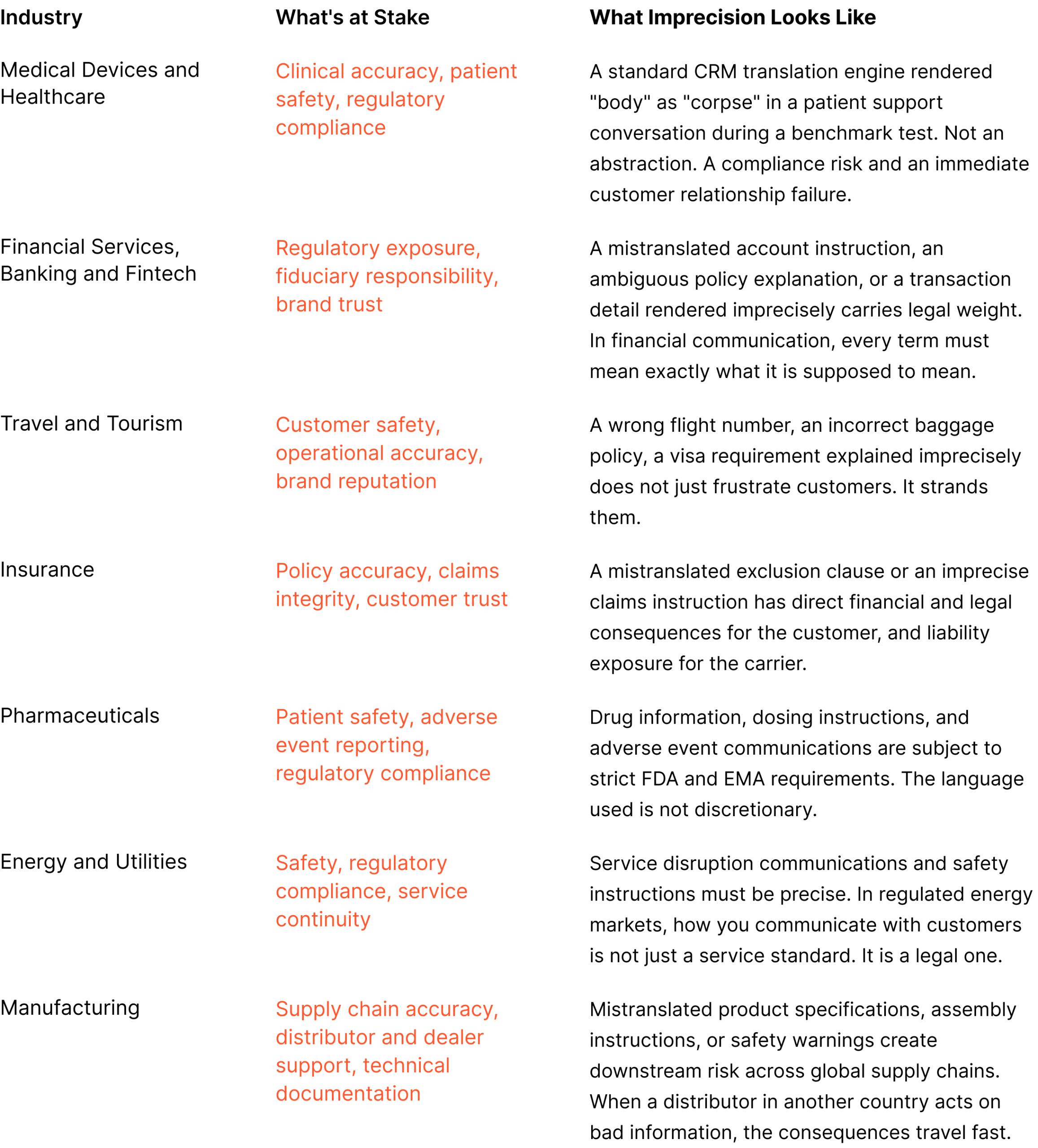
For many enterprises, customer support conversations are not just service interactions. They are regulated communications. The words used carry clinical, financial, or legal weight, and errors do not stay contained to a single exchange. Language IO is purpose-built for industries where this standard is non-negotiable.
Language Regulation Is Changing. Your CRM Vendor Is Not Tracking It.

An expanding number of markets now have enforceable language requirements that directly affect how businesses support their customers. Quebec’s Bill 96 requires companies serving customers in the province to do so in French, with fines that start at $30,000 for a first offense and scale from there. The law applies regardless of where your company is headquartered. If you have customers in Quebec, you are subject to it. Bill 96 is the most prominent example, but it is not the only one. Language access requirements are tightening across the European Union, and markets like New Zealand carry strong expectations around indigenous language support that are increasingly reflected in how businesses operate there.

What these regulations share is that compliance is not just about having a translation available. It is about the quality, consistency, and auditability of that translation. A CRM vendor is not going to flag a regulatory change in Quebec, a dedicated language translation tool partner will.
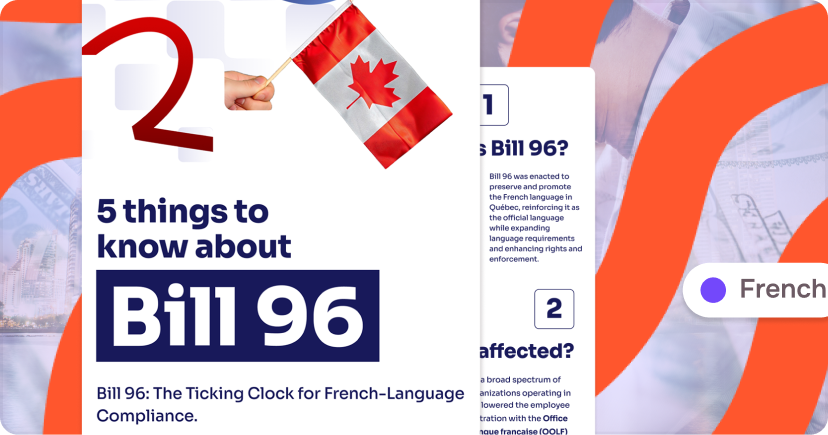
Understanding Bill 96: A guide for businesses operating in Quebec, Canada

To ensure your business is ready for the implementation of Bill 96, consider the following steps…

5 min read


Smart Model Selection

The Best Model for Every Language. Every Time. Our research shows that multi-model systems produce translations two to six times more fluent than single-model approaches.

That difference shows up in customer conversations, in resolution rates, and in the confidence your agents have in what they are communicating. Language IO’s Smart Model Selection evaluates every translation request and routes it to the best available model for that specific language pair. Not the same model for every language. That matters because translation quality varies significantly across language pairs, and a system optimized for Spanish-English may perform far worse for Japanese-English or Arabic-English.

Smart Model Selection also means you are never exposed to a single point of failure. When a model underperforms or goes down, our platform fails over automatically to a secondary model. Quality monitoring runs in real time, evaluating every translation before it reaches your agent. If the output does not meet the semantic standard, the system retries. Your agents never see a gap. Your customers never notice.

Get a demo →

Boost Efficiency

Every Agent. Every Language. One Familiar Interface. Agents you already have can go further than they ever could before.

For most global support operations, language has always been a staffing problem. You hire for it, schedule around it, and route tickets based on who speaks what. The result is a support team that is never quite the right size and customers who wait longer because the right agent is not available. Language IO changes that equation. When translation runs natively inside Salesforce, language stops being a constraint on your team and starts being a capability of your entire team. Every agent can support every customer, regardless of where that customer is writing from. Coverage gaps close. Ticket routing simplifies. The agents you already have go further than they could before.

The experience for agents is exactly what it should be: invisible. Translation happens inside the workflow they already use. Nothing changes about how they work. What changes is what they can do.

Get a demo →

Certified Secure

The Strongest Security in the Business. No Exceptions. We are certified for ISO 42001 and 27001, SOC 2 Type II, HIPAA, CCPA, GDPR, PCI, and OWASP. For the full picture, visit our security page.

Language IO has zero data retention. Your customer conversation data is never stored, never logged, and never used to train external models. That is not a policy setting. It is the architecture of the platform, and it does not change based on volume, pricing tier, or contract structure.

Get a demo →

Seamless Integration

Up and Running in Less Than a Day. Our native integration with Salesforce Service Cloud installs in under 24 hours, with no custom development required or disruption to your existing configuration.

For most global support operations, language has always been a staffing problem. You hire for it, schedule around it, and route tickets based on who speaks what. The result is a support team that is never quite the right size and customers who wait longer because the right agent is not available. Language IO changes that equation. When translation runs natively inside Salesforce, language stops being a constraint on your team and starts being a capability of your entire team. Every agent can support every customer, regardless of where that customer is writing from. Coverage gaps close. Ticket routing simplifies. The agents you already have go further than they could before.

The experience for agents is exactly what it should be: invisible. Translation happens inside the workflow they already use. Nothing changes about how they work. What changes is what they can do.

Get a demo →

Engage Customers Where You Already Work

Language IO’s turnkey solutions for popular CRMs allow you to start Salesforce translation in as little as 24 hours. For any other translation needs, our powerful API provides seamless, real-time Salesforce language translation on your preferred platform. Whether you need Salesforce multilingual support or Salesforce multi-language capabilities, we ensure fast, accurate, and secure translations to enhance your global customer experience.

YouTube player

Live Chat

Instantly translate Salesforce chat messages – both incoming and outgoing – enabling seamless communication with customers in any Salesforce language.
Salesforce Live Chat Translation →

YouTube player

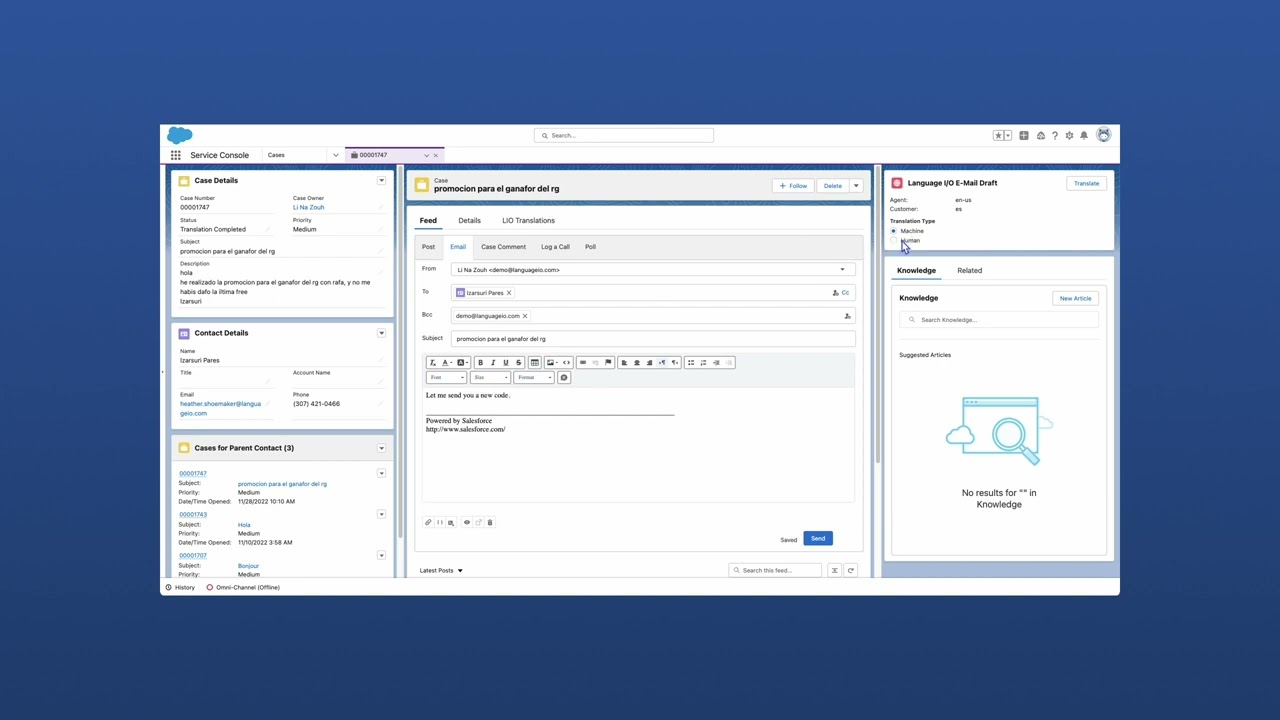
Case

With Salesforce multilingual support, resolve issues in any Salesforce language and clear out ticket queues effortlessly. Your team can handle tickets in multiple languages efficiently, ensuring fast, accurate responses and a streamlined workflow across all Salesforce translations.

Salesforce Case Translation →

YouTube player

Article

Empowering your global customers with the tools they need to find answers independently, all through Salesforce multilingual support.

Salesforce Knowledge Article Translation →

Schedule a free demo today →

What to Look for in an Enterprise Translation Partner

Not every translation solution is built for the demands of enterprise customer support. The right partner brings deep linguistic expertise, not just technology. They monitor quality in real time and take responsibility when something goes wrong. They understand the regulatory environments your business operates in and help you stay ahead of them. They treat your customer data with the same rigor you would expect from any enterprise infrastructure provider. And they hold themselves to a standard, not just a best-effort one.

Learn more →

150+

languages supported

4.5

stars in G2 Reviews

4.9

stars in Salesforce AppExchange

See the Success Stories
Talk to a Specialist to Learn More
Questions? We’ve got answers.

FAQs

What is enterprise chat translation?

Enterprise chat translation is the real-time conversion of live chat conversations between customers and support agents who speak different languages. Unlike generic machine translation, enterprise chat translation is purpose-built for the speed, tone, and domain-specific terminology demands of customer service at scale. It operates within existing support platforms, translating inbound customer messages for agents and outbound agent responses for customers, without interrupting the pace of the conversation.

How does real-time chat translation work?

When a customer sends a message in their language, the translation engine processes it instantly and delivers it to the agent in their working language. The agent responds in their own language, and the customer receives that response translated back into theirs. The entire exchange happens within the chat interface the agent already uses, with no separate system, no copy-paste, and no visible delay. The quality of that translation depends on whether the engine is built for chat specifically or adapted from document translation workflows.

Which languages does enterprise chat translation support?

Language IO supports translation across 150-plus languages, covering the major global markets enterprises operate in as well as less common language pairs that other solutions frequently don’t handle at the same accuracy standard. Coverage decisions should be driven by actual contact volume data rather than assumptions about which languages matter — the right languages for one organization’s customer base are not necessarily the right ones for another’s.

How is AI-powered translation different from standard machine translation?

Standard machine translation processes text statically, without awareness of conversational context, brand terminology, or emotional register. AI-powered enterprise chat translation learns from domain-specific training data, applies brand glossaries, preserves tone across languages, and improves over time with usage. The practical difference is visible in the output: standard MT produces word-for-word conversions that are often technically correct but contextually wrong. Purpose-built AI translation produces responses that read as if they were written for the customer in their language, not routed through a system.

What is the difference between neural machine translation and LLMs for chat translation?

Neural machine translation, or NMT, processes text by predicting the most statistically likely translation based on training data. It is fast and consistent, but it has no understanding of context, intent, or register — it translates the words in front of it without awareness of what came before in the conversation or what the customer actually meant. For short, fragmented chat input, that limitation matters.

Large language models approach translation differently. Because they are trained on vastly larger and more varied datasets, they handle ambiguity, idiomatic language, and contextual nuance better than NMT alone. They can infer what a customer likely meant from a half-sentence and produce a response that reflects the intent rather than just the words. The tradeoff has historically been speed and consistency — LLMs can be slower and less predictable than NMT in high-volume production environments.

The most effective enterprise chat translation today doesn’t choose one over the other. It uses smart model selection to route each translation request to the engine best suited for that language pair and context, combining the speed and consistency of NMT with the contextual intelligence of LLMs where it matters most. That architecture is what separates purpose-built enterprise solutions from both generic MT tools and general-purpose LLM wrappers.

Can enterprise chat translation work with Salesforce?

Yes. Language IO is Salesforce-native, which means translation operates directly within Salesforce Service Cloud without middleware, third-party connectors, or data leaving the Salesforce ecosystem. Agents work in their normal environment. Customer records, case history, and account data remain in one place. For organizations with data governance requirements or compliance obligations tied to their Salesforce instance, the native architecture means those requirements are met by default rather than engineered around.

Is chat translation accurate enough for regulated industries?

It depends on the solution. Generic machine translation is not built to meet the accuracy standards that financial services, healthcare, and insurance require. Language IO’s enterprise chat translation services are specifically designed for regulated environments, where a mistranslated interaction is a compliance risk, not just a service failure. Accuracy standards, brand glossaries, and quality controls are built into the system rather than applied after the fact, and the translation record produced is one that compliance teams can stand behind.

What should I look for in an enterprise chat translation service?

The most important questions are not about language coverage lists. They are about how the translation handles the things generic MT gets wrong: short, fragmented chat input; domain-specific terminology; tone preservation across emotional registers; and agent experience under real volume. Beyond quality, evaluate whether the service is native to your existing platform or requires middleware, how data governance is handled, and what accuracy standards apply in regulated contexts. A translation service that works well in a demo with clean, complete sentences needs to be tested against the actual input your customers send.

The Empathy Equation: Two Humans in Every Conversation

EBOOK | Section 2

The 8 friction points destroying service (and the AI solutions that fix them) →

BLOG

Multilingual CX Is Where AI Proves Its Value or Quietly Fails

BLOG

CX managers don’t need more AI.
They need fewer headaches.

BLOG

Modernizing CX Without Breaking Trust: Why the Right Metrics Still Create the Wrong Customer Experience

The Support Platform Truly Built for Two.

The ultimate customer experience isn’t defined by the smartest AI, but by the moment both humans leave feeling understood.

Get started with Language IO
Request a demo

Realtime enterprise chat translation for Salesforce. Try it today.

Get a demo

© 2024 Language IO, Inc. | Privacy Policy | Terms | Personal Data

  • LinkedIn
  • Facebook
  • YouTube
Get a personalized demo from one of our experts.

Fill out this form to proceed to the scheduling screen where you can find time with a Language IO specialist.

Get a personalized demo from one of our experts.

Fill out this form to proceed to the scheduling screen where you can find time with a Language IO specialist.

We'd love to chat.

Questions? Ready to get started? Reach out to a Language IO specialist today.


Get a personalized demo from one of our experts.

Fill out this form to proceed to the scheduling screen where you can find time with a Language IO specialist.

Get the Guide:

The Alignment Gap: Why Your Best Metrics Are Driving Your Worst Customer Experiences

We'd love to chat.

Questions? Ready to get started? Reach out to a Language IO specialist today.


We'd love to chat.

Questions? Ready to get started? Reach out to a Language IO specialist today.


Get a personalized demo from one of our experts.

Fill out this form to proceed to the scheduling screen where you can find time with a Language IO specialist.

Get a personalized demo from one of our experts.

Fill out this form to proceed to the scheduling screen where you can find time with a Language IO specialist.

Get a personalized demo from one of our experts.

Fill out this form to proceed to the scheduling screen where you can find time with a Language IO specialist.

Get a personalized demo from one of our experts.

Fill out this form to proceed to the scheduling screen where you can find time with a Language IO specialist.

Get a personalized demo from one of our experts.

Fill out this form to proceed to the scheduling screen where you can find time with a Language IO specialist.

Get a personalized demo from one of our experts.

Fill out this form to proceed to the scheduling screen where you can find time with a Language IO specialist.

Get a personalized demo from one of our experts.

Fill out this form to proceed to the scheduling screen where you can find time with a Language IO specialist.

Get a personalized demo from one of our experts.

Fill out this form to proceed to the scheduling screen where you can find time with a Language IO specialist.

Get a personalized demo from one of our experts.

Fill out this form to proceed to the scheduling screen where you can find time with a Language IO specialist.

Get a personalized demo from one of our experts.

Fill out this form to proceed to the scheduling screen where you can find time with a Language IO specialist.

Get the best content monthly
Get the checklist
Get a personalized demo from one of our experts.

Fill out this form to proceed to the scheduling screen where you can find time with a Language IO specialist.