

Customer Connections Matter.
Enterprise translation that scales securely across your business.
Deepen customer relationships while you consolidate global support, expand to new markets, and improve CX with enterprise translation software built for speed, accuracy, and compliance.


The smarter way to scale multilingual customer support.
Unify your global operations
Consolidate multilingual support into one system, eliminating the need for regional contact centers or duplicate processes.

Accelerate response times
Translate inbound and outbound messages instantly so agents can resolve tickets and find answers faster.

Protect your data
SOC 2, ISO 42001, and GDPR-aligned systems ensure complete privacy with Zero Data Retention.
Cut operational costs
Automate multilingual communication across chat, email, voice and other channels without adding headcount.

Improve customer experience
Deliver more than fluent responses—deliver understanding.
Language IO’s context-aware engine recognizes tone, formality, and intent so every customer is served in their preferred language with the accuracy and nuance of a native speaker.
Every channel. Every language.
One consistent experience.
Every channel. Every language. One consistent experience. Customer conversations happen everywhere—chat, email, ticketing, voice, and live messaging. Language IO keeps them all connected. Our enterprise translation software integrates seamlessly with your communication stack, ensuring accurate, secure translation across every touchpoint.





Browser-based content
Translate secure portals, dashboards, and web apps with Secure Page Translator, without exposing sensitive data
Whether it’s a live chat, a voice call, or a support ticket, Language IO delivers the same context-aware accuracy and privacy across channels in real time across all support channels.
Why Enterprise Translation is different.
Because accuracy, privacy, and scale aren’t optional. Enterprise translation goes far beyond converting words. It protects data, preserves brand voice, and powers multilingual support at scale. Consumer tools can’t meet enterprise demands for compliance, context, and integration. Language IO is built for organizations that need secure, context-aware communication across every global channel.
Real translation is more than language. It’s trust, compliance, and connection at scale.












Customer relationships deserve more than consumer-grade translation.
Consumer tools can get the words right, but not the meaning. Enterprise translation protects data, preserves tone, and maintains brand consistency across every language. It’s the difference between being understood and truly connecting.
Real translation is more than language. It’s trust, compliance, and connection at scale.
Accuracy

Generic translations that often miss tone and nuance

Generic translations that often miss tone and nuance
Security
Data processed or stored by third-party providers
Zero Trace architecture with SOC 2, ISO 42001, and GDPR-aligned privacy
Compliance
No audit trails or governance
Full auditability, data residency options, and enterprise-grade AI governance
Language Coverage
Limited to common global languages
Broad support including Indigenous and low-resource languages for inclusive communication
Customization
No control over tone or terminology
Glossaries and formality controls preserve brand voice across every channel
Support Expertise
Basic technical assistance only
Dedicated success team with enterprise engineers and linguistic experts who understand your workflows
Regulatory Compliance
No support for multilingual or accessibility laws
Helps brands comply with regional language mandates such as Bill 96 (Canada), the California Health Care Language Access Law, EU accessibility requirements, and others
Global language compliance is no longer optional.
New legislation is reshaping how enterprises communicate. From Bill 96 in Canada to healthcare language-access laws in California and accessibility directives across the EU, governments are requiring organizations to serve customers in their preferred language. The shift is clear: language access is now a legal and brand imperative.
Compliance today. Connection tomorrow. Language IO helps enterprises stay ahead of these mandates with secure, context-aware translation that meets regional standards without adding manual overhead. Whether you operate across provinces, states, or continents, our platform ensures you remain compliant while protecting data and preserving brand consistency.
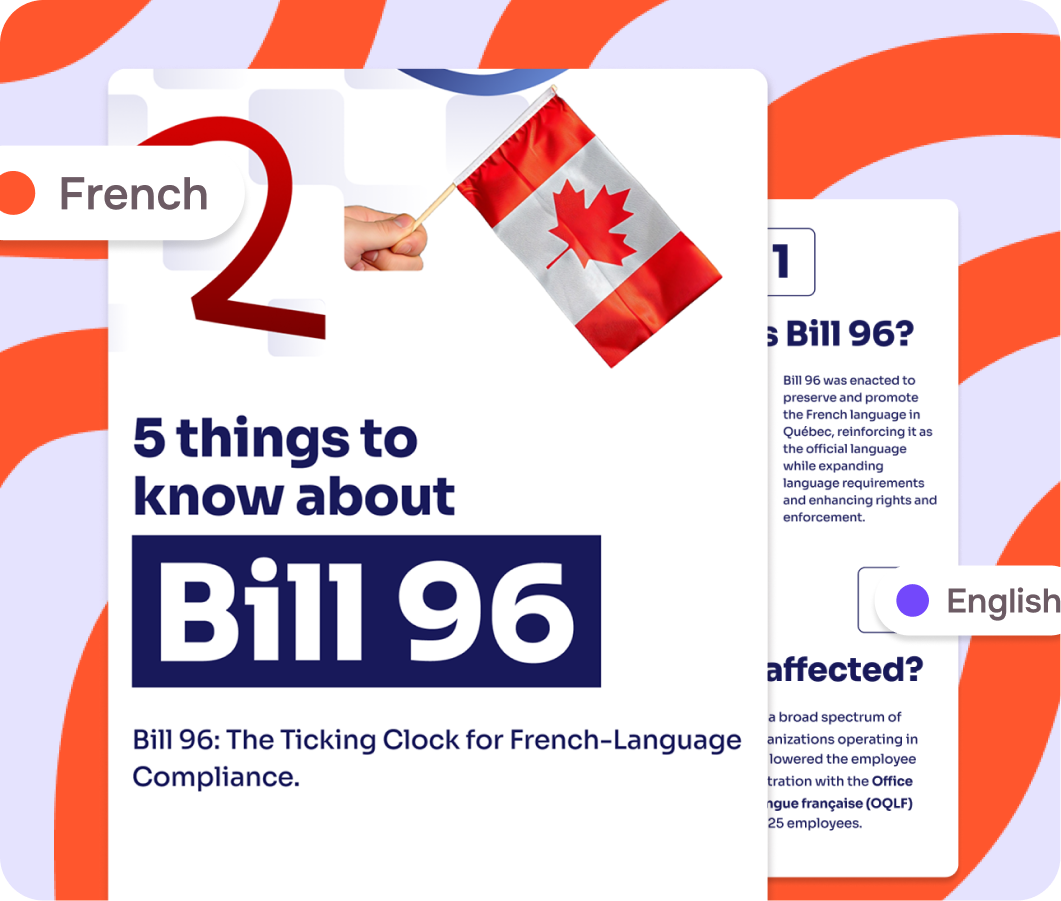
Understanding Bill 96: A guide for businesses operating in Quebec, Canada
Navigate the complexities of Bill 96. Learn about its impact on your business, compliance requirements, and best practices for ensuring your operations align with Québec’s language laws.
4 min read

Questions? We’ve got answers.
FAQs
What is the biggest obstacle to delivering great customer service globally?
Language. Not technology, not staffing ratios, not channel strategy. When a customer can’t communicate clearly with an agent, everything downstream suffers: handle time increases, first-contact resolution drops, and the customer leaves the interaction feeling processed rather than helped. Most global CX investments try to solve around that problem. The ones that work solve it directly.
Does AI replace human customer service agents?
No, and the data on this is consistent. AI handles the parts of customer service that don’t require judgment: translating a message, retrieving a knowledge article, detecting hostile language before an agent sees it. What it can’t replicate is the human element that makes a frustrated customer feel heard, or the contextual judgment that turns a complaint into a retained customer. The contact centers that perform best use AI to remove friction so agents can focus on exactly that.
How does language affect customer satisfaction scores?
Significantly and measurably. Customers who receive support in their native language report higher satisfaction, show lower escalation rates, and are more likely to describe the interaction as personal and respectful rather than transactional. The inverse is also true: customers who sense they’re receiving a rough or mechanical translation lose confidence in the brand, regardless of whether the underlying answer was correct.
What does “human plus AI” actually mean in a customer service context?
It means the division of labor is intentional. AI handles language, speed and the tasks that slow agents down. Humans handle judgment, empathy and the moments that determine whether a customer stays or goes. When that division works correctly, agents report higher job satisfaction, customers report better experiences, and the operational metrics — handle time, escalation rates, cost per ticket — all move in the right direction.
Why do customers prefer support in their native language?
Because comprehension is not the same as connection. A customer can understand a response in a second language and still feel that the interaction was cold, distant or imprecise. Native-language support closes that gap. It signals that the brand invested in reaching the customer on their terms rather than asking the customer to meet the brand on its own.
How do companies maintain a consistent brand voice across multiple languages?
This is harder than most global brands anticipate. Direct translation doesn’t carry tone. A phrase that sounds warm and confident in English can read as formal or ambiguous in Japanese or Portuguese. Maintaining brand voice across languages requires translation infrastructure built around brand-specific glossaries and style guidance, not generic engines. The brands that get this right treat translation as a brand asset, not a utility.
What is the business case for investing in multilingual customer experience?
Agent efficiency, customer retention, and market expansion, measured against the cost of the status quo. Contact centers that rely on language-specific staffing carry structural inefficiencies: scheduling constraints, coverage gaps, and headcount that doesn’t flex with demand. When any agent can serve any customer in any language, utilization improves and the cost per interaction drops. On the customer side, CSAT gains from native-language support translate directly to retention. And in new markets, the ability to support customers from day one without a native-speaking hire changes the economics of expansion.
How does toxic language in customer service affect agent performance?
More than most organizations measure. Agents who absorb hostile or abusive messages before they can respond carry that stress into subsequent interactions. Research shows it’s a primary driver of both burnout and turnover. When that language is filtered before the agent sees it, the effect is measurable: agents handle more interactions with greater accuracy and report significantly higher job satisfaction. This isn’t a wellness initiative. It’s an operational lever.
How does Language IO combine human expertise with AI translation technology?
Language IO’s platform delivers real-time AI translation, automatic language detection and localized knowledge retrieval inside the CRM agents already use. That’s the technology layer. The human layer is linguists, implementation specialists and customer success managers who configure, monitor and continuously refine performance based on actual usage data. Neither layer works as well without the other. The AI processes at a speed and scale no human team can match. The humans catch what the AI doesn’t and keep the system aligned with how the brand actually communicates.