Modernizing CX Without Breaking Trust:
Why the Right Metrics Still Create the Wrong Customer Experience

CX leaders don’t fear AI because they don’t understand it. They fear it because they do.
By Language IO
Table of Contents
CX leaders don’t fear AI because they don’t understand it. They fear it because they do.
You’re responsible for outcomes, not experiments. Every decision you make (introducing automation, changing metrics, modernizing workflows) scales instantly across thousands or millions of customer interactions.
When it works, it’s invisible. When it fails, it doesn’t fail once. It fails repeatedly, quietly, and often in ways that are difficult to trace back to a single cause.
That’s the tension many CX leaders live with today: pressure to modernize without dehumanizing the experience, to reduce costs without eroding trust, and to adopt AI without putting the brand at risk. And yet, despite the best intentions, many organizations find themselves delivering experiences that are technically efficient but emotionally hollow.
Not because agents don’t care. Not because leaders don’t value empathy. But because the systems and metrics guiding behavior are misaligned with what customers actually experience.
The Alignment Gap Leaders Carry
On paper, your KPIs are sensible:
- Resolution accuracy
- Knowledge base utilization
- CSAT
- Cost per contact
They’re clear, defensible, and easy to explain in an executive meeting. But in practice, these metrics often reward procedural correctness over contextual understanding.
Take a familiar scenario. A customer is calling for the third time about the same billing error.
From a reporting standpoint, the agent does everything right: identity verification, account lookup, scripted questions, documented resolution. From the customer’s perspective, none of that matters. What they feel is repetition.
“I already explained this.”
This is the alignment gap. When agents are measured on whether they followed the process rather than whether they demonstrated understanding, the experience may be accurate, but it doesn’t feel attentive.
Scripts replace listening. Context gets lost between interactions. And while your dashboards show consistency, customers experience friction.
Over time, these moments accumulate. Not as dramatic failures, but as subtle signals that the organization is optimized for itself, not for the person seeking help.
When Efficiency Feels Like Indifference
Efficiency is often framed as speed. Faster handle times. Faster closures. Faster deflection into lower-cost channels. But customers don’t experience efficiency as velocity alone. They experience it as effort.
When agents are measured primarily on Average Handle Time, speed becomes the goal rather than the outcome. The incentive is to move the interaction forward, even if the underlying issue isn’t fully resolved.
Tickets get closed because the system expects closure, not because the customer feels resolved. What looks like efficiency in a dashboard can feel like indifference in real life.
Customers feel rushed. They feel dismissed. They’re left wondering whether the issue was actually fixed, what will happen next, and whether they should follow up or just wait. Unsurprisingly, many of them do follow up driving repeat contacts, escalations, and frustration that no metric ever directly predicted.
CSAT might tell you whether an interaction was acceptable. It rarely tells you whether it built confidence, reduced anxiety, or strengthened trust.
Why This Is a Leadership Problem (Not an Agent Problem)
It’s tempting to frame these challenges as training issues or individual performance gaps. But agents aren’t the source of misalignment. They’re responding rationally to the incentives placed in front of them.
When success is defined by what’s easiest to measure (adherence, containment, closure rates) agents optimize accordingly. They follow scripts. They avoid risk. They close tickets quickly.
In many organizations, going off-script to show genuine empathy is treated as a compliance issue rather than a strength. “I’m sorry you’re experiencing this issue” becomes required language. “I can hear how frustrating this has been” gets flagged as unnecessary.
The result is a workforce that cares deeply but is constrained by systems that don’t reward caring. Empathy becomes something to manage instead of something to enable.
This is where brand risk quietly enters the picture. Not through a single bad interaction, but through thousands of small moments where customers feel processed rather than understood.
When It Aligns: Empathy Without Exposure
The assumption that empathy and scale are opposites is outdated. The real issue isn’t empathy, it’s unstructured empathy without context.
When systems surface relevant customer history automatically, previous interactions, known issues, emotional signals agents don’t need to ask redundant questions or rely on rigid scripts. Understanding is demonstrated immediately, often in the first sentence.
“I see you’ve already contacted us about this billing issue, and I understand why you’re frustrated. Here’s what we’ve found so far.”
Accuracy improves because agents are working from complete information, not partial prompts. Speed improves because unnecessary steps disappear. And empathy becomes safer, not riskier, because it’s grounded in facts and aligned with brand guidelines.
In this model, speed isn’t forced. It’s a byproduct of clarity. Empathy isn’t performative. It’s contextual.
And AI isn’t replacing human judgment, it’s removing the friction that prevents humans from doing their best work.
The Long Term Payoff Leaders Actually Care About
When support interactions prioritize solving the customer’s problem over hitting short-term targets, something counterintuitive happens: customers become more valuable, not less.
They renew at higher rates. They upgrade when it makes sense for them. They refer others.
Not because they were sold to in a moment of frustration, but because they trust the organization to act in their best interest. Trust is built when customers feel remembered, informed, and respected.
When systems proactively communicate, “Here’s what we know, here’s what we’re doing, and here’s what happens next”, the anxiety that drives escalations disappears. Transparency reduces effort. Clarity reduces conflict.
These are not soft outcomes. They are measurable drivers of retention and lifetime value. They just require metrics and systems that recognize emotional outcomes as real business outcomes.
What CX Leaders Are Really Buying
CX leaders aren’t buying more dashboards or faster bots. They’re buying confidence.
Confidence that AI won’t damage the brand. Confidence that modernization won’t erode trust. Confidence that empathy can scale without becoming inconsistent or unsafe.
The alignment gap closes when your metrics reflect what actually builds loyalty and when your technology makes the right behavior the easiest behavior. Because the goal isn’t faster customer experience.
It’s customer experience that feels both efficient and human.
Closing the Gap
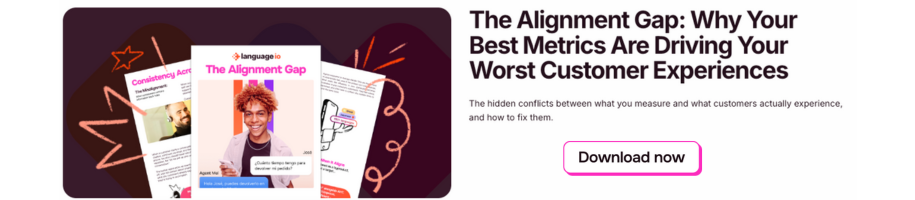
This is just one dimension of the Alignment Gap. The full Alignment Gap Playbook explores seven critical areas where traditional CX metrics conflict with the experiences that build trust and how leading organizations are closing those gaps without sacrificing scale, security, or control.
Modernization doesn’t have to break trust. But misalignment will quietly, and at scale.
Discover More
-
Why the Default CRM Translation Solution Breaks Down in Global Customer Support
Today’s generative AI models have revived the assumption that If it sounds good, it must be correct. But the reality is that translation accuracy depends heavily on context, not just linguistic ability.
-
How AI Can Fix the 5 Biggest Pain Points in Customer Service
The truth is simple: You can’t create great customer experiences if your agents are miserable. When an agent is stressed out, jumping between six different programs, and watching the clock tick, they can’t give customers the attention they deserve. All their energy goes into just managing the technology instead of actually helping people. If we…