Real-Time Language Support Isn’t a Feature. It’s an Operating Model.
Real-time language support is not about speed for its own sake.
It is about preserving continuity in moments where interruption carries real cost.

By Language IO
Table of Contents
Most organizations don’t think about language or translation in real time until something goes wrong. Only then does leadership realize that multilingual communication isn’t a background function. It sits directly inside revenue, risk, and customer trust. By the time that realization arrives, the company is usually already paying for it.
For years, enterprises have treated language support as something that happens after the fact. Documents get translated later. Tickets are reviewed and localized in batches. Voice calls are routed to native speakers or external interpreters when available. This model made sense when customer engagement moved slowly and interactions were easy to pause. That world no longer exists. Today, most meaningful customer conversations happen live, under time pressure, and with very little tolerance for friction.
Real-time language support is not about speed for its own sake. It is about preserving continuity in moments where interruption carries real cost. When a customer is explaining a billing issue, disputing a charge, or asking about account security, every pause changes the emotional tone of the interaction. Delays feel like uncertainty. Repetition feels like incompetence. Being transferred to a third party feels like abandonment. Language, in those moments, is inseparable from experience.
Why “Later Translation” Breaks Down in Live Environments
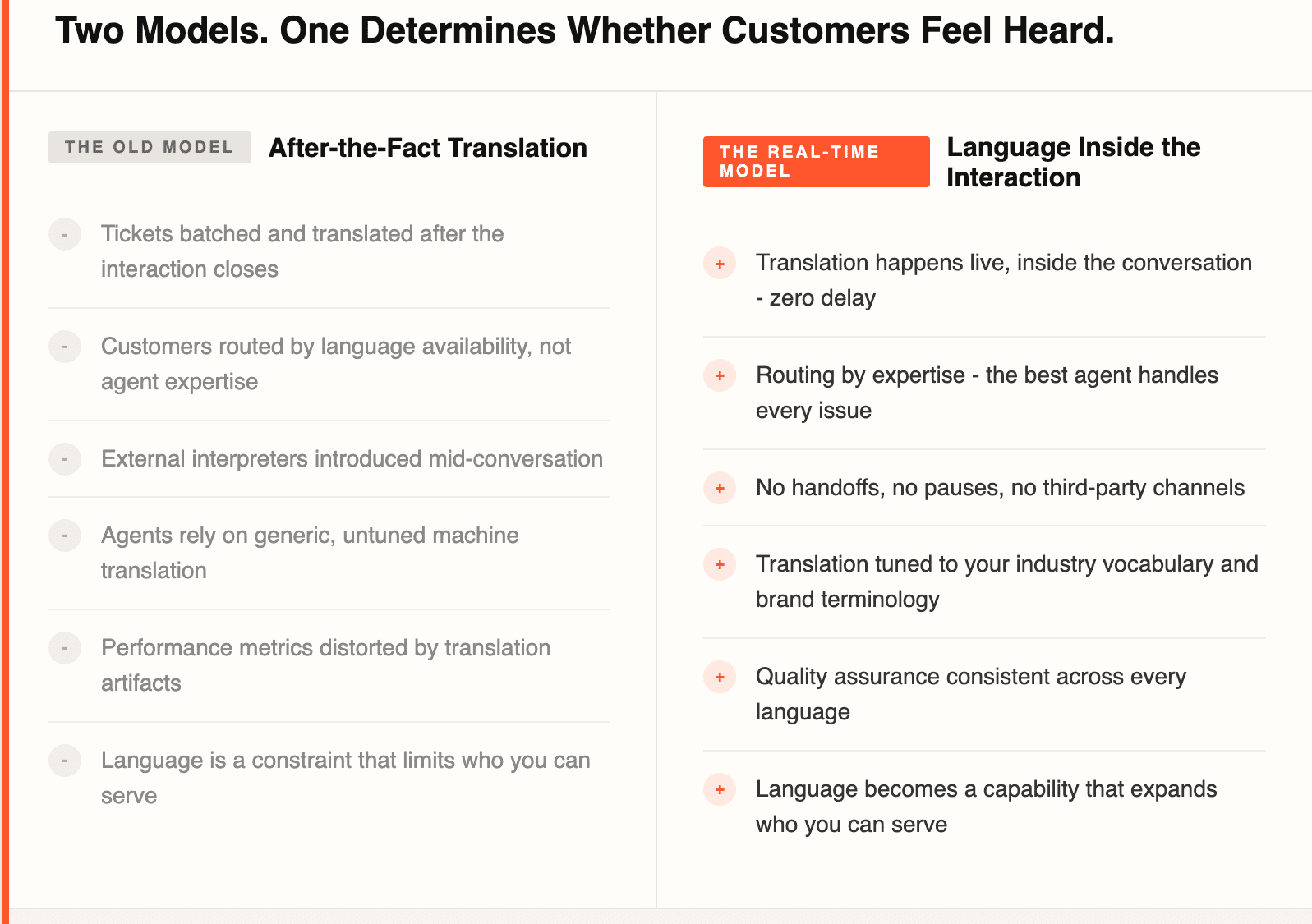
Inside many enterprises, translation still lives in back-office workflows. Content teams submit documents. Marketing sends campaigns for localization. Legal reviews compliance materials. These processes are structured, predictable, and slow by design. They are optimized for accuracy and governance, not immediacy. The problem is that customer engagement rarely fits into that structure anymore.
Consider how this plays out in a global support organization. A customer contacts an agent through chat or voice with an urgent issue. The agent speaks English. The customer does not. The system either routes the interaction elsewhere, introduces an external interpreter, or forces the agent to work through broken machine translation. None of these options preserve momentum. Each introduces latency, cost, or risk.
Over time, teams begin compensating in informal ways. They avoid complex conversations. They overuse scripted responses. They escalate issues prematurely. The organization adapts to its limitations rather than solving them. From the outside, it looks like a performance problem. Internally, it is a language infrastructure problem.
Real-time translation changes this dynamic by collapsing language mediation into the interaction itself. When done correctly, the customer and agent experience a continuous conversation. No handoffs. No pauses. No parallel channels. The language layer becomes invisible, which is exactly where it should be.
What “Real-Time” Actually Means in Practice
Real-time translation sounds straightforward: translate what someone says as they say it. In practice, enterprise environments make this far more complex. Accuracy matters. Context matters. Security matters. Compliance matters. And latency matters more than most teams realize.
A consumer-grade translation solution can tolerate small errors and awkward phrasing. A regulated support environment cannot. When a customer discusses account recovery, medical information, or financial authorization, nuance matters. Terminology matters. Tone matters.

This is where most early attempts at real-time language support fail. Organizations deploy generic tools that were never designed for enterprise conversations. They work acceptably in demos and poorly in production. Agents lose confidence. Supervisors intervene. Customers notice inconsistencies.
Effective real-time language systems are built around conversational workflows, not isolated translation tasks. They integrate directly into chat, voice, and messaging platforms. They preserve speaker intent. They adapt to industry vocabulary. They operate within security and data governance boundaries. Most importantly, they support humans rather than trying to replace them.
In strong implementations, agents are not “using a translator.” They are having a conversation. The technology fades into the background. That is not accidental. It requires architectural choices that prioritize interaction quality over raw throughput.
How Real-Time Support Reshapes Contact Center Operations
When language friction disappears, operational patterns change in subtle but meaningful ways. One of the first shifts appears in routing logic. Instead of segmenting customers by language availability, organizations begin routing by expertise. The right agent handles the issue, regardless of language. This sounds simple. In practice, it fundamentally changes staffing models.
Supervisors no longer need to overstaff rare language queues “just in case.” Specialized teams can serve global audiences. Peak demand becomes easier to manage. Workforce planning becomes more predictable. Language stops being a constraint and becomes a capability.
Training also changes. Agents no longer memorize scripts in multiple languages or rely on unreliable phrase libraries. They focus on product knowledge, empathy, and problem-solving. Quality assurance becomes more consistent because conversations follow comparable structures across languages. Managers can evaluate performance without filtering through translation artifacts.
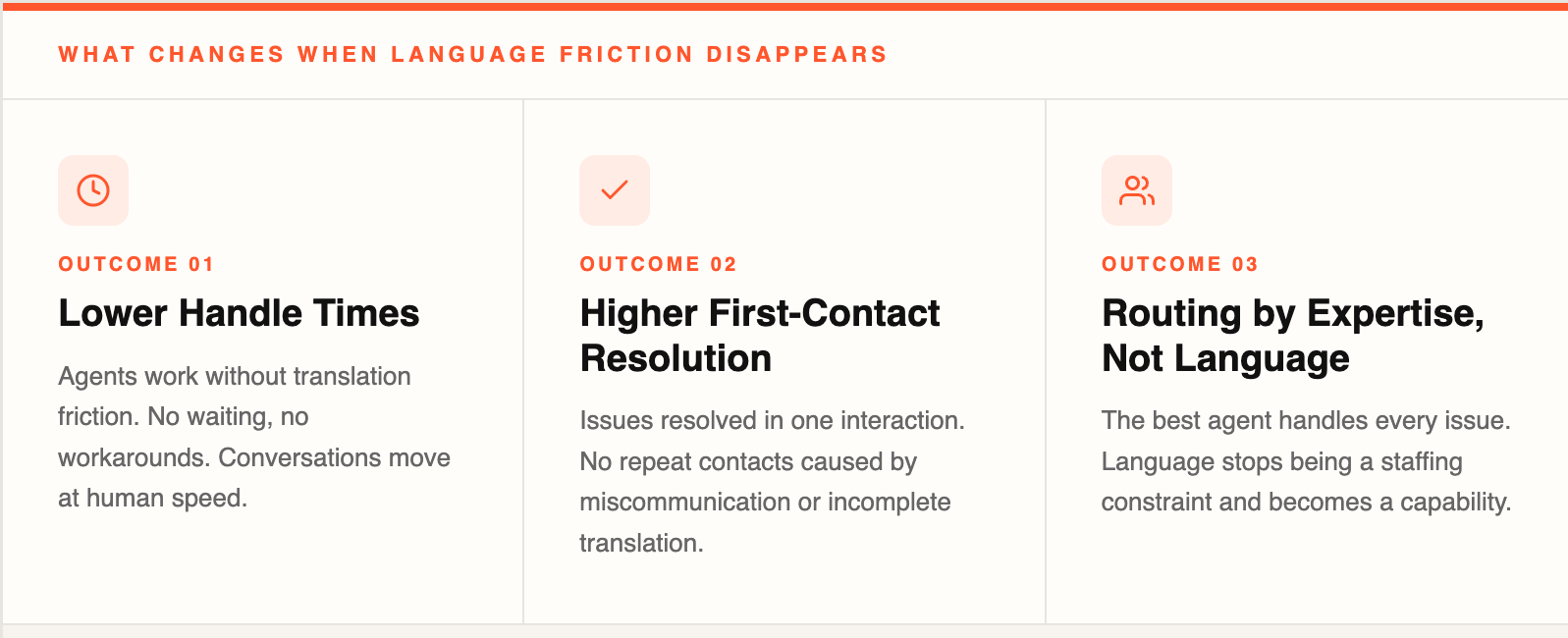
Over time, this compounds. Organizations see lower handle times. Fewer repeat contacts. Higher first-contact resolution. Not because agents are working faster, but because they are working without friction. Real-time translation removes an entire category of cognitive and procedural overhead.
The Security and Compliance Layer Most Teams Overlook
Language data is customer data. Yet many companies treat translation tools as neutral utilities rather than regulated systems. This becomes dangerous quickly, especially in healthcare, financial services, and government environments.
External interpreters introduce uncontrolled data flows. Consumer APIs route conversations through unknown processing environments. Logs and transcripts are stored outside governance frameworks. These risks often go unnoticed until an audit, incident, or legal review forces scrutiny.
Enterprise-grade real-time language platforms address this directly. They operate within controlled infrastructure. They support encryption, access controls, audit trails, and retention policies. They integrate with identity systems. They respect regulatory boundaries.
This matters operationally, not just legally. When security teams trust the system, deployment accelerates. When compliance teams approve workflows, innovation becomes easier. Language support stops being an exception that requires justification and becomes part of standard architecture.
Where Organizations Commonly Misjudge Readiness
Many enterprises assume they are “not ready” for real-time translation because their systems are complex. In reality, complexity is precisely why they need it. The biggest obstacles are rarely technical. They are organizational.
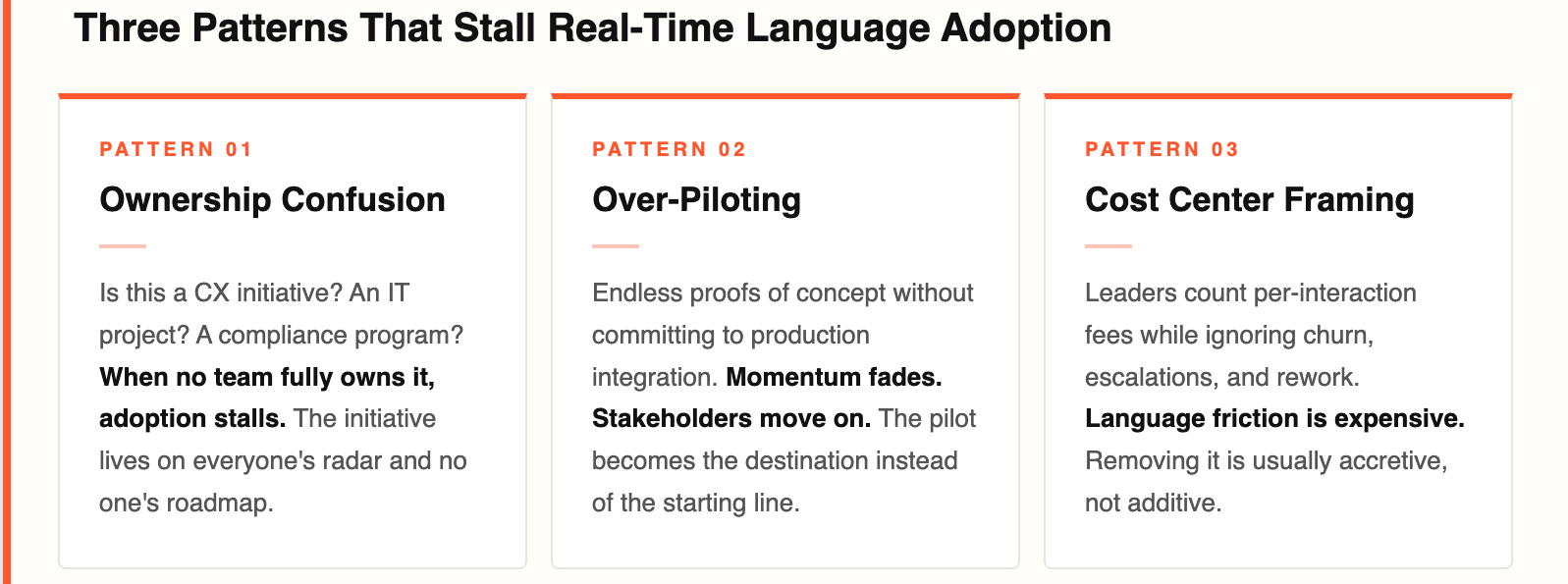
Successful deployments start with one high-impact workflow. A support queue with heavy multilingual volume. A compliance-heavy intake process. A revenue-critical onboarding flow. Teams solve that problem deeply, then expand. They treat language as infrastructure, not as a feature experiment.
Why Real-Time is Becoming a Competitive Baseline
Five years ago, offering multilingual support was a differentiator. Today, customers expect to be understood immediately, in their preferred language, across channels. They do not frame this as a “translation feature.” They frame it as basic competence.
As AI adoption accelerates, expectations will rise further. Automated systems will handle more frontline interactions. If those systems cannot operate across languages in real time, they will fragment the experience. Human escalation will become more expensive. Global scale will remain constrained.
Organizations that invest now in real-time language infrastructure are building optionality. They can deploy AI safely. They can centralize expertise. They can expand into new markets without rebuilding operations. They can maintain consistency as channels multiply.
Those that delay will find themselves layering solutions onto brittle foundations. Each workaround will solve a local problem while increasing global complexity. Eventually, language will become the bottleneck that no one planned for.
Building Conversations That Travel at Human Speed
Real-time translation is about respecting how people communicate. Conversations are fluid. They rely on timing, tone, and shared understanding. When systems interfere with that flow, trust erodes. When systems support it, relationships deepen.
The most effective enterprises understand this intuitively. They do not ask whether they can translate faster. They ask whether their customers feel heard. They ask whether their agents feel empowered. They ask whether their systems scale without degrading experience.
Real-time language support is one of the few technologies that directly influences all three. It connects operational efficiency with emotional intelligence. It links infrastructure decisions to brand perception. It turns global reach into practical capability.
That is why real-time translation is no longer a niche tool. It is becoming part of how modern organizations operate.
Discover More
-
Why the Default CRM Translation Solution Breaks Down in Global Customer Support
Today’s generative AI models have revived the assumption that If it sounds good, it must be correct. But the reality is that translation accuracy depends heavily on context, not just linguistic ability.
-
How AI Can Fix the 5 Biggest Pain Points in Customer Service
The truth is simple: You can’t create great customer experiences if your agents are miserable. When an agent is stressed out, jumping between six different programs, and watching the clock tick, they can’t give customers the attention they deserve. All their energy goes into just managing the technology instead of actually helping people. If we…