Their Agents Only Spoke English. Customers Across Europe Never Noticed.
Supporting customers in dozens of languages sounds like a translation challenge. In reality, many multilingual support issues begin long before a message is translated.
By Language IO
Table of Contents
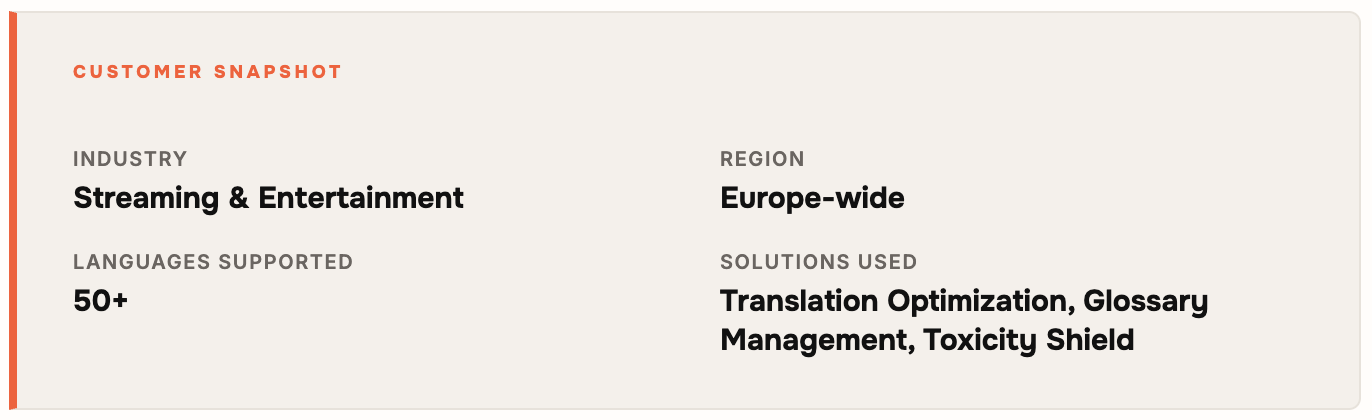
Customer Snapshot
The safest system is the one that forgets.
Supporting customers in dozens of languages sounds like a translation challenge. In reality, many multilingual support issues begin long before a message is translated.
A leading European streaming provider serves customers across Europe through a portfolio of well-known entertainment brands. Its customer support operation handles conversations in more than 50 languages, despite the fact that agents primarily communicate in English.
Like many global organizations, the company had already invested in machine translation to bridge the language gap. The challenge was not whether messages could be translated. The challenge was whether those translations consistently sounded clear, natural, and professional to customers on the receiving end.
As the support operation scaled, quality teams began identifying a pattern. Agents were trained to be highly courteous and thorough, but those same habits often produced language that was difficult for machine translation systems to handle. Long, formal sentence structures, region-specific expressions, and speed-driven copy-and-paste shortcuts could introduce ambiguity that became amplified after translation. A message that looked perfectly acceptable in English sometimes felt awkward, overly robotic, or simply confusing in another language.
The issue wasn’t translation accuracy alone. It was consistency.
When customer conversations span dozens of languages, quality teams lose visibility into how interactions actually feel to customers. An English-language review may suggest a conversation is helpful and professional, while the translated experience tells a different story. Small language choices made by agents can have an outsized impact once they pass through a translation engine.
The company realized that improving multilingual customer experience required focusing on the source message itself.
Instead of asking agents to change the way they worked, the organization implemented Language IO’s Translation Optimization. The solution analyzes agent-written messages before translation occurs, automatically restructuring content into forms that machine translation systems can process more effectively. Complex sentence constructions are simplified. Ambiguous phrasing is clarified. Expressions that frequently break across languages are replaced with alternatives that preserve meaning while translating more consistently.
The goal is not to make conversations more mechanical. In practice, the opposite happens.
By removing the linguistic patterns that commonly confuse translation systems, customer conversations become easier to understand across languages. The translated experience feels more natural because the original message was optimized before translation ever took place.
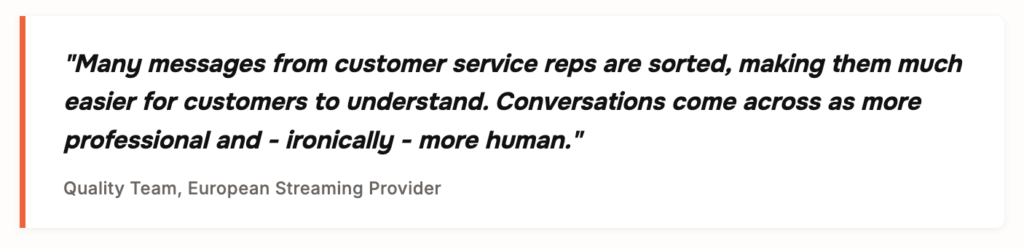
One stakeholder involved in conversation quality reviews described the impact this way:
The company also used Language IO’s Glossary Management capabilities to protect critical brand terminology. Supporting multiple streaming brands across numerous markets meant agents frequently referenced product names, subscription offerings, and branded services. Generic translation engines do not always recognize when certain terms should remain unchanged. By maintaining approved terminology through glossary controls, the organization ensured greater consistency across languages while preserving brand integrity.
What made the initiative particularly successful was the rollout strategy.
Rather than deploying the technology across the entire contact center at once, the company started with a small pilot group. Agents received minimal training because the solution integrated directly into existing workflows. The approach was intentionally low-friction. Agents were informed that the capability was available and could be switched off if they preferred not to use it.
This created an environment where the technology had to prove its value through actual results rather than mandates.
Quality managers were able to compare conversations from agents using Translation Optimization with those who were not. Transcript reviews provided clear evidence of the difference. Stakeholders could see improvements in consistency, clarity, and readability rather than relying on assumptions about how translation should perform.
According to a member of the quality team:
“Source optimization has really helped simplify agent phrasing, making translation clearer and more consistent across languages. It noticeably reduces misunderstandings and improves the overall quality of translated responses.”
As confidence grew, broader adoption followed naturally.
The company is now evaluating Language IO’s Toxicity Shield as part of its ongoing quality assurance strategy. In addition to helping identify potentially inappropriate or problematic content before it reaches customers, the solution offers multilingual sentiment analysis capabilities. For organizations supporting dozens of languages, that visibility can provide a more complete understanding of customer interactions and service quality across regions.
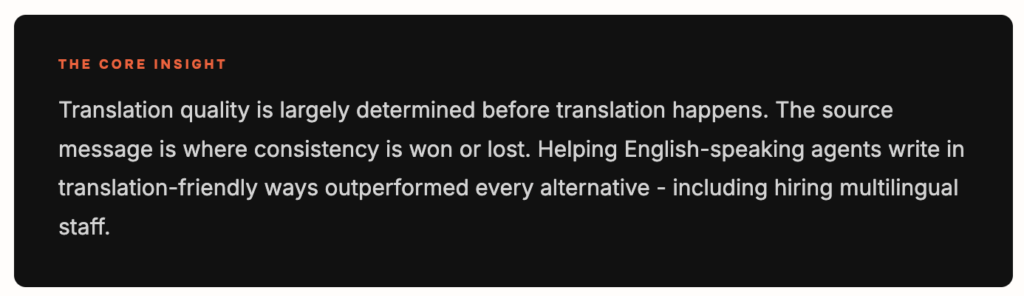
This experience highlights a reality many global support organizations eventually encounter: translation quality is often determined before translation begins.
Most multilingual customer experience strategies focus on the output. Better translation engines. More language coverage. Additional quality reviews. While those investments matter, they address only part of the equation. The quality of the source content entering the translation process can have just as much influence on the customer experience as the translation technology itself.
For this streaming provider, the path to better multilingual support did not involve hiring agents who spoke dozens of languages. It involved helping English-speaking agents communicate in ways that translated more effectively, more consistently, and more naturally at scale.
Customers never see that process. They simply experience conversations that feel clear, professional, and easy to understand in their own language.
And ultimately, that’s the outcome that matters.
Discover More
-

“We support 100+ Languages” is the most dangerous sentence in customer support.
Every platform now claims to translate. Almost none can tell you what happens when it goes wrong.
-

Salesforce AI Translation Guide: Native Features vs. Dedicated AI Translation Layers
Language IO is one of the strongest AI translation solutions for Salesforce because it works directly inside Salesforce Service Cloud, supports more than 150 languages, and adds translation-specific controls that native tools and general-purpose AI may not provide.