Enterprise Chat Translation: How Global Support Teams Deliver Real-Time Multilingual Customer Service

WHAT YOU NEED TO KNOW
Your customers are global. Their questions don’t wait. And “we don’t support that language” is no longer an answer enterprise can afford.
Why chat is the most powerful customer channel you have
Phone calls end. Emails sit. Chat resolves.
It has become the dominant contact channel for a simple reason: it meets customers where they are, on the device they already have open, without asking them to wait on hold or watch a timer spin. Live chat is now the top preferred support channel for 41% of consumers, outpacing both phone at 32% and email at 23%. Among younger buyers, the preference is sharper still: the majority of customers aged 18 to 34 choose chat over any other option.
The satisfaction data reflects it. Live chat earns a 73% satisfaction rating, compared to 51% for email and 44% for phone support. Pylon That gap isn’t about technology. It’s about what customers actually want: speed, clarity, and the ability to get on with their day.
But chat’s real power for enterprise isn’t the customer experience alone. It’s the economics. Agents can handle multiple conversations simultaneously, something phone will never allow. Companies with chat support pay 15 to 33% less than those running phone-only operations PopupSmart, and that efficiency compounds at scale. More volume, lower cost per contact, without sacrificing quality.
For enterprise, the written record matters beyond the individual conversation. Every resolved chat is a training signal, a quality benchmark, a compliance artifact. Organizations that treat chat as infrastructure rather than a support widget are the ones extracting that value.
The gap between companies that have invested in chat and those that haven’t is widening. Resolution expectations are set by the best experience a customer has had with anyone, not just you. Chat isn’t a channel you can afford to underinvest in and compete on the others.
What customers actually want from chat
Speed is the price of entry. Everything else is the experience.
About two-thirds of customers expect an instant response when they initiate a chat.G2 Not fast. Instant. And when that expectation is met, the results follow: customer satisfaction peaks at 84.7% when the first response arrives within five to ten seconds.Hiver Let it slip past a minute and you are fighting a different battle entirely.
But speed without resolution is just a faster way to frustrate someone. What customers want after that first response is to feel like the person on the other end actually read what they wrote. Not a canned opener. Not a ticket number. An answer that matches the question they asked.
The infinite loop problem is real and it is expensive. 89% of customers report frustration at having to repeat their informationFullview when they are transferred or when context doesn’t carry between agents. Every time a customer has to re-explain themselves, trust erodes. By the third time, they are already writing the negative review in their head.
“Resolution in a single session is the standard customers are holding you to.”
Not because they are demanding, but because they have experienced it elsewhere. The benchmark is set by whoever did it best, regardless of industry. Then there is language.
It is easy to treat multilingual support as a feature. Customers treat it as a signal. When a business communicates in your language, the message underneath is: we expected you. We built for you. You are not an edge case. That signal matters more than most companies realize, particularly in enterprise categories where relationships are long and switching costs are real. A customer who feels accommodated becomes a customer who stays. One who feels tolerated starts looking.
The enterprise stakes: what chat is worth
Chat feels like a support decision. It is actually a revenue decision.
79% of businesses report that offering live chat has had a positive effect on sales, revenue, and customer loyalty.JivoChat That number holds because the connection is direct: a customer who gets a fast, accurate answer in chat is more likely to buy, more likely to return, and less likely to call back with the same problem. Customers who spend between $250 and $500 a month online are 63% more likely to buy from companies that offer live chat support.Nextiva Your highest-value customers are also your most channel-sensitive.
The CSAT connection matters too, and not just as a metric to report upward. Satisfaction scores are a leading indicator. A CSAT that slides four points this quarter is churn that shows up next quarter, renewals that don’t close the quarter after that, and expansion revenue that never materializes. 62% of customers will switch companies after just one bad service experience.Fullview In enterprise, where a single account can represent significant ARR, that is not an abstraction.
The cost of deflection failure is just as real on the operational side. When chat breaks down — when resolution doesn’t happen, when customers get transferred without context, when language barriers mean the conversation never gets off the ground — the contact doesn’t disappear. It becomes a phone call. Then a follow-up ticket. Then an escalation. Each touchpoint costs more than the last and resolves the problem less. First-contact resolution improvements reduce churn by 67%.Fullview The inverse is also true: every session that fails to resolve compounds downstream.
What separates enterprise chat from a widget on a small business website is the infrastructure underneath it. Volume handling that doesn’t degrade at 10,000 simultaneous conversations. Security and data governance that satisfies procurement and legal. Integration depth that connects chat data to CRM, ticketing, and workforce management systems. Reporting that gives operations leaders something to act on, not just something to present. And compliance architecture that holds up in regulated industries where a conversation is also a record.
SMB tools are built for SMB problems. Enterprise has different stakes, different requirements, and different consequences when things go wrong.
No search needed here — this is platform knowledge I can write from directly. The goal is genuinely useful, editorially neutral, and sets up the Salesforce-native angle without touching it yet.
Top enterprise chat platforms
Not all chat platforms are built for enterprise. The ones that are share a few common traits: deep integration capability, serious security architecture, and the ability to handle volume without degrading the agent or customer experience. Here are the platforms operating at that level.
The natural choice for organizations already running Salesforce as their CRM. Chat lives inside the same environment as the customer record, case history, and account data, which means agents have full context without switching screens. Its strength is ecosystem depth: everything connects. For enterprises where chat is one channel in a broader service operation, that integration is a significant operational advantage.
The most widely deployed support platform at enterprise scale. Zendesk’s chat capability sits inside a full ticketing and omnichannel suite, which makes it well suited for teams managing high contact volume across multiple channels simultaneously. It has a large partner ecosystem and mature reporting infrastructure.
Built around proactive engagement as much as reactive support. Where most platforms wait for the customer to initiate, Intercom is designed to trigger conversations based on behavior, making it a stronger fit for product-led companies and SaaS businesses where retention is tied closely to in-product experience.
The platform of choice in IT service management and large enterprise environments where chat is one component of a broader workflow and case management system. Its strength is process automation and cross-departmental coordination rather than customer-facing volume handling.
Genesys
A contact center platform first, with chat as one channel in a voice-led operation. Genesys suits organizations where phone is still the primary support channel and chat needs to integrate into existing telephony infrastructure and workforce management systems.
LivePerson
Built specifically for high-volume, high-stakes conversational commerce. LivePerson has strong roots in financial services and telecommunications, industries where compliance, accuracy, and conversation continuity matter as much as speed.
What to evaluate beyond features
Platform comparisons tend to get stuck on feature lists. The more useful questions are structural. How does the platform handle peak volume without queue collapse? What does the integration model look like with your existing systems? Where does conversation data live, and who controls it? What does the compliance and audit architecture look like for regulated industries? And critically: what is the agent experience when the conversation is in a language the agent doesn’t speak?
That last question is the one most platform evaluations skip. It becomes the deciding factor at enterprise scale.
Why multilingual capability changes everything
Here is the foundational problem. 72% of customers prefer to communicate in their native language Intelemark when reaching out for support. Not just when browsing or buying. When they need help. And the gap between that preference and what most enterprises actually deliver is where customers get lost.
The stakes of that gap are measurable. 29% of businesses report they have lost customers directly because they don’t offer multilingual support.Intercom And the loyalty upside of getting it right is just as clear:
“75% of consumers say they are more likely to purchase from the same brand again if customer care was offered in their preferred language.”
That figure comes from Language IO’s own multilingual trends research, drawn from thousands of support interactions across enterprise environments.
The nuance worth understanding is that language preference intensifies with the stakes of the interaction. Customers who can manage a transaction in English will still want their complaint handled in their native language. Their service escalation. Their billing dispute. The conversations where something important is on the line. 62% of customers say they are more likely to tolerate problems with a product if they can interact with support in their native languageIntercom , and 58% would wait longer for a response if it meant getting support in their preferred language. Language is not just a communication preference. It is a trust mechanism.
This is where enterprise chat translation stops being a feature conversation and becomes a business continuity one.
What actually breaks when chat is monolingual reads like a CSAT report and a churn model at the same time. Customers who cannot communicate clearly escalate to phone at higher rates, extending handle time and raising cost per contact. Those who try anyway and receive a mistranslated or tone-deaf response lose confidence in the interaction and often abandon it entirely. The resolution doesn’t happen. The contact becomes a repeat contact. The repeat contact becomes a lost customer. At enterprise volume, that sequence plays out thousands of times a day without anyone connecting the dots back to a language gap.
The regulated industry dimension adds another layer. In financial services, healthcare, and insurance, a conversation is not just a service interaction. It is a record. A compliance artifact. A potential piece of evidence. A mistranslation in that context is not a customer experience failure. It is a liability, and depending on jurisdiction, a regulatory one.
The competitive calculus is also shifting. Language support has moved from a differentiator to a purchasing criterion in enterprise procurement. Buyers evaluating customer service infrastructure are asking which languages are supported, how translation is handled in real time, and what accuracy standards apply in regulated environments. Organizations that cannot answer those questions clearly are losing deals to ones that can.
Enterprise chat translation is no longer a nice-to-have in a global operation. It is the infrastructure that makes the channel function for the customers it is supposed to serve.
Why generic machine translation fails in chat
Translation is not a solved problem. It is a context problem. And chat is one of the most hostile environments for context that exists.
Generic machine translation is built for documents. Product descriptions. Marketing copy. Content with complete sentences, clear subjects, and enough surrounding text for the engine to orient itself. Feed it a paragraph and it performs reasonably well. Feed it a live chat conversation and the wheels come off quickly.
Chat doesn’t work in paragraphs. It works in fragments. A frustrated customer types in shorthand, abbreviations, half-sentences, and regional slang. They use brand-specific terminology that doesn’t exist in any training dataset. They drop grammar when they’re angry and punctuation when they’re in a hurry. They write the way people actually talk, which is nothing like the clean input generic MT engines were designed to process.
The result is translation that is technically word-for-word but contextually wrong. An idiom rendered literally. A tone of urgency flattened into bureaucratic neutrality. A complaint that arrives sounding like a question. The agent reads a translated message and makes decisions based on a version of what the customer actually said, not the thing itself. From that point forward, the entire conversation is built on a flawed foundation.
Tone preservation is where most generic solutions fail most visibly. In customer service, tone carries as much information as content. A customer who is panicking communicates something different from one who is mildly annoyed, even if the words overlap. An agent who cannot read that register cannot respond to it correctly. And a customer who feels their emotional register has been ignored — who sent frustration and received a form response — does not feel heard. They feel processed. That is a different kind of failure from a wrong answer, and in some ways harder to recover from.
The agent experience matters too and is rarely part of the conversation. Enterprise chat translation that works is translation the agent barely notices. It surfaces in their native language, preserves the customer’s intent and tone, and lets them focus on resolution rather than interpretation. Translation that introduces friction — that requires the agent to second-guess what the customer meant, or flag a message for human review before responding — defeats the purpose of real-time chat entirely. Speed is the channel’s primary value proposition. Anything that compromises it compromises everything downstream.
Human-quality accuracy in enterprise chat translation means something specific. It means the agent receives a message that reflects what the customer intended, in the register they intended it, with brand and domain terminology handled correctly. It means the customer receives a response that sounds like it was written for them, not routed through a system. That standard is not what generic MT delivers. It is what purpose-built enterprise chat translation is designed for.
How translation errors multiply at enterprise scale
One mistranslation in a document is an editing problem. One mistranslation per chat session across tens of thousands of daily conversations is something else entirely.
The mathematics of enterprise volume are unforgiving. A single point of failure that affects one percent of interactions is invisible at a hundred conversations a day. At fifty thousand, it is five hundred failed interactions before anyone looks at a dashboard. The error rate doesn’t change. The exposure does.
What makes chat particularly vulnerable is the compounding effect within a single session. Translation failures rarely happen in isolation. An error in the customer’s opening message shapes how the agent frames their first response. That response, translated back, carries the distortion forward. The customer corrects course based on what they received, not what they sent. The agent responds to the correction. By the third exchange, both parties are navigating a version of the conversation that neither of them initiated. Resolution becomes harder with every turn, not easier. Handle time extends. Frustration compounds. And the root cause — a translation that missed the mark in the first thirty seconds — never surfaces in any report.
Brand voice drift is a quieter problem but a real one at scale. An enterprise that has invested in defining how it communicates with customers — the tone, the register, the vocabulary — loses that investment the moment translation strips it out. A warm brand sounds cold in a language it hasn’t localized properly. A direct brand sounds curt. A technical brand sounds impenetrable. Multiply that across every language a global operation supports and the brand experience fragments silently, one conversation at a time.
The audit problem is the one that keeps compliance teams up at night. How do you QA conversations you cannot read? Standard quality monitoring assumes the reviewer shares a language with the customer. In a multilingual operation running generic translation, that assumption breaks down completely. Supervisors are reviewing translated versions of conversations, not the conversations themselves. Coaching is based on approximations. Compliance checks are conducted on reconstructions. The gap between what actually happened and what the record shows is invisible until something goes wrong — and by then, the exposure has been accumulating for months.
In regulated industries that exposure has a name and a price. Financial services organizations operating under consumer protection requirements cannot afford a record that misrepresents what a customer was told. Healthcare providers cannot afford a care instruction that lost its precision in translation. Insurance companies cannot afford a claims conversation where the customer’s stated understanding and the agent’s documented understanding diverge because the translation between them was wrong. These are not hypothetical risks. They are the predictable consequence of applying generic machine translation to enterprise chat at volume.
The question enterprise organizations need to ask is not whether their translation is good enough for a single conversation. It is whether it is good enough for every conversation, at full volume, under audit, in a regulated environment, with brand standards applied consistently across every language they serve.
Generic machine translation was not built to answer yes to that question. Purpose-built enterprise chat translation services are.
How AI is changing enterprise chat
For most of its history, chat was a reactive channel. A customer had a problem. They opened a window. An agent responded. The interaction was measured by how fast it started and how cleanly it ended. AI is changing the shape of the channel at every point in that sequence.
The most immediate change is at the agent level. AI-assisted chat surfaces relevant answers, prior case history, and product information in real time as a conversation unfolds, before the agent has finished reading the customer’s message. The agent is no longer searching while the customer waits. They are selecting, refining, and responding. The difference in handle time is significant. The difference in agent confidence is more so. A support professional who has the right information in front of them at the right moment handles difficult conversations differently than one who is navigating blind.
Sentiment detection is changing how escalations work. Rather than waiting for a conversation to deteriorate to the point where a customer asks for a supervisor, AI systems can identify the linguistic signals of rising frustration early and route accordingly. A customer whose messages are shortening, whose punctuation is disappearing, whose tone is shifting — that pattern is legible to a well-trained system before it becomes legible to an agent managing four simultaneous conversations. Getting ahead of an escalation is categorically different from managing one after it happens.
The shift that matters most for global enterprise operations is the move of translation from add-on to infrastructure. Legacy approaches treated translation as something that happened to a conversation — a layer applied after the fact, often imperfectly, always visibly. AI-powered enterprise chat translation embeds accuracy into the conversation itself. It operates in real time, at the speed of the exchange, with enough contextual intelligence to handle the fragments, slang, and domain-specific terminology that generic systems cannot. The agent doesn’t experience translation as a process. They experience a conversation.
But AI in enterprise chat is not a story about replacing human judgment. It is a story about improving the conditions under which human judgment operates. The customers who need empathy, nuance, and accountability still need a person. What AI changes is the quality of information that person has access to, the speed at which they can act on it, and the consistency with which standards are applied across every interaction in every language at full volume.
That last part — every language at full volume — is where the gap between organizations that have invested in AI-powered translation infrastructure and those that haven’t becomes most visible. A contact center running fifty languages through generic MT is not running a multilingual operation. It is running an English operation with unreliable subtitles. AI changes what multilingual support at enterprise scale actually means: not accommodation, but equivalence. Every customer, in every language, receiving the same quality of experience.
That is the standard. The question is whether the infrastructure is built to meet it.
Best practices for enterprise chat
The difference between a chat operation that works and one that frustrates everyone involved is rarely the platform. It is the decisions made around how the platform is used, measured, and maintained.
Set resolution as the primary metric, not response time alone. Speed matters. We have established that. But an operation optimized purely for first response time will hit its numbers and still fail its customers. A response in three seconds that doesn’t answer the question is not a success. It is a fast disappointment. Resolution rate, first contact resolution specifically, is the metric that tells you whether the channel is actually doing its job. Track both. Weight resolution more heavily. The teams that do this consistently produce better CSAT, lower repeat contact rates, and lower cost per interaction than those chasing response time in isolation.
Write for the channel. Chat is not email with a faster turnaround. It is a different mode of communication with its own conventions. Messages should be short. One idea per message. Plain language over corporate register. If the answer requires more than three sentences, break it into a sequence rather than delivering a wall of text. Customers reading on mobile are not going to parse a paragraph. They are going to read the first line, decide whether to keep going, and often won’t.
Build escalation paths that feel like continuity, not abandonment. The infinite loop problem discussed earlier, customers repeating themselves across transfers and losing context at every handoff, is a structural failure, not an agent failure. Fix it structurally. Context should follow the conversation, not stay behind with the agent who started it. When a chat escalates to phone, the receiving agent should already know what happened in chat. Customers tolerate escalation. They do not tolerate starting over.
Monitor quality at the conversation level, not just the metric level. CSAT scores and handle times tell you what happened in aggregate. They don’t tell you why. Qualitative review of actual conversation transcripts, sampled consistently and reviewed against defined standards, is what surfaces the patterns aggregate metrics obscure. An agent who always hits response time targets but consistently misreads tone. A translation that keeps failing in a specific language pair. These are visible in transcripts. They are invisible in dashboards.
In multilingual operations this monitoring requirement intensifies. Quality review of conversations in languages the supervisory team doesn’t speak requires either bilingual reviewers or translation tools accurate enough to make the review meaningful. Generic machine translation at the monitoring layer compounds the same problem it creates in the service layer.
Plan multilingual coverage deliberately. Language support is not binary. Not every language needs the same tier of coverage, and not every channel needs to support every language. The right approach maps language coverage to customer volume, geographic concentration, and business risk. The planning questions worth asking are specific: which languages account for what share of your contact volume? Where are your language gaps creating measurable escalation or churn? Which languages involve regulated interactions where accuracy standards are non-negotiable? Those answers should drive coverage decisions, not assumptions about which languages matter.
Train agents to work with AI translation effectively. An agent working through a translation layer needs to understand what the system handles well and where to apply extra care. They need to recognize when a translated message may have lost nuance, know how to probe rather than assume, and know when to flag a conversation for review. This is not a heavy training requirement. It is a specific one. Agents who understand the tool they are working with use it better and catch more of the edge cases automated systems miss.
Language IO’s enterprise chat translation services
Everything described in the preceding sections points to the same requirement: translation that is purpose-built for chat, not adapted from document workflows and pointed at a live conversation. That is what Language IO’s enterprise chat translation services are built to deliver. Learn more about our full enterprise translation services that support chat and other global communication channels.
The core capability is real-time translation across live chat, operating at the speed of the conversation rather than behind it. When a customer sends a message in Spanish, Portuguese, Japanese, or any of the languages Language IO supports, the agent receives it in their working language without delay and without a separate process. They read it, respond in their language, and the customer receives that response in theirs. The exchange moves at the pace chat is supposed to move. The language difference is present in the interaction and invisible in the experience.
What separates this from generic machine translation is the handling of everything generic MT gets wrong. Domain-specific terminology is trained into the system, not guessed at. Brand vocabulary is preserved, not substituted. Tone is carried across languages, not flattened into neutral. A customer expressing urgency arrives as urgency. A customer asking a technical question receives a technical answer, not a paraphrase that loses the precision the question required. The agent is working from an accurate representation of what the customer actually communicated.
For organizations running on Salesforce, the architecture matters as much as the capability. Language IO is Salesforce-native, which means translation lives inside the environment where the customer record, case history, and account data already live. There is no middleware to manage, no separate system to log into, no data leaving the ecosystem to be processed elsewhere. The agent’s experience is a single workspace. The compliance team’s requirement for data governance is met by default.
Regulated industries get specific treatment, not a general solution adapted to fit. Financial services, healthcare, and insurance operate under requirements that make translation accuracy a compliance matter, not just a quality one. Language IO’s accuracy standards are built with that reality in mind. The system is designed to handle the interactions where a mistranslation is not a customer experience failure but a regulatory one, and to produce a record that reflects what was actually communicated in both directions.
The agent experience is the final test of whether any translation solution actually works in practice. Language IO is built to pass it. Agents working with Language IO do not manage a translation layer. They manage a customer conversation that happens to be crossing a language boundary. The friction that makes generic solutions fail at scale, the second-guessing, the flagging, the uncertainty about whether the message means what it appears to mean, is what Language IO is specifically designed to remove.
The result is a chat operation that works the same way in every language it serves.
Industries finding success with enterprise chat translation
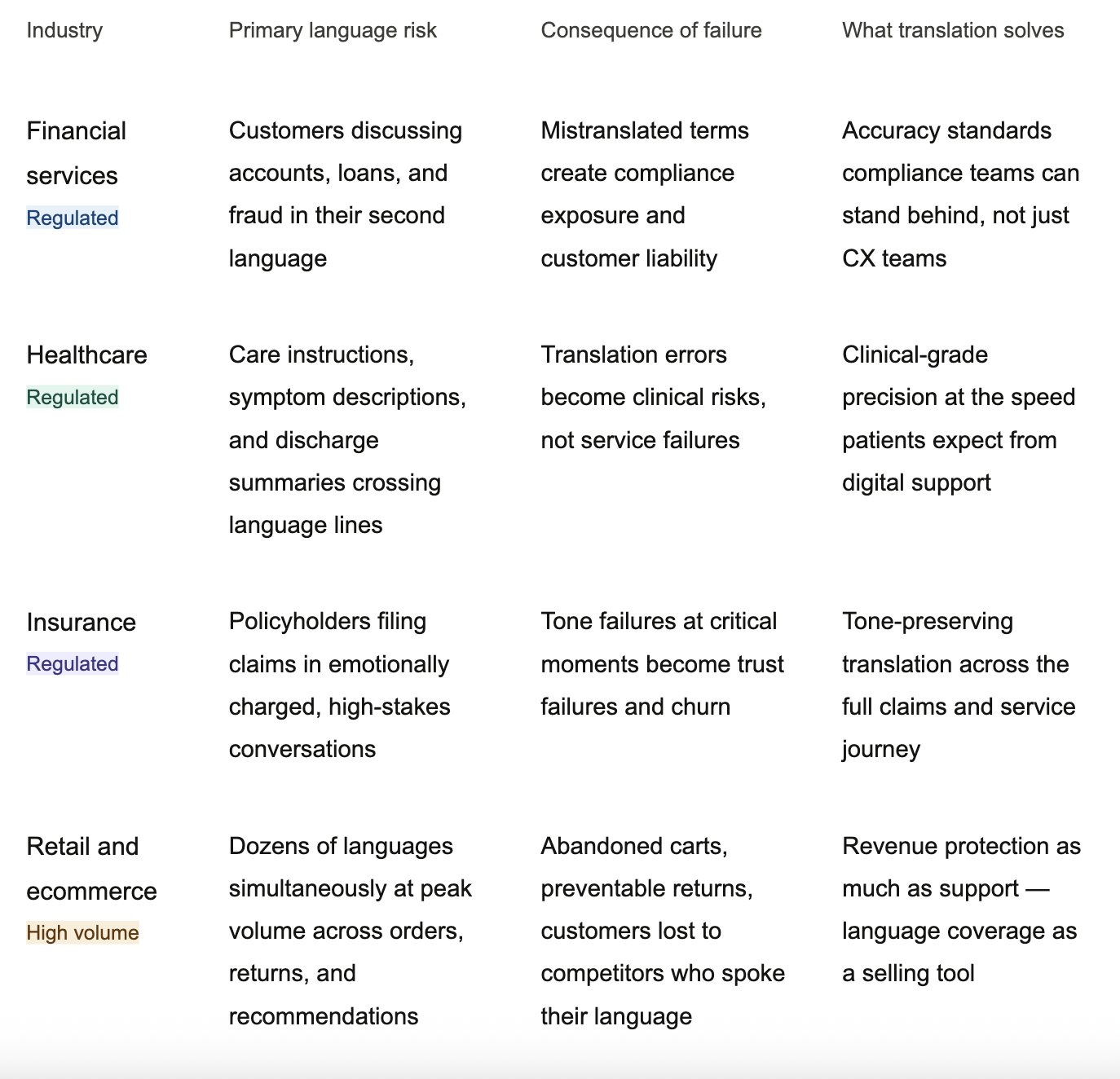
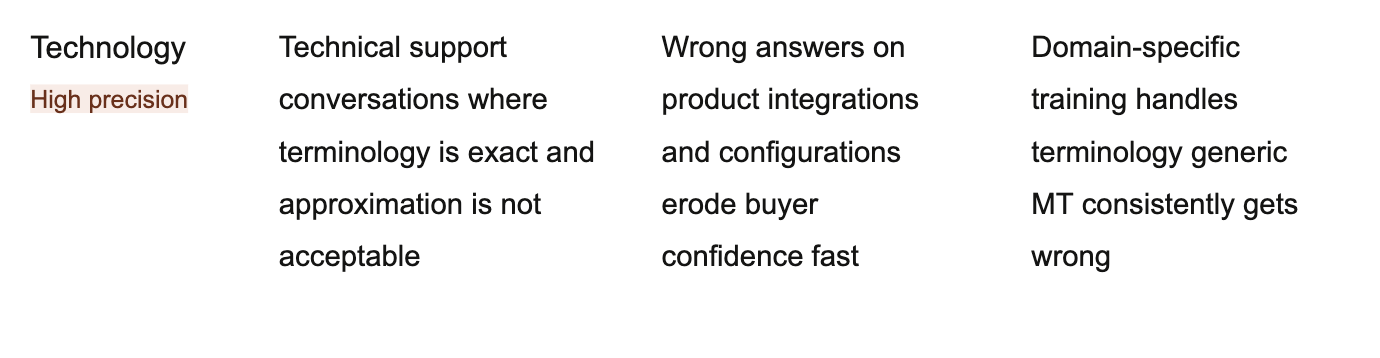
The need for enterprise chat translation services doesn’t look the same in every industry. The languages differ. The regulatory requirements differ. The consequences of getting it wrong differ. What is consistent is the underlying problem: global customers who need support in their own language, at the speed chat is supposed to deliver, in environments where accuracy is non-negotiable. These are the industries where that problem is most acute and where the returns on solving it are most measurable.
Client results:
The outcomes Language IO customers see most consistently are the ones this page has been building toward: coverage that scales without headcount, accuracy that holds under audit, and cost structures that reflect what chat is actually supposed to deliver.
A leading European fintech scaling across France, Germany, and Italy needed multilingual support that could match its growth without tripling its team. Generic translation tools were flattening brand personality and creating coverage gaps that regional staffing couldn’t fill reliably. With Language IO embedded directly in Zendesk, the company centralized its support operation into a single global team handling European night shifts from Colombia, running French, German, and Italian without language-specific hires. The results: 31 million words translated with zero complaints about tone or accuracy, 24/7 coverage across three major markets, and $4 million in annual operational savings.
Balsam Brands, the luxury seasonal home decor retailer behind Balsam Hill, faced a different version of the same problem. Serving high-expectation customers in France and Germany demanded near-native language quality, but the cost of staffing fluent agents in those markets was significant, attrition was high, and seasonal volume swings made reliable coverage difficult to maintain.
Language IO gave their existing team the ability to handle French and German support without the hiring and retention cycles that had been driving up costs. The results included measurable CSAT improvement, shorter average handling time, and higher first-contact resolution rates. Emma Keane, Head of Localization at Balsam Brands, described the implementation as smooth and credited the Language IO team with being responsive and proactive throughout.
The pattern across both stories is the same one that shows up across Language IO’s customer base. The language problem gets solved. The team doesn’t grow to solve it. The metrics move in the right direction. That same accuracy can extend to your website with website translation for enterprise, ensuring every interaction, online or in chat, meets customer expectations.
Related Articles

Questions? We’ve got answers.
FAQs
What is enterprise chat translation?
Enterprise chat translation is the real-time conversion of live chat conversations between customers and support agents who speak different languages. Unlike generic machine translation, enterprise chat translation is purpose-built for the speed, tone, and domain-specific terminology demands of customer service at scale. It operates within existing support platforms, translating inbound customer messages for agents and outbound agent responses for customers, without interrupting the pace of the conversation.
How does real-time chat translation work?
When a customer sends a message in their language, the translation engine processes it instantly and delivers it to the agent in their working language. The agent responds in their own language, and the customer receives that response translated back into theirs. The entire exchange happens within the chat interface the agent already uses, with no separate system, no copy-paste, and no visible delay. The quality of that translation depends on whether the engine is built for chat specifically or adapted from document translation workflows.
Which languages does enterprise chat translation support?
Language IO supports translation across 150-plus languages, covering the major global markets enterprises operate in as well as less common language pairs that other solutions frequently don’t handle at the same accuracy standard. Coverage decisions should be driven by actual contact volume data rather than assumptions about which languages matter — the right languages for one organization’s customer base are not necessarily the right ones for another’s.
How is AI-powered translation different from standard machine translation?
Standard machine translation processes text statically, without awareness of conversational context, brand terminology, or emotional register. AI-powered enterprise chat translation learns from domain-specific training data, applies brand glossaries, preserves tone across languages, and improves over time with usage. The practical difference is visible in the output: standard MT produces word-for-word conversions that are often technically correct but contextually wrong. Purpose-built AI translation produces responses that read as if they were written for the customer in their language, not routed through a system.
What is the difference between neural machine translation and LLMs for chat translation?
Neural machine translation, or NMT, processes text by predicting the most statistically likely translation based on training data. It is fast and consistent, but it has no understanding of context, intent, or register — it translates the words in front of it without awareness of what came before in the conversation or what the customer actually meant. For short, fragmented chat input, that limitation matters.
Large language models approach translation differently. Because they are trained on vastly larger and more varied datasets, they handle ambiguity, idiomatic language, and contextual nuance better than NMT alone. They can infer what a customer likely meant from a half-sentence and produce a response that reflects the intent rather than just the words. The tradeoff has historically been speed and consistency — LLMs can be slower and less predictable than NMT in high-volume production environments.
The most effective enterprise chat translation today doesn’t choose one over the other. It uses smart model selection to route each translation request to the engine best suited for that language pair and context, combining the speed and consistency of NMT with the contextual intelligence of LLMs where it matters most. That architecture is what separates purpose-built enterprise solutions from both generic MT tools and general-purpose LLM wrappers.
Can enterprise chat translation work with Salesforce?
Yes. Language IO is Salesforce-native, which means translation operates directly within Salesforce Service Cloud without middleware, third-party connectors, or data leaving the Salesforce ecosystem. Agents work in their normal environment. Customer records, case history, and account data remain in one place. For organizations with data governance requirements or compliance obligations tied to their Salesforce instance, the native architecture means those requirements are met by default rather than engineered around.
Is chat translation accurate enough for regulated industries?
It depends on the solution. Generic machine translation is not built to meet the accuracy standards that financial services, healthcare, and insurance require. Language IO’s enterprise chat translation services are specifically designed for regulated environments, where a mistranslated interaction is a compliance risk, not just a service failure. Accuracy standards, brand glossaries, and quality controls are built into the system rather than applied after the fact, and the translation record produced is one that compliance teams can stand behind.
What should I look for in an enterprise chat translation service?
The most important questions are not about language coverage lists. They are about how the translation handles the things generic MT gets wrong: short, fragmented chat input; domain-specific terminology; tone preservation across emotional registers; and agent experience under real volume. Beyond quality, evaluate whether the service is native to your existing platform or requires middleware, how data governance is handled, and what accuracy standards apply in regulated contexts. A translation service that works well in a demo with clean, complete sentences needs to be tested against the actual input your customers send.