The world of customer service has entered its AI era—and there’s no turning back.
As businesses face increasing demand for lightning-fast support, personalized experiences, and cost-efficiency, AI has stepped in as the hero we didn’t know we needed (but definitely do).
From automating repetitive queries to delivering multilingual conversations at scale, call center AI is transforming how companies connect with customers.
In this article, we’ll break down the global call center AI market—its size, trends, key players, technologies, and what the future holds. Grab your chatbot, and let’s dive in.
Call Center AI Market: TL;DR
- The global call center AI market is booming, expected to cross billions by 2030, thanks to rising demand for automation, personalization, and better CX.
- Trends like conversational AI, predictive analytics, and multilingual support (hello, Language IO!) are fueling rapid adoption across industries.
- Market segmentation spans components (software, services), channels (voice, chat, email), regions, and verticals like BFSI, retail, and healthcare.
Market Size & Share Forecast
Spoiler alert: the call center AI market isn’t just trending—it’s exploding. According to a report by MarketsandMarkets, the global call center AI market was valued at USD 1.6 billion in 2022 and is projected to reach USD 4.1 billion by 2027, growing at a compound annual growth rate (CAGR) of 21.3% during the forecast period.
This growth is largely fueled by the increasing need for efficient and scalable customer support, the shift toward cloud-based contact centers, and the accelerating adoption of AI-driven technologies like natural language processing, machine learning, and conversational AI.
North America currently leads the global market, accounting for over 35% of total revenue as of 2023, driven by early AI adoption, robust tech infrastructure, and the presence of industry giants like Google, Amazon, and IBM.
However, the Asia-Pacific region is catching up fast, expected to experience the highest CAGR at over 23%. The growth is fueled by booming digital economies in countries like India, China, and Southeast Asia, where mobile-first engagement and AI adoption in customer service are rising sharply.
What’s driving this surge? A convergence of factors: businesses are scaling support functions globally, customers are demanding faster and more personalized service, and AI tools are becoming smarter, more accessible, and more accurate.
According to Gartner, over 60% of customer service interactions will be managed by AI technologies by 2025, up from just 20% in 2020. That’s not just growth; it’s a revolution in how support is delivered.
Market Trends & Growth Drivers
So, what are some of the call center AI market trends and the factors driving growth? Let’s take a look.
1. Enhanced Customer Experience and Personalization
AI makes it possible to treat every customer like a VIP. Through real-time personalization and intelligent routing, customers receive responses that feel custom-fit to their needs. Rather than generic interactions, AI tailors responses based on browsing history, past interactions, and preferences.
This level of personalization reduces customer frustration and increases satisfaction. It also strengthens loyalty, as people tend to return to companies that understand and anticipate their needs.
Personalizing interactions by communicating in a customer’s native language further deepens this connection, making customers feel truly recognized and respected. From first contact to follow-up, AI ensures customers feel heard, valued, and understood in the language they are most comfortable with.
2. Compliance and Data Security
With great AI comes great responsibility. In regulated industries like finance and healthcare, data privacy isn’t optional—it’s essential. AI tools now include built-in compliance features such as automated audit trails, real-time redaction, and secure data access protocols.
Companies are increasingly adopting AI to not only ensure smoother service but also to meet the requirements of regulations like GDPR, HIPAA, and CCPA. These systems can flag risky behaviors, protect sensitive data, and ensure that even automated interactions meet strict security standards.
As data privacy laws tighten (we see you, GDPR), companies are turning to AI not just to speed things up, but to ensure compliance through automated logging, redaction, and secure data handling.
3. Omnichannel Engagement
Your customers aren’t just calling—they’re everywhere: web chat, social media, email, messaging apps, and more. AI unifies these touchpoints, making it possible to deliver consistent service and responses no matter how or where a customer reaches out.
AI-driven omnichannel systems help businesses respond in real-time across platforms, with full context and continuity. For example, a query started via chat can be picked up seamlessly via email.
This enhances the customer experience and prevents the dreaded “starting over” frustration.
AI ensures all those touchpoints talk to each other, creating a cohesive brand experience across channels.
4. Rise of Multilingual Support
Global business means global customers, and that means communication across languages. AI-powered solutions, like Language IO, enable chatbots and agents to converse fluently in dozens of languages without hiring massive translation teams.
This is especially vital for companies operating in multiple markets or regions. Customers get fast, accurate responses in their preferred language, improving both accessibility and satisfaction.
As AI continues to evolve, its ability to understand nuance and cultural context also improves, reducing miscommunication risks.
AI-powered translation platforms like Language IO are making multilingual CX scalable and natural, not a Google Translate guessing game.
5. Cost Optimization and Workforce Efficiency
AI is the MVP of doing more with less. It handles repetitive, high-volume inquiries so your team can focus on tasks that require human nuance and critical thinking. From Tier 1 automation to agent assistance tools, AI boosts efficiency across the board.
Moreover, AI helps forecast demand, optimize staffing schedules, and monitor call center agent performance metrics. This results in cost savings, reduced burnout, and a more agile, responsive support operation.
It’s not just a tech upgrade—it’s an operational advantage.
From automating Tier 1 queries to forecasting call volume spikes, it helps contact centers reduce overhead without compromising on quality.
Call Center AI Market Segment Analysis
Let’s explore call center market AI segment analysis by component, channel, application, end-user industry, and region.
By Component
The market is divided into software and services.
- Software: This segment held the largest share of the market in 2023, driven by demand for AI platforms like chatbots, predictive analytics engines, and speech recognition tools. As AI matures, expect even more specialization within this category.
- Services: Managed services and professional services are on the rise, with businesses seeking help in deployment, training, and ongoing optimization. As complexity increases, third-party AI experts are in high demand.
By Channel
The shift toward omnichannel communication has prompted AI adoption across all major channels.
- Voice: Still dominant, especially in traditional sectors like BFSI and healthcare. Voice bots are increasingly used to reduce wait times and triage calls.
- Chat: The fastest-growing segment, fueled by consumer comfort with text-based communication and mobile-first design.
- Email & Social Media: AI sorts, categorizes, and prioritizes messages—sometimes even writing the first response.
By Application
AI in call centers isn’t just about answering calls. It’s about optimizing entire workflows.
- Customer Engagement & Support: Real-time, intelligent interactions that improve resolution rates and satisfaction.
- Workforce Optimization: AI helps with scheduling, performance analytics, and quality monitoring.
- Predictive Analytics: Businesses use AI to anticipate customer needs and prevent churn.
- Fraud Detection & Risk Management: Especially in sectors like finance, where real-time pattern recognition is critical.
By End-User Industry
Several industries are leading the adoption of AI-driven contact center technology:
- BFSI: With high customer interaction volumes and complex regulatory needs, banks and insurers benefit greatly from AI.
- Retail & E-commerce: AI enables high-volume, multilingual, and automated support during shopping seasons.
- Healthcare: AI chatbots and virtual agents help manage patient queries, appointments, and follow-ups.
- Telecom & Utilities: These industries rely on AI for outage alerts, billing questions, and tier-1 support triage.
By Region
- North America: Holds the largest market share due to early AI adoption, advanced infrastructure, and strong R&D presence.
- Asia-Pacific: Expected to see the highest CAGR (23.4%) through 2030, driven by mobile-first economies and digital transformation.
- Europe: Focused on data privacy, with adoption driven by GDPR-compliant AI platforms.
Beyond the Hype: The Real State of Enterprise AI u0026 Language in 2025
AI + Language Strategy: Lead or Get Left Behind
Largest Market Players in the AI Call Center Industry
Here we’ll explore the largest players shaping/reshaping conversational AI and speech intelligence in contact centers.
1. Language IO
Language IO specializes in real-time, secure, and brand-personalized translation solutions designed specifically for enterprise customer support teams. Language IO’s technology enables global companies to communicate seamlessly with customers in multiple languages, while preserving the nuances of brand voice, tone, and terminology, without the need to hire native-speaking agents across every region.
Built with the enterprise in mind, Language IO places a strong emphasis on security, offering robust data encryption and compliance with major data protection regulations like GDPR and CCPA. Language IO easily integrates with leading CRM systems such as Salesforce and Zendesk, allowing large organizations to quickly scale multilingual support without disrupting existing workflows.
By combining high translation accuracy with a deep commitment to brand integrity and security, Language IO empowers enterprises to deliver a consistent, high-quality customer experience across all markets. Language IO is an ideal choice for businesses in highly regulated or brand-sensitive industries, such as finance, healthcare, e-commerce, and technology, where both linguistic precision and data confidentiality are critical.
2. Google
Google has long been a powerhouse in AI, and its Dialogflow platform is at the core of many call center AI deployments. Designed to build conversational interfaces, Dialogflow powers everything from simple chatbots to complex virtual agents capable of managing multistep conversations.
The platform integrates effortlessly with Google Cloud services and supports natural language understanding (NLU) in over 20 languages, helping businesses implement multilingual customer service strategies.
However, it’s important to note that the translations may not be highly personalized to each brand’s voice and may lack the highest levels of security.
3. IBM
IBM’s Watson AI platform remains a leader in enterprise AI, particularly when it comes to natural language understanding (NLU) and sentiment analysis.
Watson Assistant helps build conversational agents that can handle voice and chat interactions, and it comes with advanced capabilities like customer intent recognition, pre-trained industry content, and analytics.
IBM is especially prominent in highly regulated sectors such as healthcare and finance, where trust, transparency, and compliance are key.
4. Amazon Web Services (AWS)
Amazon Connect is AWS’s flagship cloud contact center platform, known for its scalability and ease of integration. With built-in support for AI tools like Amazon Lex (for conversational interfaces) and Amazon Polly (for lifelike text-to-speech), Connect allows businesses to deploy smart, responsive call centers quickly.
It’s especially popular with companies already embedded in the AWS ecosystem looking to enhance CX while keeping infrastructure unified and flexible.
5. Microsoft
Microsoft’s Azure AI portfolio, bolstered by its acquisition of Nuance Communications in 2022, is reshaping conversational AI and speech intelligence in contact centers. Nuance brings decades of voice recognition expertise, making Microsoft a dominant force in healthcare, finance, and other complex customer-facing sectors.
Combined with Azure Bot Services, Microsoft enables enterprises to build robust virtual agents that scale with their business. Communications (acquired in 2022) offers strong voice and conversation AI solutions.
Call Center Market and AI Technologies
Let’s delve a bit deeper into the call center market and the AI technologies to be aware of.
Translation Technology
Translation technology is becoming a foundational tool for AI-powered contact centers. It enables real-time communication across multiple languages, allowing businesses to engage customers in their preferred language without needing a dedicated multilingual staff.
While it greatly enhances accessibility, it’s important to note that translations may not always capture brand-specific nuances and could present security considerations.
Despite these challenges, translation technology helps businesses expand globally and provide more inclusive customer support.
Conversational AI
Conversational AI is the heart and soul of modern AI-powered contact centers. These technologies go beyond simple keyword recognition, leveraging natural language processing (NLP) and machine learning to understand context, sentiment, and intent. Whether through voice bots or chat interfaces, conversational AI enables companies to offer fast, accurate, and context-aware responses that mimic human dialogue.
What makes it powerful is its ability to engage across multiple channels, from web chat and mobile apps to voice IVRs. It creates smoother interactions, reduces hold times, and allows businesses to serve more customers with less friction.
Predictive Behavioral Routing
Predictive behavioral routing uses AI to analyze customer behavior, sentiment, and interaction history in real time. It then pairs the customer with the agent best suited to their needs, based not just on availability, but on interpersonal compatibility and skillset.
For example, a frustrated customer with a history of escalations might be routed to a highly empathetic, experienced agent. This technology improves resolution rates, enhances customer satisfaction, and makes the most of agent strengths.
AI can predict customer behavior and match them with the best-suited agent in real-time.
Generative AI
Generative AI is revolutionizing how support content is created. Instead of pulling pre-written responses from a script, these models generate unique, context-aware replies based on the specific conversation. This leads to more human-like and relevant interactions that adapt to each customer scenario.
Generative AI also plays a huge role behind the scenes—automating tasks like training bots, writing FAQ content, and even generating call summaries or internal reports. It’s a force multiplier that makes both bots and agents smarter and faster.
Sentiment and Speech Analytics
Sentiment and speech analytics give AI the ability to read between the lines. By analyzing tone, pitch, speed, and choice of words, these tools can detect customer emotions, like frustration, confusion, or urgency, and adjust responses or escalation paths accordingly.
This capability helps supervisors identify calls that need attention in real time and can provide deeper post-call insights for training and quality assurance. It’s like having a real-time emotional barometer in every customer interaction.
The Future of Contact Center AI
The future of contact center AI will involve the integration of human agents and artificial intelligence, bringing numerous benefits. Let’s see what this will entail.
Hyper-Personalization
Hyper-personalization takes tailored support to a whole new level. With access to customer data from CRMs, purchase histories, browsing behavior, and even past support tickets, AI can anticipate what a customer needs before they even ask.
This not only speeds up resolution times, but it also makes customers feel seen and understood.
Imagine a chatbot that says, “Welcome back, Alex—about your recent order…” That’s not just smart—that’s brand loyalty in action.
Expect bots to anticipate needs before the customer even types them.
Human-AI Collaboration
Will AI replace call center agents? No, AI isn’t here to steal jobs—it’s here to supercharge them. In the modern contact center, AI serves as a real-time assistant: suggesting answers, highlighting relevant resources, and automating data entry so agents can focus on the human side of support.
The future of contact centers lies in synergy, where agents and AI work in tandem. Think co-pilot mode: AI handles the repetitive tasks, and agents swoop in for emotional intelligence and complex resolutions.
End-to-End Automation
End-to-end automation refers to the full streamlining of customer journeys, from first contact to resolution, without the need for human intervention. It starts with AI answering FAQs, continues through intelligent routing, and ends with automated workflows like returns, billing inquiries, or appointment bookings.
This kind of automation reduces operational costs, shortens resolution times, and ensures consistency. For routine issues, customers prefer fast and frictionless support, and AI delivers just that. Automated journeys for repetitive tasks free humans for empathy-driven interactions.
Main Challenges of the Global Contact Center AI Market
Despite the numerous advantages, the global contact center AI market does have its challenges.
Lack of Skilled Workforce
One of the biggest hurdles in scaling AI solutions is talent. Building, training, and maintaining AI systems requires a blend of technical, analytical, and linguistic skills, not to mention AI ethics and compliance expertise.
The rapid pace of AI innovation has outstripped the availability of trained professionals. As a result, companies either struggle to build in-house teams or rely heavily on specialized vendors, which can increase costs and reduce flexibility.
Knowing Where AI Excels (and Where It Doesn’t)
AI thrives at handling structured tasks—think tracking orders, updating records, or answering simple questions. But it can struggle when nuance, emotion, or context is critical.
It’s important to design AI systems that recognize their own limitations. The best customer experiences happen when AI knows when to escalate to a human, especially for sensitive, complex, or emotionally charged issues.
Integration Complexity
AI works best when it’s deeply integrated into a company’s broader ecosystem. But that’s easier said than done—especially for enterprises with legacy systems, siloed data, or fragmented tech stacks.
Successful AI implementation often requires rethinking workflows, retraining staff, and reengineering back-end systems. It’s not just a plug-and-play solution; it’s a strategic shift that requires time, budget, and cultural buy-in.
Key Takeaways
The AI call center market is on the rise, with technologies such as conversational AI and real-time analytics driving smarter, faster, and more personalized customer service.
Companies that integrate AI effectively—especially with multilingual tools like Language IO—can unlock efficiency, reduce costs, and scale globally without sacrificing CX.
The future? It’s automated, intelligent, and a little bit awesome.
FAQs
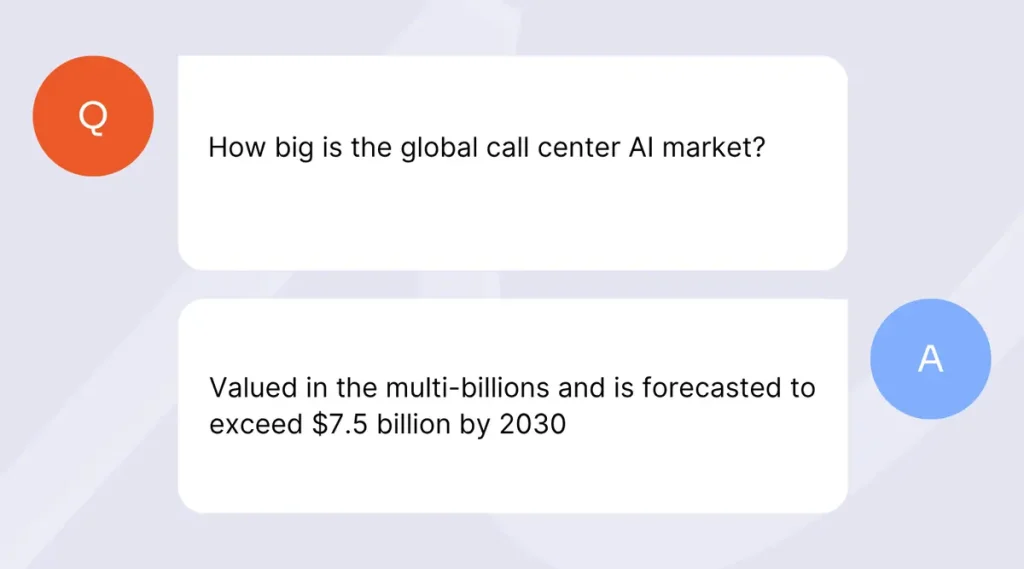
How big is the global call center AI market?
The market is valued in the multi-billions and is forecasted to exceed $7.5 billion globally by 2030, growing at a CAGR north of 20%.
How are contact center AI solutions transforming customer service in 2025?
AI is automating first-contact resolutions, enabling 24/7 support, personalizing interactions, and supporting agents in real time—all while cutting operational costs.
Which region accounted for the largest global call center AI market in 2024?
North America leads the pack due to early adoption, enterprise budgets, and a mature tech ecosystem.
Who are the key players in the global call center AI market?
Major players include Google, IBM, AWS, Microsoft, NICE Ltd., and rising stars in language and automation like Language IO.
What is the growth rate in the global call center AI market?
The market is growing at over 20% CAGR through 2030.
What is the role of artificial intelligence in modern call centers?
In an artificial intelligence call center, AI handles routine inquiries, supports agents with smart recommendations, predicts outcomes, and helps personalize customer journeys at scale.
What are the main factors driving the call center AI market?
Demand for 24/7 support, rapid expansion, better customer experience, cost optimization, and compliance are all major drivers.
What are the various verticals in the call center AI market?
BFSI, retail, healthcare, telecom, travel, and utilities are among the leading adopters.
Which channel segment dominated the call center AI market in 2024?
Voice remains dominant, but chat is the fastest-growing due to its flexibility and cost-effectiveness.
What’s the projected market size for the contact center AI market by 2032?
Analysts project it will surpass $15 billion globally, fueled by AI’s expanding capabilities and enterprise demand.