Real-Time Language Support Isn’t a Feature. It’s an Operating Model.
Real-time language support is not about speed for its own sake.
It is about preserving continuity in moments where interruption carries real cost.

By Language IO
Table of Contents
Why “Later Translation” Breaks Down in Live Environments
What “Real-Time” Actually Means in Practice
Real-time translation sounds straightforward: translate what someone says as they say it. In practice, enterprise environments make this far more complex. Accuracy matters. Context matters. Security matters. Compliance matters. And latency matters more than most teams realize.
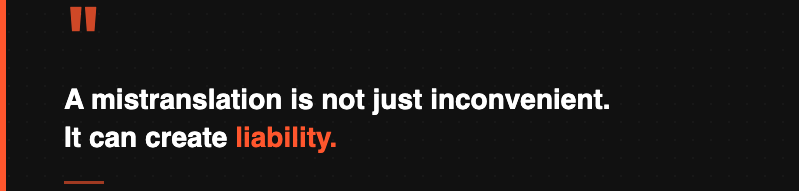
A consumer-grade translation solution can tolerate small errors and awkward phrasing. A regulated support environment cannot. When a customer discusses account recovery, medical information, or financial authorization, nuance matters. Terminology matters. Tone matters.
This is where most early attempts at real-time language support fail. Organizations deploy generic tools that were never designed for enterprise conversations. They work acceptably in demos and poorly in production. Agents lose confidence. Supervisors intervene. Customers notice inconsistencies.
Effective real-time language systems are built around conversational workflows, not isolated translation tasks. They integrate directly into chat, voice, and messaging platforms. They preserve speaker intent. They adapt to industry vocabulary. They operate within security and data governance boundaries. Most importantly, they support humans rather than trying to replace them.
In strong implementations, agents are not “using a translator.” They are having a conversation. The technology fades into the background. That is not accidental. It requires architectural choices that prioritize interaction quality over raw throughput.
How Real-Time Support Reshapes Contact Center Operations
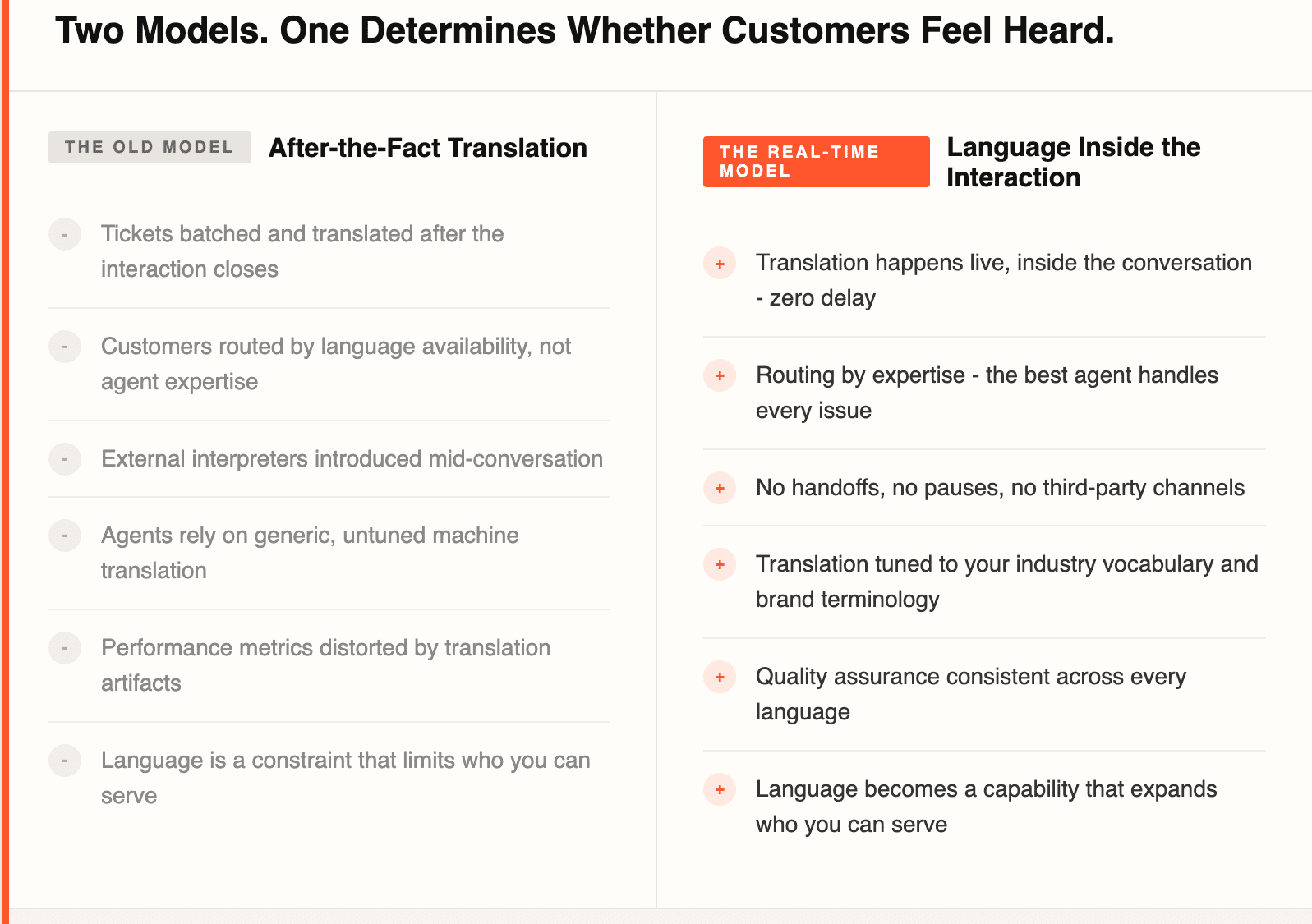
When language friction disappears, operational patterns change in subtle but meaningful ways. One of the first shifts appears in routing logic. Instead of segmenting customers by language availability, organizations begin routing by expertise. The right agent handles the issue, regardless of language. This sounds simple. In practice, it fundamentally changes staffing models.
Supervisors no longer need to overstaff rare language queues “just in case.” Specialized teams can serve global audiences. Peak demand becomes easier to manage. Workforce planning becomes more predictable. Language stops being a constraint and becomes a capability.
Training also changes. Agents no longer memorize scripts in multiple languages or rely on unreliable phrase libraries. They focus on product knowledge, empathy, and problem-solving. Quality assurance becomes more consistent because conversations follow comparable structures across languages. Managers can evaluate performance without filtering through translation artifacts.
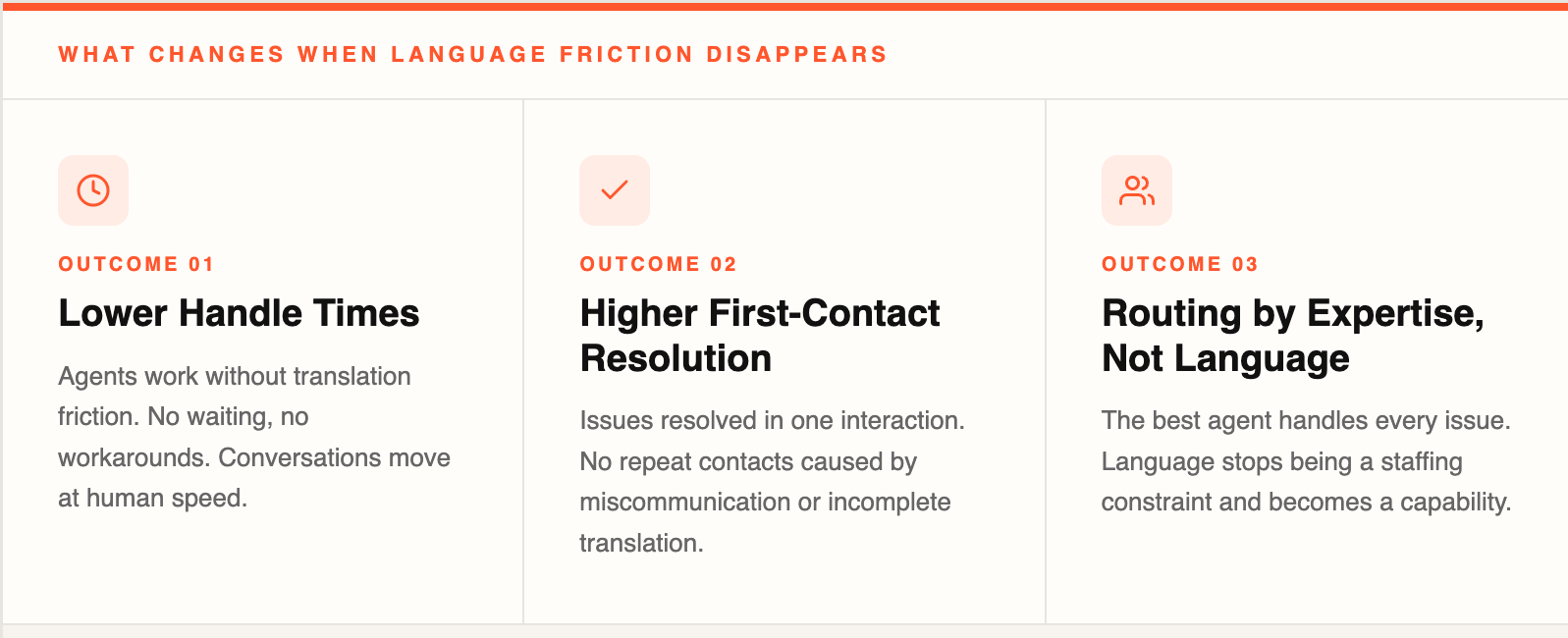
Over time, this compounds. Organizations see lower handle times. Fewer repeat contacts. Higher first-contact resolution. Not because agents are working faster, but because they are working without friction. Real-time translation removes an entire category of cognitive and procedural overhead.
The Security and Compliance Layer Most Teams Overlook
Where Organizations Commonly Misjudge Readiness
Many enterprises assume they are “not ready” for real-time translation because their systems are complex. In reality, complexity is precisely why they need it. The biggest obstacles are rarely technical. They are organizational.
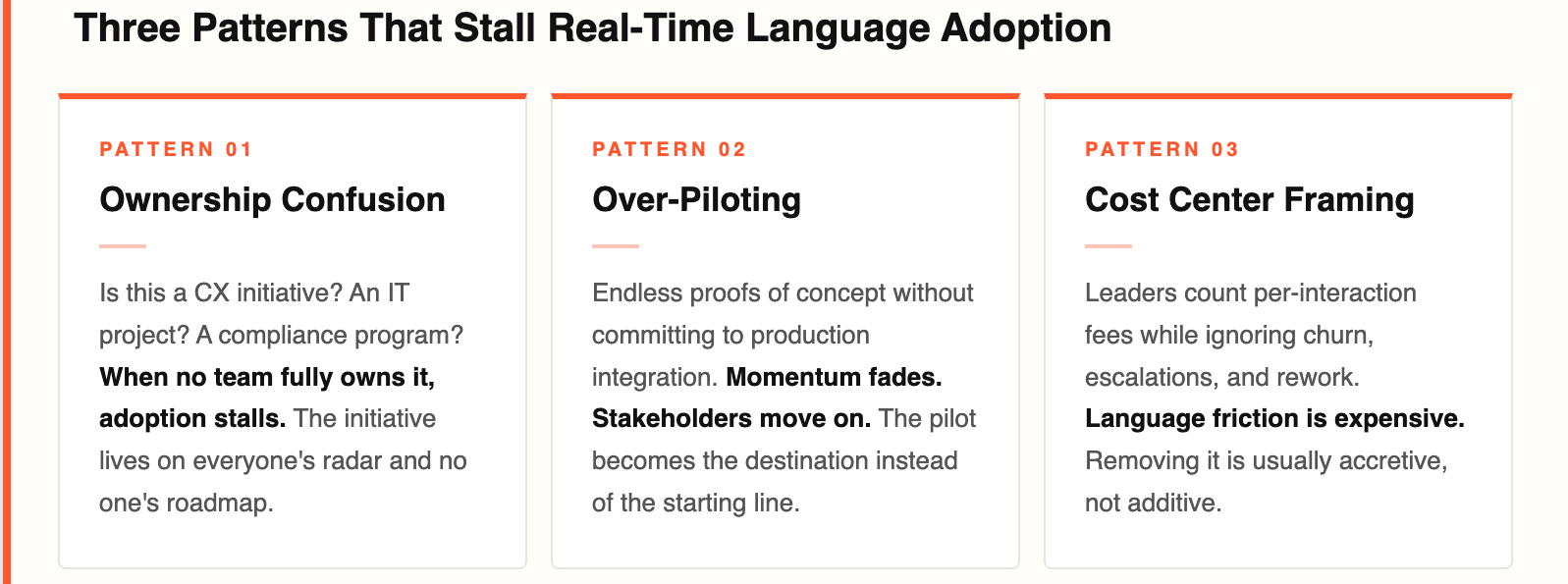
Successful deployments start with one high-impact workflow. A support queue with heavy multilingual volume. A compliance-heavy intake process. A revenue-critical onboarding flow. Teams solve that problem deeply, then expand. They treat language as infrastructure, not as a feature experiment.
Why Real-Time is Becoming a Competitive Baseline
Building Conversations That Travel at Human Speed
That is why real-time translation is no longer a niche tool. It is becoming part of how modern organizations operate.
Discover More
-

The Magic Bullet is Dead. Long Live the Specialist.
For two years, the pitch fit on a slide. One model. Ask it anything. Watch it do everything. The general-purpose AI would write your code, run your meetings, answer your customers, and refactor the org chart then summarize it in a podcast.
-
AI Translation for Financial Services and Technology
Language IO provides financial services and technology companies with AI translation that can handle industry terminology, move fast enough for customer support, and protect the sensitive information inside every conversation. Organizations using AI translation need to understand what personal data is processed, why it is processed, where it goes, how long it is kept, which…