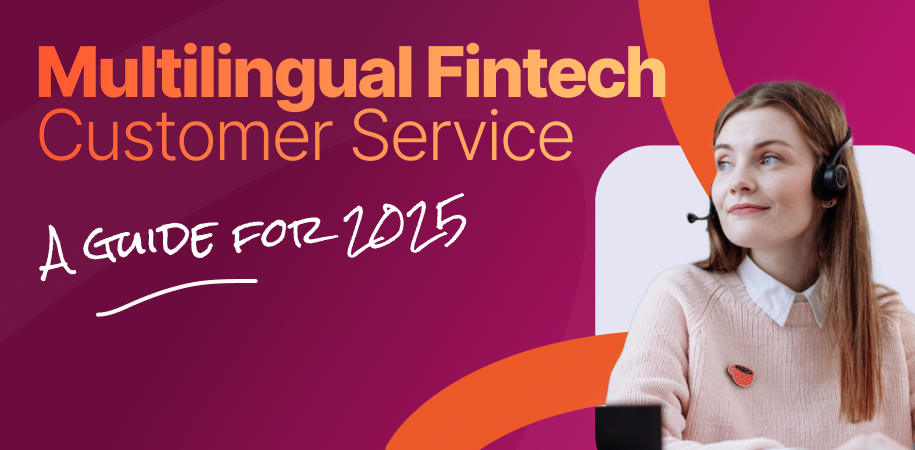
Fintech companies are revolutionizing financial services, offering seamless digital solutions for everything from payments to investments. However, with a rapidly expanding global user base, customer support must evolve to meet multilingual demands.
Effective communication is no longer optional—it’s a competitive advantage.
In this article, we’ll explore how fintech businesses can build world-class multilingual customer support that meets the needs of a diverse audience.
TL;DR
- Global Accessibility: Provides support across languages and regions, ensuring clear communication and fostering trust with international users.
- Enhanced Data Security: Prioritizes secure, encrypted translations and compliance with regional financial regulations.
- Omnichannel Support: Delivers consistent, multilingual assistance across live chat, social media, email, and more.
- AI-Driven Automation: Streamlines customer service workflows, automates translations, and increases efficiency without compromising accuracy.
What Is Fintech Customer Service?
Fintech customer service is the backbone of digital financial platforms, ensuring that users can navigate everything from transactions to account security without a hitch.
Unlike traditional banking, fintech support must be lightning-fast, accessible across digital channels, and equipped with advanced automation to handle the ever-growing number of customer inquiries.
Whether it’s a live chat agent helping a user reset their two-factor authentication or an AI-driven chatbot answering a question about cross-border payments, fintech support has to be seamless, reliable, and, most importantly, multilingual.
Language IO provides seamless, reliable multilingual fintech customer service support to fintech companies looking to cater to a global market. High-quality machine translation is integrated into customer service workflows, ensuring accuracy and customer satisfaction.
The Importance of Multilingual Customer Support for Fintech Businesses
Fintech companies aren’t just catering to one region or language anymore. A user in Tokyo might be sending money to a family member in Mexico while someone in Germany is investing in U.S. stocks. Without multilingual customer support, fintech companies risk alienating users who feel frustrated when their complex financial queries can’t be answered in their native language.
Beyond customer experience, multilingual support is a compliance necessity. Financial regulations vary by country, and miscommunication can lead to costly mistakes. A clear, localized explanation of terms and policies can be the difference between a satisfied, loyal customer and a compliance nightmare. By investing in multilingual fintech support, businesses ensure that users feel confident in their transactions, no matter where they are in the world.
Multilingual support also builds trust and credibility, two essential factors in an industry where security and transparency are paramount. Customers are more likely to trust a fintech platform that can explain loan terms, transaction fees, and data protection policies in their preferred language.
Companies that fail to provide clear and accurate translations risk misinterpretations that can lead to disputes, chargebacks, and even legal trouble. This is where Language IO steps in, enabling fintech companies to integrate real-time AI-powered translations into their customer service workflows, ensuring compliance and accuracy across multiple languages.
Your Global Fintech Playbook—Decoded.
The key to success is communication that feels local, no matter where you’re from.
How to Improve Your Fintech Customer Support: Practical Guide with Tips
First-class customer support is essential for fintech companies. Effective and reliable customer service across omnichannel fintech solutions, such as fintech call centers and AI-generated chatbots, ensures the brand’s credibility and reputation, as well as safeguarding client data security and integrity. Fintech customer support can be enhanced in several ways.
Recognize Your Customers and Target Audience
Fintech users aren’t a monolith. They range from tech-savvy millennials looking for easy investing options to first-time online banking users who need extra guidance. Understanding your customer base is step one.
By analyzing user demographics, fintech companies can determine which languages to prioritize, which regions require specialized support, and how to tailor messaging for different audiences. A customer in Spain might need different guidance than a customer in India when it comes to financial regulations, and support should reflect that.
Prioritize Privacy and Security
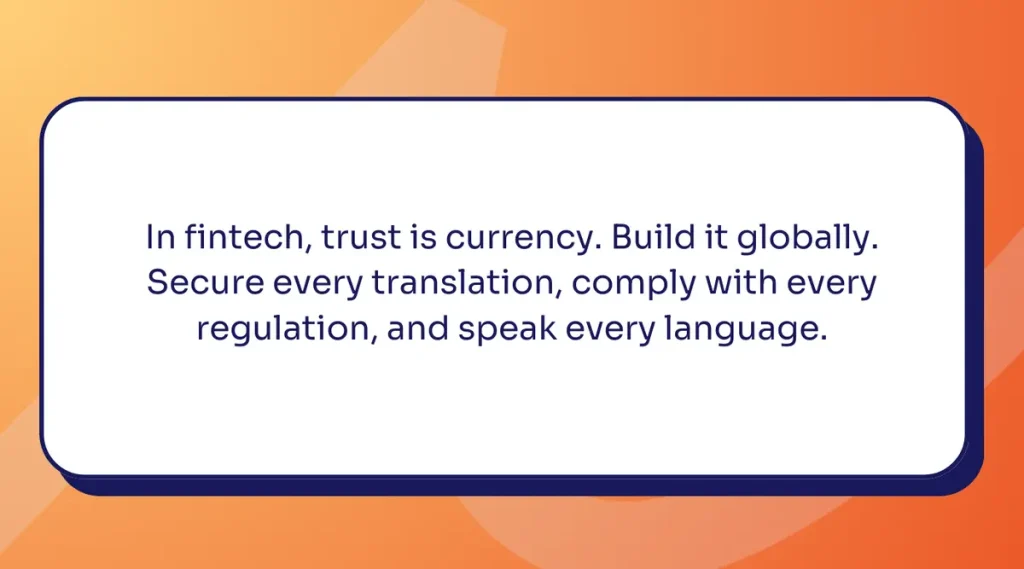
Trust is everything in financial services, and a single misstep can erode confidence in a fintech platform. Multilingual support should come with airtight security measures. Whether it’s ensuring that translated chat transcripts remain encrypted, training multilingual support agents on privacy laws in different regions, or using AI-driven authentication processes, security should be at the heart of every customer interaction.
Users need to feel that their sensitive financial data is being handled with the same level of protection, whether they’re speaking with a representative in English, Mandarin, or Portuguese. Language IO prioritizes customer privacy and security, ensuring data is encrypted and never stored in its database.
Expand Your Communication Channels
Customers expect fintech support to be available on their terms, which means offering multilingual assistance across multiple platforms. A user might start by asking a quick question via social media, follow up through live chat, and finally request documentation over email. Every step of the process should be seamless, no matter the language.
AI-powered chatbots equipped with real-time translation can ensure that users receive immediate responses in their preferred language, while multilingual help centers provide self-service options for those who prefer to find answers on their own.
Invest in Customer Support Tools
Human agents can only do so much, and as fintech companies scale, the need for automation grows. AI-driven translation tools, like those provided by Language IO, ensure that customer inquiries are handled with accuracy and speed, eliminating the need to hire massive multilingual teams.
By integrating real-time translation into customer service platforms, fintech companies can provide instant support in multiple languages without compromising accuracy. Automated ticketing systems can categorize and route multilingual inquiries efficiently, ensuring that customers aren’t left waiting for answers simply because they speak a different language.
Latest Trends in Customer Service in Financial Services
Fintech customer support is undergoing a transformation, with new trends shaping the way businesses interact with users. AI-driven customer support is leading the charge, with chatbots and virtual assistants reducing response times and providing 24/7 assistance. Hyper-personalization is becoming the norm, with fintech companies leveraging data analytics to offer tailored financial advice and support based on user behavior.
Proactive customer support is another game-changer, as fintech businesses now use predictive analytics to anticipate issues before they arise, reaching out to customers with solutions before they even realize there’s a problem.
Meanwhile, voice AI and conversational banking are making interactions even more intuitive, allowing users to manage their finances through natural voice commands rather than clunky menus and forms.
However, none of these innovations can be truly effective without multilingual capabilities. Language IO ensures that fintech companies can provide a seamless experience for users around the world.
Transform Your Multilingual Fintech Customer Service With Language IO
If you’re running a fintech company, you already know that exceptional customer support is crucial. But delivering that same level of service across multiple languages? That’s where things get tricky.
Language IO makes it easy by integrating AI-driven translation technology into your existing support platform, ensuring that customer inquiries are translated accurately and in real time.
Whether your users are chatting, emailing, or submitting help desk tickets, Language IO ensures they get clear, precise responses—no language barriers, no miscommunications, just seamless global support.
Final Thoughts on Multilingual Fintech Customer Support
Providing multilingual customer support in fintech is no longer an optional feature—it’s a necessity. Customers expect fast, reliable, and accurate assistance in their preferred language, and businesses that fail to deliver risk losing trust and market share.
With AI-powered translations, fintech companies can bridge the language gap, ensuring clarity, compliance, and customer satisfaction. Language IO plays a crucial role in this transformation, equipping fintech firms with the tools needed to provide real-time multilingual support.
In a rapidly evolving financial landscape, businesses that prioritize language accessibility will gain a competitive edge and build lasting customer relationships.
FAQs
What are the characteristics of good fintech customer service?
Good fintech customer service is fast, secure, and accessible to users worldwide. It should prioritize multilingual communication, provide real-time responses, and ensure that customer interactions remain seamless across different channels.
Security and regulatory compliance are also crucial, as financial data requires the highest levels of protection.
What are the biggest challenges of customer service in the fintech industry and what can be done to overcome them?
Regulatory compliance, data security, and language barriers are some of the biggest challenges in fintech customer service. Companies can overcome these hurdles by investing in AI-driven translation tools, implementing automated security measures, and training support agents on regional financial laws.
By combining technology with human expertise, fintech businesses can provide a reliable, multilingual customer experience that meets global standards.