Website Translation for Enterprise
WHAT YOU NEED TO KNOW
You decided to translate your website. Good. Your competitors already have. Here is what most enterprise teams find out too late: translating your site is the easy part. The moment those pages go live, you have made a promise to every customer who finds them. That your company speaks their language. Not just on the homepage. Everywhere.
Language IO builds the infrastructure that makes that promise true.
What Most Enterprise Website Translation Strategies Miss
Most enterprise teams treat website translation as a marketing project or outsource it to enterprise translation services. Get the pages into Spanish, French, German, Japanese. Ship it. Check the box.
What they have actually done is open a door. The customers who walk through it will need support. They will open tickets, start chats, and call. They will expect the same quality of experience in their language that you deliver in English. If you cannot provide it, your translation spend becomes a customer acquisition budget for your competitors.
The enterprises that get multilingual right plan the full customer journey before the translated site ever goes live. That starts with a distinction most translation briefs get wrong.
Translation vs. Localization — Why the Difference Costs Enterprise Companies Money
These words get used interchangeably. They should not be.
Translation converts words. It is the right tool for functional, factual content: support documentation, legal disclosures, product specs, knowledge base articles. The goal is accuracy. A faithful rendering of the source.
Localization converts meaning. It adapts content so it resonates culturally, emotionally, and contextually with a specific market. It does not translate the words. It reimagines the intent.
What should be translated?
Anything where accuracy is the primary requirement. Support articles. Technical documentation. Compliance disclosures. Error messages. Transactional emails. Correct matters. Creative does not. However, keeping true to your brand voice, product names and special terminology is still important.
What should be localized?
Anything where persuasion is the primary requirement. Ad copy. Campaign taglines. Value propositions. Homepage headlines. Calls to action. What sounds compelling in English frequently sounds flat, confusing, or worse in another language. Localization rewrites for the market. It does not convert from the source.
What should never be directly translated?
Idioms. Humor. Cultural references. Slogans built on wordplay. These do not travel. Attempting to translate them produces copy that ranges from awkward to brand-damaging.
The enterprise that understands this distinction allocates its budget correctly. The one that does not ends up with a beautifully translated website and ad copy that fails in every market it runs.
The Legislation Making Enterprise Website Translation Mandatory
For a growing number of enterprises, multilingual is no longer a growth strategy. It is a legal requirement. Here is what the regulatory landscape looks like right now.
Bill 96 is Quebec’s comprehensive language law, fully in effect as of June 1, 2025. It requires any business with 25 or more employees that conducts business in Quebec to provide customer-facing materials, digital content, and communications in French.
The reach is wider than most enterprises realize. All companies selling products in Quebec are required to serve the public in French, not just those with physical locations in the province. Penalties range from $3,000 to $30,000 per violation.
The part Bill 96 makes explicit that most website translation briefs miss: if an English e-commerce site offers a chat service, the French site must provide the same service.Translating your site without translating your support infrastructure is not compliance. It is half a job.
The EU Digital Services Act
The DSA requires large online platforms operating in the EU to provide terms and conditions in all official EU languages and to offer multilingual customer support across member states. This is not a soft recommendation. It is a condition of market access.
The European Accessibility Act
The European Accessibility Act, effective June 28, 2025, mandates that digital products and services — including websites, e-commerce platforms, and audiovisual media — must be accessible to all users. For multilingual enterprises, accessibility and language access are two sides of the same compliance requirement. The directive applies to enterprises outside of the EU that provide services or sell products to consumers within the EU.Being headquartered in the US does not exempt you.
US Title VI and the ADA
Title VI of the Civil Rights Act and the Americans with Disabilities Act mandate language access services for individuals with limited English proficiency. For enterprises in regulated sectors, particularly financial services and healthcare, this shapes what multilingual support actually has to look like — not just what the website says, but how service is delivered.
What the legislation has in common
Every one of these laws shares a structural insight that enterprise teams should internalize: the obligation does not stop at the website. Quebec’s Bill 96 explicitly requires French customer service. The DSA requires multilingual support. The EAA covers the full digital service experience. The regulatory trend is toward full-journey language access, not translated landing pages.
The Corporate Website Translation Checklist
Run these questions before your corporate website translation launches. Most enterprise teams can answer the first category confidently. The later ones are where strategies fall apart.
 What the legislation has in common
- Is your source English copy clean and free of idioms that will not survive translation?
- Have you separated content that needs translation from content that needs localization?
- Is your CMS built to handle text expansion? German and Finnish run significantly longer than their English equivalents. Layouts break.
- Have you accounted for RTL languages like Arabic and Hebrew in your design system?
- Are your image assets culturally appropriate for target markets, or do they need to be replaced?
Can you actually support the customers you are about to acquire?
This question does not appear on most enterprise website translation checklists. It is the most important one.
- When a customer from your new market opens a support ticket, who responds?
- Do your agents have real-time translation, or are multilingual requests routing to a small pool of bilingual agents?
- What is your resolution time for non-English tickets today? Is that acceptable for a market you are actively courting?
- Is your knowledge base available in the same languages as your website?
- Are your chat and messaging channels equipped for multilingual conversations?
- Are you ready for the support volume a successful launch will generate?
A translated website that converts well is a success. A translated website that converts well but delivers a degraded support experience in every new market is a churn machine.
Is your data protected?
- Do you know where your translation vendor is processing your content?
- Can they confirm your data is not training third-party models?
- Have legal and compliance reviewed the data handling practices of every tool in your translation stack?
- Does your translation infrastructure meet the regulatory requirements of each target market, not just the linguistic ones?
Do you have a quality feedback loop?
- How will you know if a translation is performing well after launch?
- Are you tracking CSAT and resolution rates by language, or only in aggregate?
- Who owns translation quality post-launch? What is their process for catching and correcting problems?

Related Articles
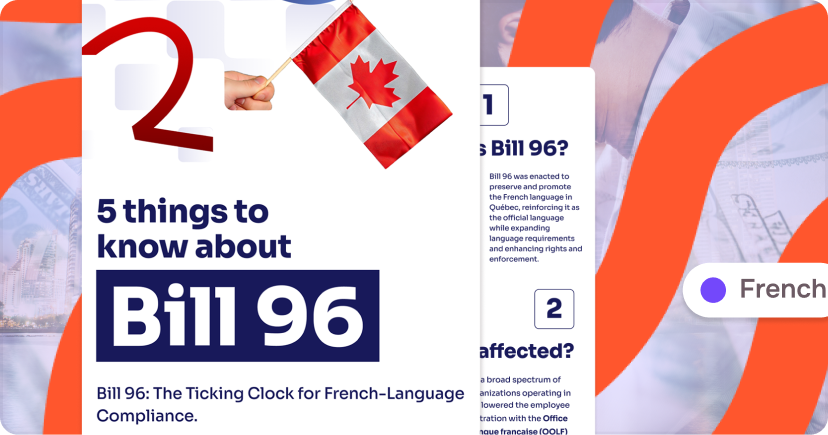
Understanding Bill 96: A guide for businesses operating in Quebec, Canada
To ensure your business is ready for the implementation of Bill 96, consider the following steps…
5 min read

Don’t trust your customer conversations to a default translation solution.
Don’t trust your customer conversations to a default translation solution unless you are okay with losing millions of dollars each year from misunderstandings.
4 min read


When Every Customer Speaks Your Language: The Real Business Impact with Language IO
In a world where customers expect immediate, human-like service, no matter where they live or what language they speak, language has become the new business frontier.
1 min read
What Corporate Website Translation Requires Behind the Scenes
The website is visible. The infrastructure behind it is not. That infrastructure — often powered by enterprise translation software — is what determines whether your corporate website translation investment pays off or stalls at acquisition.
Real-time agent translation. Your support team should be able to work with customers in any language without a bilingual agent in the loop. Every agent becomes multilingual. Resolution times drop. Routing complexity disappears.
A multilingual knowledge base. If customers in new markets cannot self-serve in their language, every avoidable question becomes a ticket. That is cost you are generating for yourself.
Translated chat and messaging. If a customer starts a conversation in French, the entire conversation works in French. Not routed. Not delayed. Not escalated to a specialist. Handled.
Quality monitoring by language. Translation quality degrades without oversight. Terminology drifts. Source content updates do not always propagate to translated versions. You need visibility at the language level.Compliance infrastructure. In regulated industries, translation accuracy is not a customer experience issue. It is a legal one. A mistranslation in a financial disclosure or clinical document is not a bad review. It is a regulatory action.
What These Industries Need to Get Right About Their Website Translation
Multilingual expansion carries different stakes depending on where you operate. The mistranslation that costs a retail brand a bad review costs a medical device company an FDA citation. Getting it right starts with understanding what “right” actually means in your industry.
Industry
What They Cannot Get Wrong
Financial Services

Regulatory language that holds up in every jurisdiction. A mistranslated disclosure is not a UX problem. It is a legal one.
Medical Devices & Pharma
Instructions for use, adverse event reporting, and patient-facing content where translation errors carry clinical and regulatory consequences. The FDA, EMA, and MDR all have something to say about this.
Technology & SaaS
Product support at global scale. Your users expect help in their language with the same depth your English documentation provides.
Retail & E-Commerce
The post-purchase experience. Getting customers to buy in their language is the easy part. Keeping them requires support that actually works.
Travel & Hospitality
Real-time. Travelers do not wait for a bilingual agent. The support has to be there when they need it, in the language they need it.
How Language IO Fits Into Your Enterprise Multilingual Strategy
Language IO does not do website translation. We do something more valuable: we make sure the customers your translated website acquires actually stay.
We are enterprise AI infrastructure for multilingual customer communication. We connect directly to the platforms your support teams already use, including Salesforce, Zendesk, and ServiceNow, and we handle the conversations your translated website is about to generate.
Real-time agent-to-customer translation across chat, messaging, and ticketing. Knowledge base and self-service translation so customers in every market can find answers without opening a ticket. Domain-specific accuracy for industries where a mistranslation carries real consequences. Data privacy that meets enterprise security requirements, including a hard commitment that your content never trains an external model. Quality monitoring that catches drift before it reaches your customers.
Going through each one. Main offenders: sentences that exist to set up other sentences, a few constructions that are too tidy to sound written, and one or two banned words hiding in there.
See a demo.

Questions? We’ve got answers.
FAQs
What is enterprise website translation?
Enterprise website translation converts your website content into additional languages for international markets. At enterprise scale, that means managing large content volumes, multiple languages, ongoing updates, and the compliance requirements of each target market. It is also the starting point of a multilingual customer journey. Not the end of one.
What is the difference between website translation and website localization?
Translation converts words. Localization converts meaning. Your homepage headline, ad copy, and campaign taglines cannot be translated word for word into another language and expected to perform. They need to be rewritten for the market, with its cultural context, its idioms, and its expectations. Translation is the right tool for functional content: support documentation, legal disclosures, product specs. Localization is the right tool for persuasive content: anything where the goal is to resonate, not just inform. Confusing the two is one of the most expensive mistakes enterprises make in multilingual expansion.
Do I need to translate my entire website?
No. A full site translation sounds thorough. It is often wasteful and occasionally counterproductive. Pages that drive acquisition — your homepage, product pages, key landing pages — need to be localized for each market, not just translated. Functional, factual content — support documentation, FAQs, technical specs — should be translated accurately. Content built on cultural context, wordplay, or English-language idioms should be rewritten entirely for each market. A smart multilingual strategy audits content by type before a single word goes to translation.
What should I localize instead of translate?
Ad copy. Campaign taglines. Value propositions. Calls to action. Any content where the goal is emotional or persuasive resonance rather than factual accuracy. These need to be adapted by someone who understands the target market: its humor, its cultural references, what sounds credible versus what sounds foreign. Running this content through a translation engine produces copy that is technically accurate and commercially inert. If you are investing in paid media in a new market, localize the creative. Do not translate it.
How much does corporate website translation cost?
It varies significantly based on language pairs, content volume, content type, update frequency, and quality requirements. Professional human translation typically runs between $0.10 and $0.30 per word, per language. A mid-sized enterprise website with ongoing updates across five languages can reach six figures annually. The more useful question is what a mistranslation costs: regulatory penalties, brand damage, support volume generated by content that confuses rather than converts. Translation done cheaply at the front end tends to be expensive everywhere else.
What happens after I translate my website?
This is the question most enterprise website translation strategies do not have a good answer to. When your translated site goes live, customers in new markets will find it. They will convert. Then they will need support. They will open tickets, start chats, and expect responses in their language at the same speed and quality you deliver in English. If your support infrastructure is not multilingual, your translation investment has funded a customer acquisition engine you cannot service. Website translation is the opening of a commitment. Treat it like one.
How do I support customers in languages my team doesn’t speak?
Real-time translation infrastructure built into your support platform. Rather than routing non-English contacts to a small pool of bilingual agents, or asking customers to wait while a specialist is found, Language IO enables your existing team to handle conversations in any language. The agent works in English. The customer communicates in theirs. Resolution times stay consistent across every market you operate in.
Is website translation legally required?
In a growing number of markets, yes. Quebec’s Bill 96 requires businesses with 25 or more employees that sell to Quebec residents to provide customer-facing content and support in French, including websites, chat, and customer service. The EU Digital Services Act requires large platforms to offer multilingual terms and support across member states. The European Accessibility Act, in effect since June 2025, requires digital services sold in the EU to meet accessibility standards that include language access. In the US, Title VI and the ADA impose language access requirements in regulated sectors. The direction across every major market is the same: full-journey multilingual access, not just translated pages.
Does Quebec’s Bill 96 apply to my business?
If you have 25 or more employees and sell to customers in Quebec, including through e-commerce without a physical presence in the province, Bill 96 likely applies to you. The law requires French versions of your website, customer communications, and support channels. It also requires equivalency: if your English site offers chat support, your French site must offer chat support. Translating your website without building multilingual support behind it is not compliance. Penalties run from $3,000 to $30,000 per violation. If you are unsure whether Bill 96 applies, your legal team should be the first call. This should be the second.
Does Language IO do website translation?
No. Strong vendors specialize in website translation and localization, and for the content conversion piece, they are the right partner. Language IO handles everything that comes after: the multilingual customer communication infrastructure that makes your translated website viable at enterprise scale. Real-time agent translation, multilingual support across chat and ticketing, knowledge base translation, quality monitoring. The website gets customers in the door. Language IO makes sure they stay.
Where does Language IO fit in a multilingual strategy?
Language IO owns the post-acquisition layer. Once a customer finds your translated website, every interaction they have with your company from that point forward runs through infrastructure that either supports multilingual communication or does not. Most enterprises have the website covered. Very few have the support layer built to match it. That gap is where satisfaction scores diverge by language, where resolution times balloon for non-English speakers, and where the ROI on your translation investment quietly leaks. Language IO closes that gap.