
Published
8 Jobs an LLM Can Do in Translation, and the One It Can’t
What is the role of LLMs in translation?
A large language model (LLM) is an AI system trained on text at a scale that lets it read, generate, and transform language, including across languages.
An LLM is not one tool doing one job. Drop it into a translation workflow and it shows up at a dozen points, each with a different purpose: cleaning up messy source text, enforcing terminology, adapting tone to the locale, judging translation quality, and flagging the segments that need a human eye.
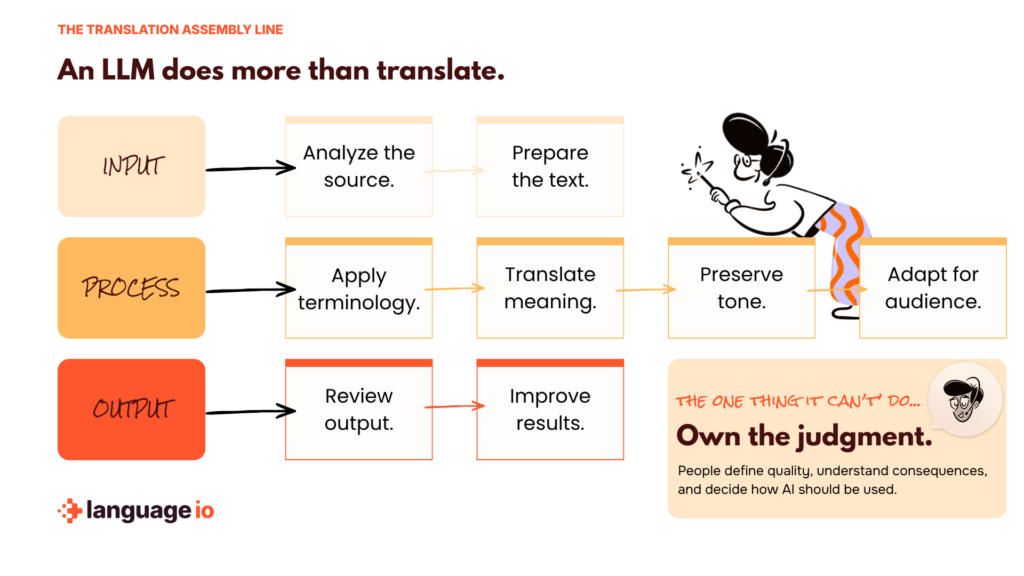
The mistake is treating the model as the whole workflow. The better approach treats it as a set of specialized workers, each pointed at the task it does best, with human expertise calibrating the standard and catching what the machine gets confidently wrong. That is how LLMs fail now. Not clumsily. Fluently. They produce a translation that reads perfectly and means something slightly off, and a fluent error survives a casual read in a way a clumsy one never would.
SHARE THIS POST
Key Takeaways

- LLMs contribute across the full translation pipeline, not just at the point of translation.
- Source quality, terminology, tone, and model selection all happen before a word is translated.
- Quality review and output improvement are themselves LLM jobs that run after translation.
- Human judgment is not a checkpoint — it is the architecture that makes the whole system accountable.
The 8 Jobs At-A-Glance
- Analyze the source
- Prepare the text
- Apply terminology
- Translate meaning
- Preserve tone
- Adapt for audience
- Review the output
- Improve results
TLDR
- An LLM contributes to translation in at least eight distinct ways: analyzing source content, preparing text, enforcing terminology, translating meaning, preserving tone, adapting for audience, reviewing output, and improving results over time. The job it cannot do is own the judgment about what quality means, what consequences matter, and how AI should be used. That job belongs to the people running the program.
BEFORE TRANSLATION
Setting the model up to succeed
Garbage in, garbage out is the whole game in translation. A model can only work with the text it is handed, and in customer support that text is a mess by default. Agents type on phones between chats. “THX” stands in for thanks, “u” for you, “acct” for account. Typos slip through, product jargon runs next to shorthand that no dictionary lists, and the grammar bends whichever way gets the message out fastest.
Feed that raw into a translation engine and it breaks. “THX” comes back untranslated, or turns into a word no reader recognizes. One garbled sentence becomes the same garbled sentence across all 155 languages you support.
Companies with expertise like Language IO manage this before translation starts. Translation Optimization reads the shorthand, fixes the typos, expands the abbreviations, and settles the non-standard grammar into text a model can translate cleanly. Fix the source once and the error stops multiplying downstream.
Terminology: One term, one translation
Terminology is where translation quietly goes wrong, and in regulated industries it goes wrong with consequences. A medical device company had instructions that read “inject this into your body.” In one target language, “body” came back in the sense of a corpse. The sentence was fluent. It was also telling a patient to inject a dead body, and a reader skimming the translation would never have flagged the source.

That is the failure terminology control exists to catch. A word with more than one sense picks the wrong one, or the same concept gets two names across a document, and the output reads clean while meaning something the writer never said.
An LLM enforces a glossary at a scale no manual review reaches. Give it your approved terms and their target-language equivalents and it holds the line on every segment, so “body” carries the sense you intended and the term you settled on in review is the term that ships every time.
DURING TRANSLATION
Cleaning the source gets you a sentence the model can translate. It does not tell the model how the sentence should sound. That is the next decision, and it is where two companies with identical source text should end up with different translations.
Industry and brand voice: sounding like the company that wrote it
A translation can be accurate and still wrong. A medical device manufacturer and a mobile game studio might send the exact same sentence, “please confirm you want to continue,” and a model translating both the same way has failed one of them. The device maker needs the formal register a regulated audience expects. The game studio wants the casual voice its players would recognize. Same words in, different translations out, and the difference is brand and industry, not accuracy.
An LLM handles this through prompting tuned to a company’s voice and its field. Feed the model the terminology, the register, and the tone rules for a given brand, and the translation comes out sounding like that brand wrote it in the target language, rather than like a machine that happened to get the words right.
Tone and register: a choice the source never made
Most languages force a decision English leaves open. Address one person or a formal audience and English says “you” either way. French makes you pick tu or vous. German splits du and Sie. Spanish, Japanese, Korean, and dozens more encode the relationship between speaker and listener directly in the grammar, and there is no way to translate the sentence without choosing.
Get the choice wrong and the translation insults the reader while every word stays technically correct. A support reply that addresses a customer with the familiar form can read as presumptuous in one market and friendly in another. The formal form reads as respectful in one context and cold in the next. The right call depends on the brand, the audience, and the norms of the specific locale, and it can flip between two markets that speak the same language.
An LLM holds this consistently once it knows the rule. Tell the model that a brand addresses customers formally in German and warmly in Brazilian Portuguese, and it applies that decision on every segment instead of guessing per sentence. The register stops drifting, and a reply that opens formally does not slide into casual grammar three lines down
What is model routing in AI translation?
Here is the assumption worth killing: that you pick the best translation model and use it for everything. There is no best model. There is a best model for German legal text, another for casual Brazilian Portuguese, another for Japanese honorifics, and they are rarely the same model. Lock yourself to one and you are accepting its weak language pairs to keep its strong ones.
Quality holds up when each job goes to the model that performs best on it. That means testing models against real content in each language pair and routing the work accordingly, rather than betting the whole operation on one vendor’s average performance. A model that trails on one pair may lead on the next, so the routing is a standing decision that shifts as models improve and new ones arrive.
This is the part most teams cannot build on their own. Evaluating models across 155 languages, keeping the comparisons current as the field moves, and routing each segment to the right one is infrastructure, not a setting you toggle. It is also the reason a model-agnostic approach beats a single-model one on quality, not just on principle.
AFTER TRANSLATION
The model has produced a translation. Now the question is whether it is any good, and at the volume of customer support, nobody can read every segment to find out. This is where an LLM stops being the translator and becomes the reviewer.
LLM as a judge: grading the output at scale
Total Quality Assessment used to mean a linguist scoring translations by hand, rating adequacy and fluency segment by segment. Accurate, and impossible to do across thousands of tickets a day. A model trained to run that assessment does it at the speed and volume the work actually moves at, scoring every segment instead of a sample.
One rule is not optional. The judge cannot be the model that did the translation. Ask a model to grade its own work and it rates itself high, because the same judgment that produced the translation is the judgment being asked to check it. It approves its own reasoning by definition. A separate model, trained specifically to evaluate rather than to translate, catches what the first one was blind to. Language IO trains its judge models for exactly this, kept apart from the models doing the translation.
Automated post-editing: fixing the output before a human sees it
A raw translation is a first draft. It carries the meaning but reads a little stiff, or picks a phrasing a native speaker would not, or applies the style guide unevenly. Historically a human editor smoothed all of that, one segment at a time, which is where post-editing cost piles up.
A second model can take the first pass. It refines fluency, aligns the text to the style rules, and resolves the small awkwardnesses that separate a translated sentence from one that sounds native, before the content reaches a person. The human who does step in is now approving a near-final draft instead of rebuilding a rough one, which is a faster and cheaper place to start.
Confidence scoring: pointing humans at the segments that need them
The last job an LLM does here is decide what it is unsure about. A model can score its own confidence segment by segment and flag the low-confidence ones, so review stops meaning “read everything” and starts meaning “read the parts that are actually at risk.”
That changes the economics of quality. A linguist reviewing every segment does not scale past a certain volume. A linguist reviewing the flagged 5 percent does, and they spend their time where the risk lives instead of confirming translations that were fine. The machine handles the volume. The human handles the doubt.
The expertise that you can’t automate
Read back over the workflow and count the jobs an LLM did. It cleaned up the source. It held terminology in line. It set the register, routed each segment to the right model, judged the output, post-edited the rough spots, and flagged its own doubts. That is a lot of a translation workflow running on models, and it is real. You can get close to publishable quality with LLMs alone.
Close is the operative word. Every one of those steps involves the model deciding what something probably means, and now and then it decides wrong in a way that reads perfectly. That is the failure mode worth fearing, because a clumsy error announces itself and a fluent one does not. “Inject this into your body” came back grammatically flawless and told a patient to inject a corpse. No confidence score catches that. No second model reliably catches it either, because the same blind spot that produced it can pass it. A person who knows the language and the subject catches it.
So the human linguist does not disappear as the models improve. Their job changes. They stop translating segment by segment and start doing the two things a model cannot do for itself: calibrate the standard, deciding what good means for this brand in this language, and fact-check the confident output, reading the flagged and high-stakes segments to catch the fluent mistakes that survive every automated check.
But the linguist is one role inside a larger one. Look at everything the workflow required: rubrics for the judge model, glossaries the enforcement model applies, prompts tuned per brand and locale, and a routing layer that knows which model wins on German legal text and which wins on Japanese honorifics. That is not the work of a translator. It is the work of a provider fluent in both linguistics and AI, because each half is useless without the other. Linguists without AI engineering cannot build the system. AI engineers without linguistic expertise cannot tell a good translation from a fluent wrong one. The rare thing, the thing worth partnering for, is both in one place.
Which is why one model is never the answer, and neither is one discipline. The best translator is not the best judge, and the judge cannot be the translator. The best model for German is not the best for Japanese. A workflow this good depends on matching each job to the model built for it, building the standards the models enforce, and putting human judgment where the models are blind. Language IO runs the multi-model architecture and the linguistic expertise as one system, across 155 languages, so the models do what they are good at and the people catch what the models cannot see.
| Job | What the LLM does | Where humans matter |
|---|---|---|
| 1Analyze the source | Flags ambiguity, complexity, and quality risk before translation runs | Defining what risk means for your content type and industry |
| 2Prepare the text | Applies terminology anchors, handles segmentation and structure | Maintaining and approving the terminology library |
| 3Apply terminology | Enforces approved term pairs consistently across translation output | Deciding which terms require enforcement and which allow flexibility |
| 4Translate meaning | Moves semantic content across language boundaries at scale | Reviewing edge cases where meaning is ambiguous or culturally loaded |
| 5Preserve tone | Reads source register and matches it in the target language | Defining brand voice standards that go into the system |
| 6Adapt for audience | Localizes for cultural context, routes content to the right model | Setting audience context, validating localization decisions by market |
| 7Review the output | Scores translations on accuracy, fluency, terminology, and tone | Defining quality thresholds; reviewing flagged content |
| 8Improve results | Uses confidence scores and feedback signals to refine output over time | Deciding what improvement means and whether the system is trending right |

FAQs
Questions? We’ve got answers.
Can LLMs replace human translators?
Not entirely, and the reason is specific. LLMs get close to publishable quality on their own, but they fail fluently. They produce a translation that reads perfectly and means something slightly off, and that kind of error survives a casual read. A human who knows the language and the subject catches what no confidence score and no second model reliably will. The human role shifts from translating segment by segment to calibrating the standard and fact-checking the confident output.
Why use a different LLM to judge output instead of the one that produced it?
Because a model asked to grade its own work rates itself high. The same judgment that produced the translation is the judgment being asked to check it, so it approves its own reasoning by definition. A separate model, trained to evaluate rather than to translate, catches what the first one was blind to
What is LLM as a judge in translation?
It is using a model to run Total Quality Assessment, the adequacy and fluency scoring a linguist used to do by hand. A trained judge model rates every segment at the speed and volume customer support actually moves at, rather than a linguist sampling a fraction of the output.
How do you keep terminology consistent across languages?
An LLM enforces an approved glossary on every segment, so a term does not drift into a synonym two lines later and a word with more than one sense does not pick the wrong one. Consistency at this scale is a machine problem, and it matters most in regulated content where a single wrong sense changes what the text tells the reader.
Why does model choice matter for translation quality?
Because no single model wins everywhere. The best model for German legal text is not the best for casual Brazilian Portuguese or Japanese honorifics. Matching each job to the model that performs best on it holds quality up across a full language set, which a single-vendor approach cannot do.
Do LLMs work on real customer support text?
Only after the source is cleaned up. Support messages arrive full of shorthand, typos, and non-standard grammar, and fed raw into a translation engine they break. Optimizing the source first, expanding the abbreviations and settling the grammar, is what makes the rest of the workflow reliable.
Discover More
-

The Magic Bullet is Dead. Long Live the Specialist.
For two years, the pitch fit on a slide. One model. Ask it anything. Watch it do everything. The general-purpose AI would write your code, run your meetings, answer your customers, and refactor the org chart then summarize it in a podcast.
-
AI Translation for Financial Services and Technology
Language IO provides financial services and technology companies with AI translation that can handle industry terminology, move fast enough for customer support, and protect the sensitive information inside every conversation. Organizations using AI translation need to understand what personal data is processed, why it is processed, where it goes, how long it is kept, which…