Published
AI translation for healthcare: The complete guide to accuracy, compliance, and patient safety
How can AI translation help healthcare organizations respond in real time across chat, email, voice, support cases, and digital portals?
A patient asks whether a new symptom is normal. A caregiver needs help using a medical device. A health plan member wants to understand why a claim was denied. When those conversations cross languages, the translation has to do more than sound natural. It has to preserve the meaning, protect sensitive information, and give the reader a clear next step. The quality of the result depends on the system surrounding the AI.
SHARE THIS POST
Key Takeaways

- The system around the AI matters as much as the AI itself. A fluent translation can still be wrong and in healthcare, a wrong translation that reads naturally is harder to catch than a broken one.
- Security and accuracy are separate problems. HIPAA compliance does not guarantee an accurate translation, and an accurate translation does not mean PHI was handled correctly. Both need their own controls.
In This Article:
- What AI translation for healthcare actually is
- Why accuracy requires more than a good model
- How translation errors affect patient safety
- What HIPAA compliance means for your vendor
- Where AI works and where it shouldn’t replace a human interpreter
- What to ask when evaluating a platform
TLDR
AI translation for healthcare uses machine translation and large language models to translate patient and customer communications at scale.
- A healthcare-ready platform should:
- Protect protected health information during processing
- State clearly whether content is stored or used for model training
- Apply approved medical and company terminology
- Evaluate translation quality
- Flag higher-risk content for human review
- Work inside approved service and communication platforms
- Support the organization’s HIPAA obligations
What is AI translation for healthcare?
AI translation for healthcare is the use of machine translation, large language models, and related quality controls to translate healthcare communications between languages.
Common uses include:
- Patient support conversations
- Appointment and scheduling messages
- Health plan and benefits questions
- Billing support
- Medical device troubleshooting
- Care coordination
- Patient portal messages
- Knowledge articles and educational content
The work may involve protected health information, medical terminology, or instructions that affect care. That raises the standard for both security and accuracy.
Is AI translation accurate enough for healthcare?
AI translation can support many healthcare communication workflows, but no model is equally accurate across every language, subject, and type of message.
A modern model may produce a sentence that reads perfectly while changing a small part of the meaning. That is harder to catch than a broken translation because nothing in the sentence looks wrong.
Healthcare translation accuracy depends on several controls.
Clean source text before translation
Healthcare support messages often contain typos, acronyms, voice transcription errors, and incomplete sentences. Consider this message:

A system needs to understand that “pt” means patient and “med” probably means medication. It also needs enough context to determine what changed and how that relates to the device.
Cleaning and clarifying the source gives the translation model a better sentence to work with. One unresolved abbreviation can otherwise become a different error in every target language.
Apply approved terminology
Medical words often have several possible translations. Product names, device components, treatment terms, insurance categories, and internal program names may require one approved version.
A healthcare glossary gives the system those decisions in advance. Terminology controls help prevent the same term from changing across conversations or taking on the wrong meaning in a medical context.
Choose the model for the job
There is no single translation model that performs best across every language pair. One model may be stronger with conversational Spanish. Another may handle German technical content better. Japanese honorifics, regional Portuguese, and clinical terminology create different problems.
Language IO uses a model-agnostic approach that can route translation work to different models based on language and content instead of sending everything through one engine. The wider workflow can also use models for source cleanup, terminology enforcement, quality evaluation, and review.
Check the output
The model producing a translation should not be the only system judging its quality. A separate evaluation model can score the output for meaning, fluency, terminology, and style. Lower-confidence or higher-risk segments can then be directed to a linguist.
That gives human reviewers a focused queue instead of asking them to read every routine support message.
How can translation affect patient safety?
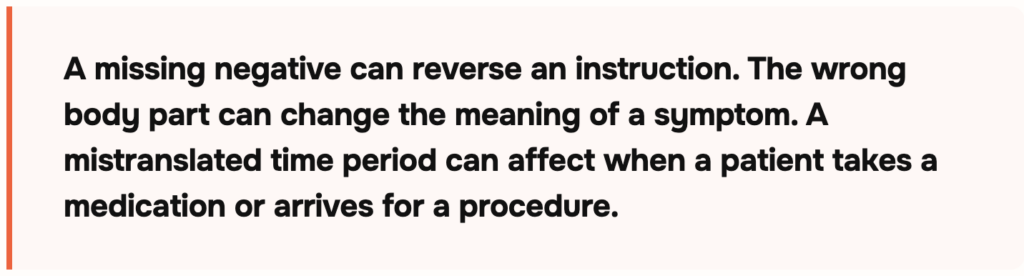
A translation error can change what a patient believes they should do.
Risk increases when a message contains:
- Medication instructions or dosages
- Timing and frequency
- Symptoms or contraindications
- Procedure preparation
- Device instructions
- Follow-up steps or warnings
- Time-sensitive guidance
The tone also matters. Some languages require the translator to choose between formal and familiar forms of address. The wrong choice can sound disrespectful, cold, or overly casual.
A safe system needs linguistic controls that account for the subject, audience, and locale.
Is AI translation HIPAA compliant?
AI translation can be used within a HIPAA-compliant workflow when the healthcare organization and its vendors meet the applicable requirements. HIPAA compliance depends on the complete implementation. It includes the technology, contracts, internal policies, access controls, risk analysis, and the way employees use the system.
The U.S. Department of Health and Human Services states that a covered entity or business associate may use a cloud service to process electronic protected health information when it has an appropriate Business Associate Agreement with the provider and otherwise complies with the HIPAA Rules.
Healthcare organizations evaluating an AI translation provider should ask:
- Does the service store source text or translated output?
- Is customer content used to train AI models?
- Which subprocessors receive the content?
- How is data protected while it moves through the system?
- Will the vendor enter into an appropriate Business Associate Agreement?
- How are user access and system activity controlled?
- How is translation quality measured?
- What happens when the system is unsure?

How does Language IO protect healthcare translation data?
Language IO describes its platform as HIPAA-aligned and built for sensitive enterprise communications. Its security architecture includes the following controls.
Zero Data Retention
Language IO states that source content and translated output are removed after the translation is returned. The content is not kept in Language IO databases or logs. This limits how much sensitive information remains inside the translation environment after processing.
No customer-data training
Language IO states that customer translations are not retained or used to train AI models. That rule applies to the translation workflow rather than asking customers to exchange privacy for model improvement.
Protected processing
Language IO says it uses encrypted connections and protects personal data before sending content to approved translation subprocessors. Once the translation is completed, the original and translated content are scrubbed from Language IO and subprocessor systems.
Audited security and AI governance
Language IO’s published security program includes:
- ISO 27001
- ISO 42001
- SOC 2 Type II
- Quarterly penetration testing
- Weekly vulnerability scanning
- Ongoing intrusion detection and prevention
ISO 27001 covers the management of information security. ISO 42001 covers the management and oversight of AI systems, including risk, accountability, monitoring, and data protection. These controls support vendor review. They do not replace a healthcare organization’s own HIPAA analysis or contractual requirements.
Healthcare AI translation compared with a consumer tool
| Capability | Healthcare-ready AI translation | Typical consumer translation tool |
|---|---|---|
| Intended use | Enterprise and sensitive communications | General personal use |
| PHI handling | Evaluated as part of a controlled healthcare workflow | May prohibit or limit sensitive data |
| Data retention | Defined in security documentation and contracts | Varies by product and account type |
| AI training | Customer content excluded | Terms may permit reuse |
| Business Associate Agreement | Confirmed during vendor review when applicable | Often unavailable |
| Medical terminology | Managed glossaries and approved terms | Limited controls |
| Quality evaluation | Translation scoring and review workflows | Usually self-service |
| Human review | Available for higher-risk content | Usually unavailable |
| System integration | Embedded in approved service platforms | Often requires copy and paste |
| Security evidence | Audits, certifications, testing, and documentation | Varies widely |
“Consumer tool” covers many different services. The exact terms must be checked for each product and plan.
Where can healthcare organizations use AI translation?
AI translation works best in repeatable communication workflows where speed matters and the level of risk can be defined.
Patient and member support
Agents can respond to common questions about appointments, billing, coverage, account access, and service issues in the patient’s language.
Medical device support
A translation system can apply approved product and component terms while agents help customers with setup, troubleshooting, maintenance, or use.
Digital health platforms
Translation can be added to authenticated portals, support applications, chat experiences, and other digital services through integrations or APIs.
Knowledge content
Organizations can translate support articles and routine educational content at scale. Clinical instructions and other high-risk materials may need a separate review process.
Voice and live service
Real-time translation can help contact center teams support more languages without transferring every interaction to a bilingual agent. Organizations still need clear rules for situations that require a qualified interpreter.
Can AI replace medical interpreters?
AI translation is useful for routine customer support and many written communications. It should not be treated as a replacement for qualified medical interpreters in every situation.
A live clinical encounter may involve informed consent, a diagnosis, treatment decisions, legal rights, or urgent symptoms. Those conversations may require a qualified interpreter under the organization’s policies and applicable law.
What should a healthcare AI translation platform include?
A serious evaluation should cover four areas.
Security
The vendor should document retention, encryption, subprocessors, model training, access controls, incident response, and independent audits.
Translation quality
The platform should support medical terminology, context, regional language differences, quality scoring, and human review.
Workflow fit
The translation should happen inside the systems employees already use. Copying patient messages into an unapproved public tool creates an avoidable security gap.
Governance
The organization should be able to define which content can be translated automatically, which content requires review, and which situations must be routed to a human interpreter.

FAQs
Questions? We’ve got answers.
Does Language IO store patient conversations?
No. Translation content is processed in real time and removed after delivery. We do not store source or translated content in our databases or logs.
Do you use healthcare data to train AI?
No. We do not use customer translation content to train our models.
Is Language IO HIPAA compliant?
Our platform is built to align with HIPAA requirements. We protect health information through encrypted processing and Zero Data Retention. Your organization’s compliance also depends on your contract, implementation, risk analysis, access controls, and any required Business Associate Agreement — we work through all of that with you during onboarding.
Is Zero Data Retention required by HIPAA?
No, HIPAA does not mandate a specific technical design. Zero Data Retention reduces the amount of sensitive content left behind after processing, and it operates alongside the contracts, policies, safeguards, and risk management your workflow requires.
Can Language IO translate medical terms accurately?
Yes, when the system has the right context and approved terminology in place. A general-purpose model may default to a common meaning that does not fit the healthcare context. Our glossary controls and quality review process reduce that risk significantly.
Can our employees use free translation websites?
We strongly advise against entering PHI into any unapproved service. Before using any translation tool, your organization should review its data use, retention practices, security posture, subprocessors, access controls, and BAA availability.
Google Translate does not offer a Business Associate Agreement for standard consumer accounts, which means it cannot be used to process PHI under HIPAA without separate arrangements
Discover More
-

The Magic Bullet is Dead. Long Live the Specialist.
For two years, the pitch fit on a slide. One model. Ask it anything. Watch it do everything. The general-purpose AI would write your code, run your meetings, answer your customers, and refactor the org chart then summarize it in a podcast.
-
AI Translation for Financial Services and Technology
Language IO provides financial services and technology companies with AI translation that can handle industry terminology, move fast enough for customer support, and protect the sensitive information inside every conversation. Organizations using AI translation need to understand what personal data is processed, why it is processed, where it goes, how long it is kept, which…