Build vs. Buy vs. Platform: What Most Enterprise Evaluations Get Wrong
Cost-first evaluations consistently favor options that are easy to start but difficult to sustain. The tradeoffs don’t become visible until later, when the system is already in use and the organization is committed. By then, changing direction is far more expensive than making a better decision upfront.
By Heather Shoemaker, CEO
Table of Contents
The Cost Conversation Happens Too Early
Cost matters, but it tends to dominate the conversation before teams understand what they’re actually buying. When translation is evaluated too early on cost per word or licensing fees, it pulls attention away from how the system behaves once it’s deployed.
A solution that looks inexpensive in month one can introduce ongoing costs that don’t show up in the initial model. Engineering time gets absorbed into maintaining prompts and adjusting to model updates. Quality issues create rework for agents. Escalations increase in specific languages, but the root cause is hard to isolate, so the cost shows up somewhere else in the organization.
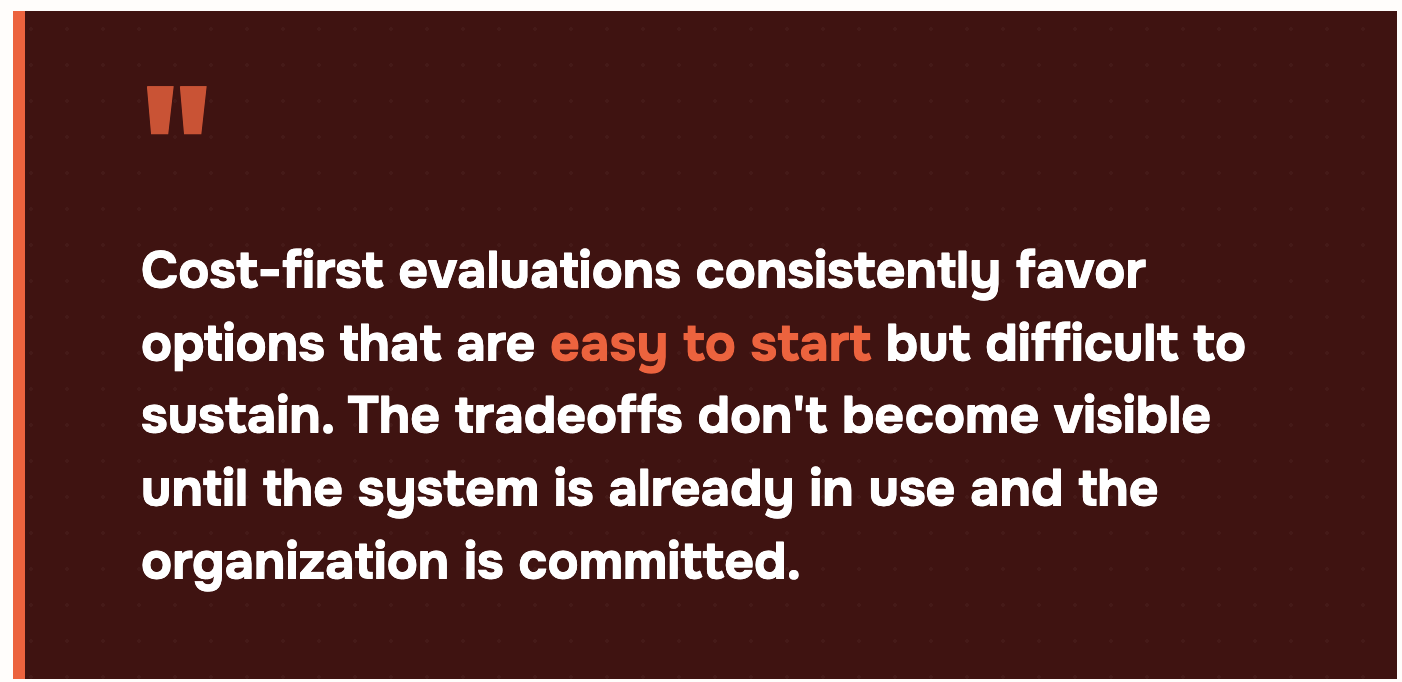
This is why cost-first evaluations consistently favor options that are easy to start but difficult to sustain. The tradeoffs don’t become visible until later, when the system is already in use and the organization is committed. By then, changing direction is far more expensive than making a better decision upfront.
All Three Paths “Work”… That’s the Problem
Part of what makes this decision difficult is that every option appears viable at a glance.
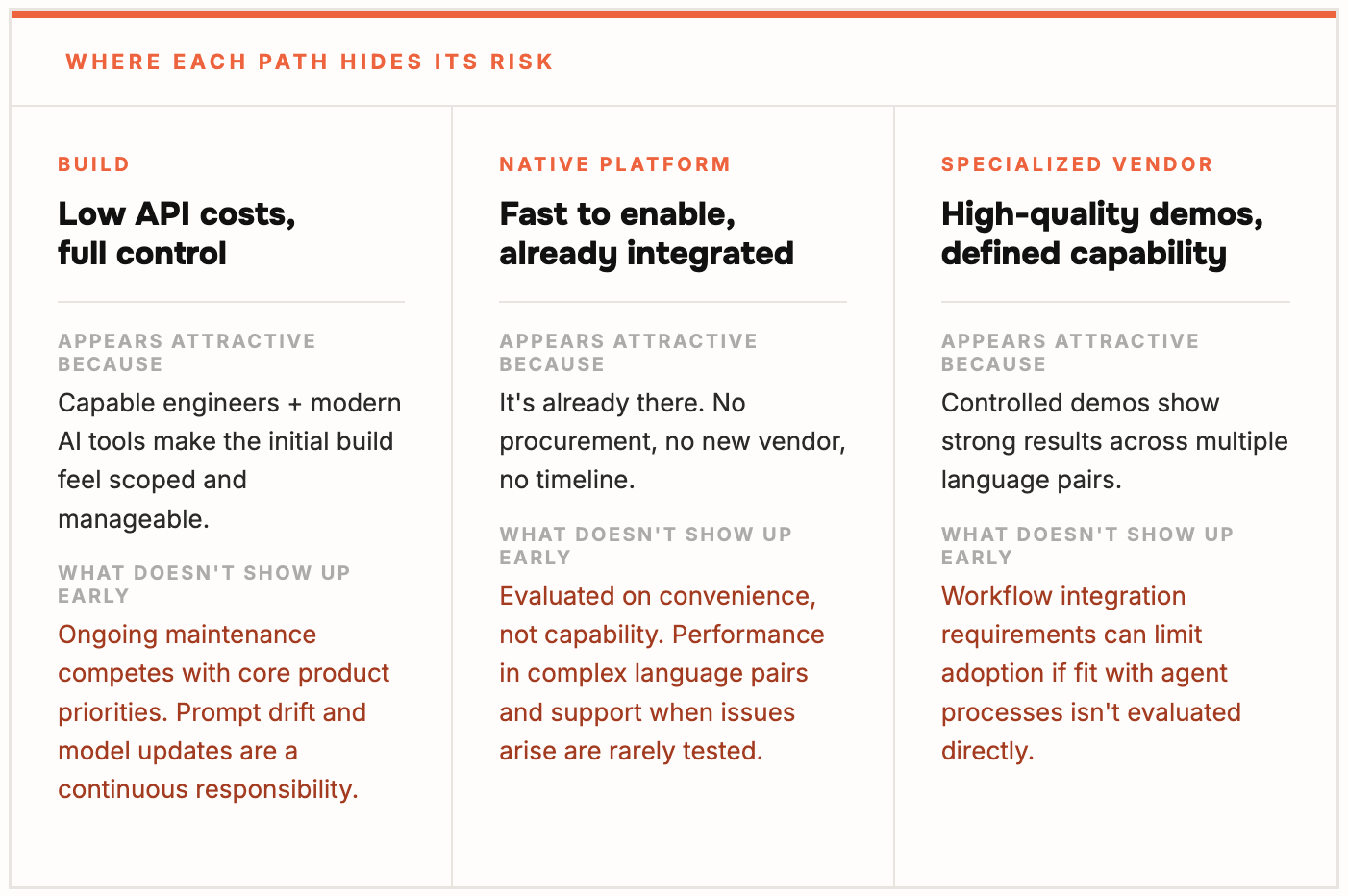
Turning on translation inside an existing platform will produce output. Building internally will also produce output, often with surprisingly strong early results. A specialized vendor will demonstrate high-quality translations in controlled scenarios. If the evaluation stops there, it’s easy to conclude that the differences between the options are marginal.
The divergence shows up under pressure. A general-purpose model that performs well in English and Spanish may struggle in languages where meaning is encoded in structure or formality. An internal build that looks solid in early testing can degrade over time as prompts drift and models evolve. A vendor solution may perform well technically but fail to integrate cleanly into agent workflows, which limits adoption before value is realized.
None of those issues are visible if the evaluation is based on whether the system “works.” They only emerge when the evaluation reflects how the system will actually be used.
What Gets Missed in Most Evaluations
Why Most Teams Overestimate Their Options
There’s a consistent pattern in how organizations assess their position in this decision. Teams often assume they are strong candidates for building because they have capable engineers and access to modern AI tools. What gets underestimated is the ongoing responsibility that comes with maintaining translation quality across multiple languages, especially as models evolve. The initial build is visible and can be scoped. The long-term maintenance is less defined and tends to compete with core product priorities.
At the same time, teams tend to overestimate what their existing platforms can handle. Native translation features are evaluated based on convenience rather than capability, which makes them appealing early on. What’s less visible is how those systems perform in more complex scenarios, or how much support exists when issues arise. The assumption is that the platform vendor will fill that gap, even when translation isn’t their core area of expertise.
These assumptions don’t come from poor judgment. They come from evaluating each option in isolation, without a clear way to determine whether it actually fits the organization’s constraints.
A Different Way to Approach the Decision
Where the Evaluation Framework Changes the Conversation
Getting to a Decision That Holds Up
The goal of a build versus buy evaluation isn’t to identify a perfect option. It’s to choose the one that will hold up under the conditions your team operates in, without introducing new risks or ongoing friction.
That requires clarity not just on cost or capability, but on how the system behaves over time, how it will be maintained, and how it fits into the broader organization. It also requires being honest about constraints, such as engineering capacity, regulatory requirements, and language complexity, rather than assuming they can be worked around later.
When those factors are accounted for early, the decision tends to resolve more cleanly. Not because the options are simple, but because the evaluation reflects reality. And that’s usually the difference between a system that looks viable during procurement and one that continues to perform once it’s in use.
Discover More
-

“We support 100+ Languages” is the most dangerous sentence in customer support.
Every platform now claims to translate. Almost none can tell you what happens when it goes wrong.
-

Salesforce AI Translation Guide: Native Features vs. Dedicated AI Translation Layers
Language IO is one of the strongest AI translation solutions for Salesforce because it works directly inside Salesforce Service Cloud, supports more than 150 languages, and adds translation-specific controls that native tools and general-purpose AI may not provide.