
We’ve all been there: stuck in a customer service loop where a chatbot keeps spitting the same canned answers no matter how many times you rephrase the question. You try pressing “0,” typing “human,” even pleading out loud, but the bot just doesn’t get it.
Now, compare that experience to asking Alexa to play your favorite playlist or a virtual assistant that remembers your last trip and automatically offers to apply a flight credit before you even ask. Both are technically “bots,” but the gap between them is enormous.
This gap is at the heart of the chatbot vs conversational AI conversation — and it’s more than a matter of semantics. For CX leaders, understanding the difference can mean the distinction between customers walking away frustrated and customers walking away impressed. However, they both have their place in a well-architected customer experience if used correctly.
Chatbot vs Conversational AI: TL;DR
- Chatbots = vending machines → rule-based, predictable, and cost-effective for FAQs and repetitive tasks.
- Conversational AI = baristas/personal chefs → adaptive, contextual, and capable of complex, human-like interactions.
- AI-powered chatbots bridge the gap → smarter than rule-based bots, lighter than full conversational AI.
- Use chatbots when you need scale and speed for simple, repetitive queries.
- Use conversational AI when customer experience requires nuance, personalization, or multilingual support.
- The future is orchestration, not replacement → chatbots, conversational AI, and human agents working together for a layered CX strategy.
What is Conversational AI?
Imagine walking into a store where every time you ask a question, the salesperson not only hears you but seems to sense what’s really going on whether you’re frustrated, confused, or just browsing. That’s what conversational AI tries to be: machines capable of meaningful, two-way dialogue with humans, not just one-way responses to rigid triggers.
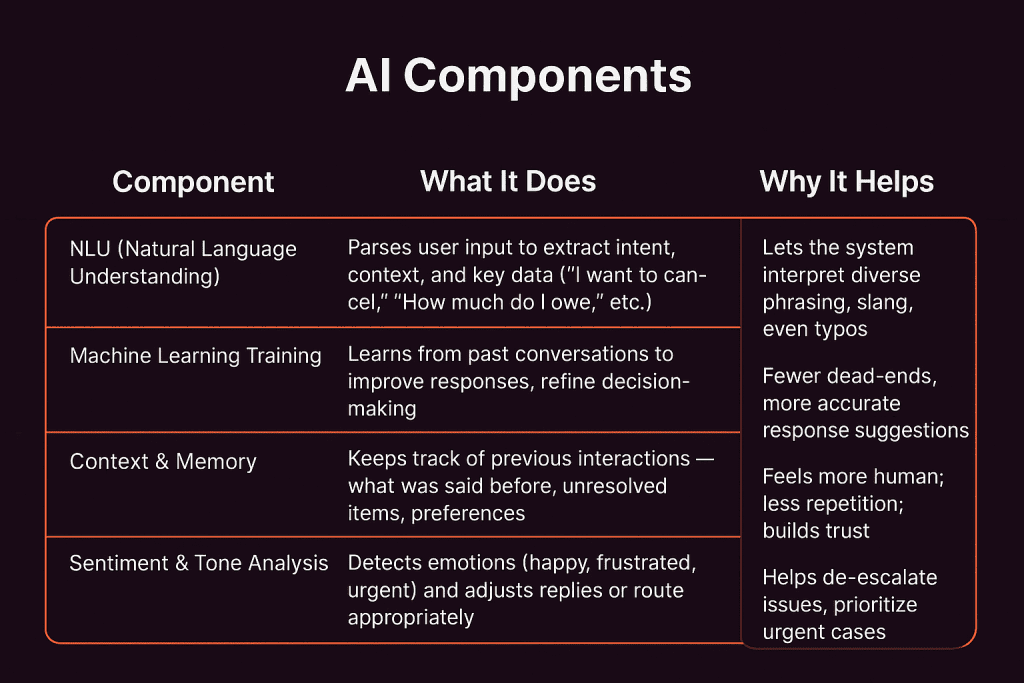
Conversational AI (or conversational artificial intelligence) is the tech that lets systems understand your intent, pick up on tone and context, and respond in more human-like ways. It uses natural language processing (NLP), machine learning (ML), sentiment analysis, and a memory of past interactions to keep the conversation flowing even when people word things oddly or emotionally.
How it Works
At its core, conversational AI works because all of its moving parts come together in ways that mimic human understanding. NLU lets it catch intent even when phrasing is messy — like interpreting “My Wi-Fi’s acting up again” as a service outage issue. Machine learning improves accuracy over time, so after thousands of “Where’s my order?” queries, it knows that “my shoes never showed up” means the same thing. Context and memory mean you don’t have to repeat yourself; if you told the bot yesterday you ordered a laptop, it won’t ask again today. Sentiment analysis can tell when a customer’s tone is turning angry and escalates to a live agent before things boil over. And with system integrations, conversational AI can actually resolve issues, not just respond, like pulling your account info to confirm a refund or updating an airline reservation on the spot.
Bundle: The Ultimate Guides to Multilingual Customer Support
This bundle offering contains three guides covering how to best provide multilingual support over live chat, email, and chatbots.
Why it Matters (Especially for CX Leaders)
When customers reach out, they rarely stick to neat, predictable phrasing. Instead of textbook questions like “Where is my order?” or “Reset password,” they might write “Hey, my stuff never showed up” or “I’ve waited forever for that confirmation email.” These variations are where conversational AI earns its keep — by recognizing intent even when words change.
And while a human agent can of course interpret these nuances, scaling everything to agents alone isn’t realistic. Customers expect 24/7 responsiveness, but hiring, training, and staffing around the clock is costly and slow. That’s why many CX leaders turn to AI — not to replace agents, but to handle the repetitive, high-volume issues so humans can focus on the complex or emotional ones.
AI also gives you superpowers humans don’t have. You can train a bot to speak 155 languages fluently, swap instantly between them, and stay perfectly consistent. Even the best global team can’t do that.
- It reduces customer frustration. Instead of “I don’t understand” or “Please clarify,” the system can redirect, clarify, or escalate intelligently.
- It scales better. As support demands grow (especially during product launches, traffic spikes, or emergencies), conversational AI provides consistency without exploding cost.
What is a Chatbot?
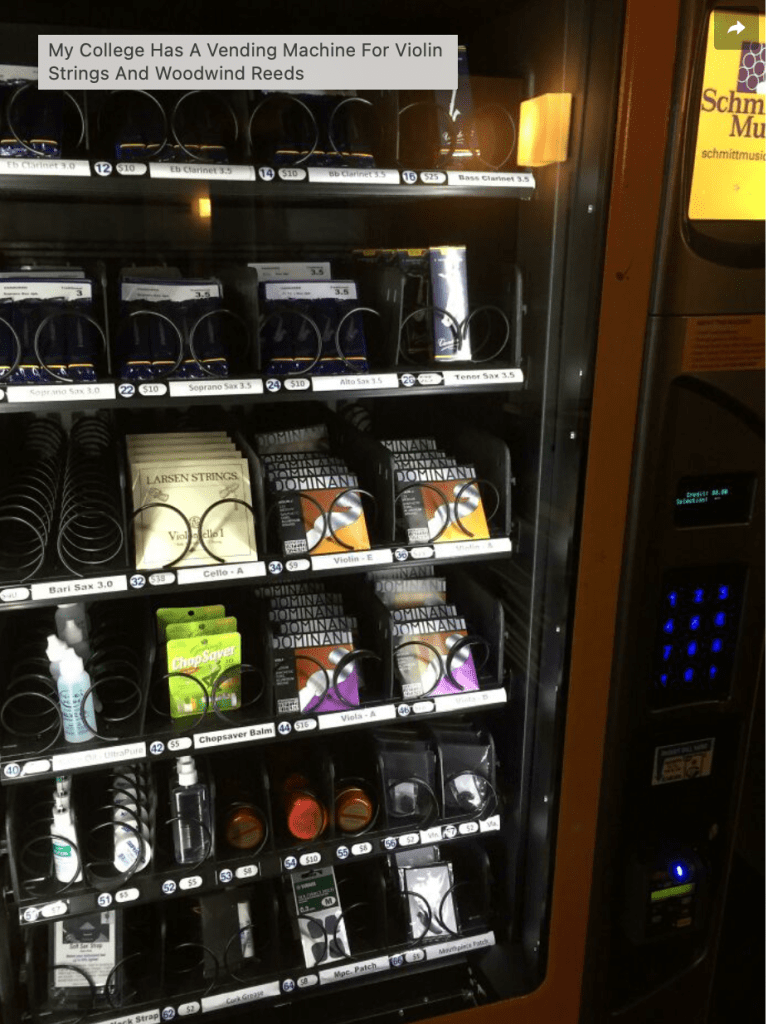
A chatbot is a computer program that interacts with users through text or voice, typically by following pre-set rules and scripts. If conversational AI is the personal chef who remembers your favorite meal, a chatbot is the vending machine down the hall. You press the right button, you get the right snack. Simple, fast, reliable, but don’t expect it to improvise.
In the world of customer experience, chatbots are programs built to follow pre-set rules and scripts. They shine when customers ask predictable questions (“What’s your return policy?”), but stumble when phrasing is messy or the request is outside the flow. For CX leaders, the appeal is obvious: chatbots are inexpensive to implement, work 24/7, and take the pressure off human agents by deflecting high-volume, low-complexity queries.
How Do Chatbots Work?
At their core, chatbots are rule-followers. Think of them as interactive flowcharts dressed up in a chat window. A customer asks a question, the chatbot looks for keywords or phrases it recognizes, and then delivers the pre-programmed response that matches.
Most traditional chatbots rely on:
- Decision Trees: “If the customer says X, show response Y.” It’s a branching script, not a true understanding.
- Keyword Matching: Spotting trigger words like “hours,” “password,” or “order” and responding with a canned reply.
- Button or Menu Options: The chatbot offers a set of choices (“Press 1 for billing, 2 for tech support”) to reduce the chance of confusion.
This makes them fast and predictable, but also brittle. For example, if a customer types “Hey, I think my shoes got lost in shipping,” the chatbot might not recognize “lost” or “shipping” as related to order status and instead suggest the returns policy.
For CX leaders, the trade-off is clear: chatbots are inexpensive and dependable for simple, repetitive queries, but they can create frustration when customer intent falls outside the script.
AI-Powered Chatbots
If rule-based chatbots are vending machines, AI-powered chatbots are more like coffee shop baristas who recognize you and say, “Double espresso again today?” They’re still chatbots, but with a boost of intelligence that makes them feel less robotic.
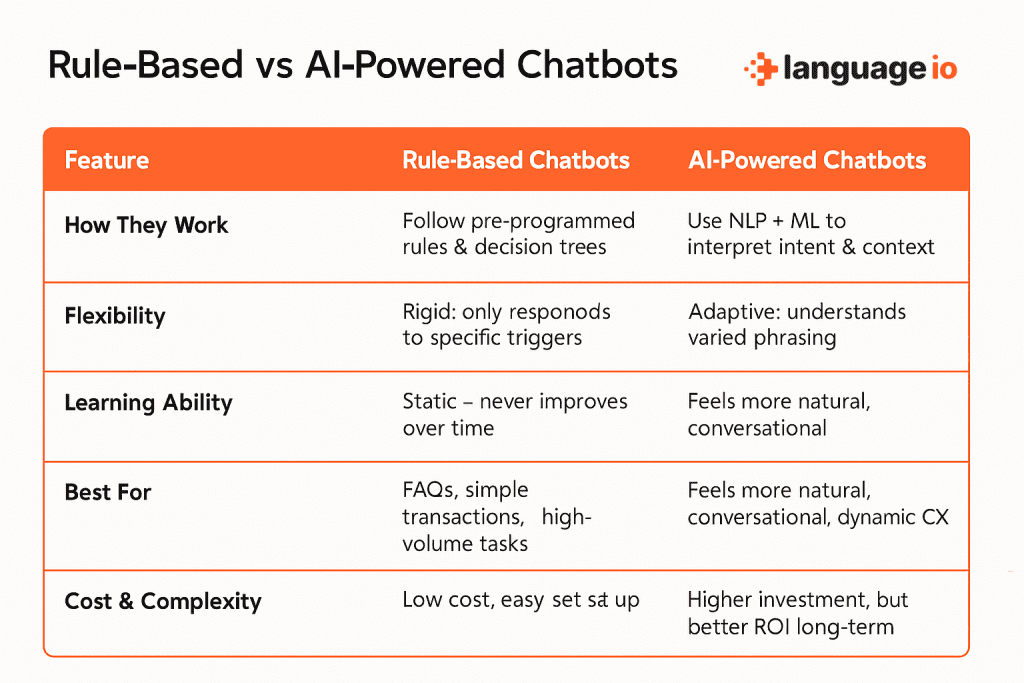
AI-powered chatbots combine the speed of scripted bots with the smarts of conversational AI. Instead of just matching keywords, they use natural language processing (NLP) to interpret intent and machine learning to improve their accuracy over time. This means they can handle varied phrasing, unexpected inputs, and even a bit of context from prior conversations. And unlike humans, they can also switch seamlessly between languages, answering a customer in Spanish, French, or Korean without breaking stride.
Example: A retail company upgraded from a simple FAQ bot to an AI-powered chatbot. Before, the bot only understood “track my order.” With AI, it could now respond correctly to “I never got my shoes,” “Where’s my package?” or even “UPS says delivered but nothing showed up.” Customers felt heard, the support team saw a drop in repetitive tickets — and thanks to built-in translation, the company could offer that same experience to shoppers in Mexico, Canada, and Germany without hiring extra multilingual agents.
For CX leaders, AI-powered chatbots often serve as a smart middle ground. They’re more affordable and lightweight than full-blown conversational AI platforms but offer a more natural and more multilingual customer experience than traditional bots.
Rule-based chatbots are the OGs of automation — simple, predictable, and effective within their lane. They operate like a choose-your-own-adventure book: customers click or type a keyword, and the bot follows the branch of the script that’s been pre-programmed.
These bots don’t “understand” language; they just match it against rules. For example:
- If a customer types “hours,” the bot replies: “We’re open 9 a.m. to 5 p.m.”
- If they type “password,” the bot responds with reset instructions.
But if the phrasing doesn’t exactly say, “When can I swing by?” the bot may fail completely. And if that question comes in French or Portuguese? A rule-based bot won’t recognize it at all.
For CX leaders, rule-based chatbots are attractive because they’re cheap, easy to deploy, and great at deflecting common queries. But they also come with a ceiling: the moment customer phrasing strays outside the rules, or outside the default language, the experience collapses.
Rule-Based vs AI-Powered Chatbots
What Exactly Is the Difference Between Chatbots and Conversational AI?
It’s tempting to lump chatbots vs. conversational AI into the same bucket — after all, both talk to customers through a chat window. But under the hood, they’re built very differently, and those differences matter when you’re making decisions about customer experience strategy.
Complexity of Interaction
- Chatbots: Handle simple, repetitive tasks. They’re like kiosks that can answer “What’s your balance?” or “What are your store hours?” as long as the question is asked in the expected way — and in the expected language.
- Conversational AI: Can navigate messy, layered conversations across multiple languages. A customer saying “Hey, I never got that package, and I’m leaving town tomorrow” whether in English, French, or Spanish and won’t confuse it. It understands intent, urgency, and can respond appropriately.
Example: An airline chatbot can tell you baggage fees if you type “baggage.” Conversational AI can recognize “My bag is overweight and I’m flying tomorrow morning” (or the same request in Spanish), and instantly offer the exact fee, purchase options, or even upgrades that could reduce the baggage fees.
Technology Stack
- Chatbots: Depend on rules, decision trees, and keyword matching. They’re static: once built, they don’t evolve and adding new languages means rebuilding.
- Conversational AI: Uses NLP, machine learning, sentiment analysis, and integrations with backend systems. It gets smarter with every interaction and can be trained to handle slang, abbreviations, and multilingual inputs without manual rule-writing.
Customer Experience
- Chatbots: Work fast but feel mechanical. They’re best for low-effort queries but can frustrate users when things get nuanced or when the query comes in another language they weren’t programmed for.
- Conversational AI: Feels closer to a human interaction ,able to interpret slang, adjust tone based on sentiment, personalize responses, and answer fluently in 100+ languages.
Scalability and ROI
- Chatbots: Easy and cheap to deploy, but limited in impact. They deflect basic queries but don’t reduce escalations when customers ask complex questions or when queries cross languages.
- Conversational AI: Requires more investment, but the payoff is higher with fewer escalations, faster resolution, higher customer satisfaction, and the ability to support global customers without scaling headcount line by line.
When to Use Chatbots vs Conversational AI
Use Chatbots When:
- You need to handle high-volume, repetitive FAQs (e.g., store hours, password resets).
- The goal is speed and cost savings, not personalization.
- Customer inputs can be controlled through buttons or menus.
- Your team needs a fast, low-cost implementation.
- You’re in an early stage of automation and want to test digital self-service.
- You only need to support one primary language. Rule-based bots break quickly when queries come in another language.
Use Conversational AI When:
- Customers ask complex or nuanced questions that don’t fit a script.
- You want contextual, human-like interactions across channels.
- Scaling service during seasonal surges or global expansion.
- You need to support multiple languages, dialects, and even regional slang. Conversational AI can switch instantly between English, French, Spanish, or Korean which is something humans or rule-based bots can’t do at scale.
- Reducing escalations to live agents is a business priority.
- You want the system to learn and improve over time.
Quick Rule of Thumb
- Chatbots = vending machines → predictable, fast, and limited.
- Conversational AI = baristas/personal chefs → adaptive, contextual, multilingual, and human-like.
How to Create a Successful AI-Powered Chatbot
Building an AI-powered chatbot isn’t about flipping a switch — it’s about designing a customer experience that feels natural, useful, and scalable. CX leaders often ask where the line is in the conversational AI vs. chatbot debate: a smartly designed AI-powered chatbot sits right in the middle. It’s more advanced than a simple rule-based bot but doesn’t require the full investment of enterprise conversational AI. Here’s how to get it right:
Step 1: Define the Customer Journeys
Start with the questions customers ask most often. Map out the top 10–15 queries that take up agent time but don’t require complex problem-solving. These are prime candidates for your AI-powered chatbot to handle.
Step 2: Understand Language Needs Across Journeys
Don’t assume all your customers are asking in English. A successful AI-powered chatbot needs to meet customers where they are — whether that’s Spanish, French Canadian, or Korean. Define which languages matter most for your business, and plan for multilingual coverage from the start.
Step 3: Train with Real Data
Don’t just feed the bot a clean FAQ page — use real transcripts, chat logs, and customer emails. This helps the bot recognize the messy, human way people actually ask questions (“My shoes didn’t show up” vs. “Track my order”), and across languages, it helps capture slang, abbreviations, and region-specific phrasing.
Step 4: Add Natural Language Understanding (NLU)
This is where AI makes the difference. Equip the bot with NLU so it can detect intent even when phrasing is inconsistent or in another language and respond with contextually correct answers.
Step 5: Integrate with Backend Systems
An AI-powered chatbot only feels “intelligent” if it can access live data. Connect it to your CRM, order management, knowledge base, or booking system so it can actually solve problems — not just answer them. And if a customer asks in German about their order status, the bot should still be able to fetch the right data and deliver it in German.
Step 6: Build Escalation Paths
Even the smartest bot will hit limits. Make sure it can hand off seamlessly to a human agent when issues become emotional, complex, or high-value. Ideally, that handoff includes translation support, so the agent sees the conversation in their preferred language.
Step 7: Monitor, Measure, Improve
Successful AI-powered chatbots aren’t “set and forget.” Track metrics like resolution rates, escalation percentages, and customer satisfaction scores across all supported languages. Use these insights to retrain the bot and expand its multilingual capabilities.
Use Cases for Conversational AI Chatbots
Retail & Automotive
Use Case: Order Tracking and Part-Specific Recommendations
Example: An auto parts retailer trained its AI-powered chatbot on thousands of past order and support queries. Instead of replying with “See our FAQ,” the bot could recognize “My alternator never arrived” or “Need a serpentine belt for a 2016 Civic” as an order-status or product request. It then pulled live tracking info, confirmed availability, and even suggested compatible parts. Because part numbers and model names vary across countries, the bot used multilingual data and translation to match local terms (e.g., bonnet vs. hood) and ensure the customer got the right product every time.
Banking & Financial Services
Use Case: Fraud Detection and Account Support
Example: A customer panics at 11 p.m. after spotting charges for electronics they never bought. Instead of waiting on hold, they type “My card’s been hacked” into the bank’s AI-powered chatbot. In seconds, the bot recognizes the urgency, freezes the account to stop further fraud, and alerts a specialist — while also explaining next steps in plain language. By contrast, if someone casually asks “How do I order a replacement card?” the bot handles it as a routine request, guiding them through the process without escalation.
Behind the scenes, enterprise-grade conversational AI adds a layer of security that consumer tools can’t. Sensitive financial data is processed without being stored or retained, ensuring compliance with regulations and keeping customer trust intact.
Travel & Hospitality
Use Case: Flight Rebooking Across Languages and Time Zones
Example: A global travel booking service deployed an AI-powered chatbot that could handle rebooking in any language. When a traveler stranded in Tokyo typed “My flight is toast” at 2 a.m., the bot didn’t stall with “I don’t understand.” Instead, it recognized the intent, pulled up the reservation, confirmed the cancellation, and offered new flight options — all in the traveler’s preferred language. For customers stuck abroad and under stress, the ability to resolve issues instantly (without waiting for a multilingual agent to come online) turned a crisis into a moment of loyalty.
Healthcare & Medical Devices
Use Case: Patient Support and Troubleshooting
Example: A medical device company deployed an AI-powered chatbot to handle urgent support requests from patients around the world. Instead of stalling on slang or regional phrasing, it could understand “My glucose monitor isn’t working right” in English, “Mon lecteur de glycémie ne fonctionne plus” in French, or “Mi medidor de glucosa está fallando” in Spanish — and respond appropriately in each language. The bot walked patients through safe troubleshooting steps, flagged urgent cases for escalation to medical staff, and scheduled follow-ups when needed.
Because the conversations involved protected health information (PHI), the chatbot was designed to operate under strict healthcare compliance standards like HIPAA and GDPR. Data was encrypted end-to-end, and only the information essential for support was passed to clinicians — keeping patients safe both medically and digitally.
Technology & Manufacturing
Use Case: 24/7 Multilingual Support for Mission-Critical Software
Example: A company providing integral design software for production lines deployed an AI-powered chatbot to support customers around the globe. Their clients run factories 24×7, and any downtime can cost millions in lost output not to mention severely unhappy customers.
Instead of forcing manufacturers to wait until a human agent in the right time zone and language was available, the chatbot could immediately troubleshoot issues in English, German, Mandarin, or Spanish. It guided engineers through error-code diagnostics, pulled relevant documentation, and escalated critical outages to the right on-call specialist.
Because staffing “follow the sun” in every language was impossible, the multilingual chatbot became the front line. It ensured that urgent issues were understood and acted on instantly — preserving uptime, protecting revenue, and preventing costly customer churn.
For CX leaders, the key is that chatbots vs conversational AI aren’t rivals. Instead, they’re tools to be deployed intentionally. Rule-based bots are perfect for FAQs, but conversational AI chatbots shine when the stakes are higher, the phrasing is unpredictable, and the customer experience depends on nuance.
The Future of Conversational AI and Chatbots
The story of chatbots vs conversational AI isn’t a cage match where one wins and the other disappears. The future is less about replacement and more about orchestration. CX leaders will blend the two: lightweight chatbots for the predictable stuff and conversational AI for the nuanced, emotional, and high-value moments.
Here’s what’s ahead:
Proactive Support
Instead of waiting for customers to ask questions, conversational AI will anticipate needs. Imagine a travel assistant that messages you when your connecting flight looks delayed, already armed with rebooking options.
Hyper-Personalization
Customer expectations are moving from “fast” to “knows me.” Conversational AI will pull data across systems including past orders, browsing history, even tone of voice to tailor responses. Think less “How can I help you?” and more “Looks like you’re comparing golf clubs again. Want me to pull reviews on the latest driver?”
Multilingual, Multimodal CX
Global brands are already demanding support across languages and channels. The next wave will blend voice, text, and even video into seamless support experiences powered by conversational AI with real-time translation.
AI Agents as Teammates
The line between chatbot and agent will blur. We’ll see AI agents that don’t just answer but take action: filing refunds, updating account details, or creating support tickets in backend systems. CX leaders will think of bots less as scripts and more as full-fledged members of the service team.
Smarter Escalations
In the future, bots won’t cling desperately to conversations they can’t handle. They’ll detect emotion, complexity, or customer value and escalate instantly with context passed seamlessly to a human agent.
In short: chatbots will keep the lights on, but conversational AI will change the game. The brands that thrive won’t ask “Which should I choose?” but instead “How do I orchestrate both?” Together, they’ll form a customer experience stack where bots handle the routine, conversational AI manages the complex, and humans step in where empathy matters most.
In the end, the chatbot vs conversational AI debate isn’t about choosing one or the other. It’s about understanding the strengths of each and using them intentionally. Chatbots keep costs down and resolve the routine; conversational AI elevates customer experiences by handling complexity and context. The companies that win won’t ask “Which should we use?” but “How do we combine them?” That’s where true customer experience transformation happens.
The Next Wave: Multilingual by Default
The next frontier in the chatbot vs conversational AI evolution is multilingual support. Customers don’t just want faster answers — they want answers in their language. Traditional chatbots struggle here, often defaulting to one language or producing clunky translations.
Conversational AI, however, can process natural language across dozens of languages and dialects, switching seamlessly in the same conversation. For global CX leaders, this means support that feels personal no matter where the customer is — a Spanish-speaking shopper in Miami, a Mandarin speaker in Singapore, or a French customer in Montreal. The future isn’t just conversational, it’s truly multilingual.
Summary
Chatbots and conversational AI often get lumped together, but they serve very different purposes in customer experience. Chatbots are rule-based tools: quick, affordable, and effective for simple, repetitive tasks. Think of them as vending machines which are predictable, but limited.
Conversational AI, by contrast, is adaptive. It uses natural language processing, machine learning, and integrations to interpret intent, handle nuance, and even switch seamlessly across languages. It’s closer to a human interaction — the barista who remembers your order, but with the scalability and availability humans can’t match.
For CX leaders, the distinction matters because it’s not about picking one or the other. It’s about fit and orchestration. Chatbots keep costs down by automating routine inquiries. Conversational AI elevates service by managing complex, global, or high-stakes interactions. Together, they create a layered strategy where automation handles the repetitive, humans handle the emotional, and AI bridges the space in between.
The real differentiator looking forward is multilingual scale. Customers expect help in their own language, on their own schedule. Conversational AI makes that possible by delivering consistency, security, and empathy at a scale.
FAQs
What is a chatbot?
A chatbot is a rule-based automation tool that responds to customer questions using pre-programmed scripts or keyword matching. It’s great for simple, repetitive queries like “What are your store hours?” or “How do I reset my password?”. It’s fast, low-cost, and predictable, but it struggles when customers phrase things differently, ask complex questions, or switch languages.
What is conversational AI?
Conversational AI is a more advanced form of automation that uses natural language processing (NLP), machine learning, and backend integrations to understand intent, context, and even sentiment. Unlike chatbots, it can handle messy phrasing, layered conversations, and multiple languages, delivering responses that feel closer to a real human interaction.
Are chatbots and conversational AI the same?
No. Chatbots are rule-based systems that follow pre-programmed flows, while conversational AI uses NLP and machine learning to understand intent, context, and tone. Both handle digital conversations, but conversational AI is far more flexible and human-like.
How do chatbots relate to conversational AI?
Chatbots can be seen as the simpler cousin of conversational AI. Some chatbots are enhanced with AI, but not all. Conversational AI expands on chatbots by adding memory, context, and adaptive learning.
What is the difference between a chatbot and an AI chatbot?
A standard chatbot is rule-driven: it can only respond to what it’s programmed to recognize. An AI chatbot uses natural language understanding and machine learning to interpret messy phrasing and improve over time.
What are AI assistants and how can they support your teams?
AI assistants are advanced conversational AI systems that go beyond answering questions. They can complete tasks — like filing a refund, scheduling a meeting, or generating reports — which reduces agent workload and frees humans for higher-value work.
What are the differences between a chatbot and an agent?
A chatbot follows scripts; an agent (human or AI) brings reasoning, flexibility, and emotional intelligence. In CX, chatbots handle routine queries, while agents step in for complex or sensitive cases.
What is an AI agent?
An AI agent is software that acts independently to complete tasks using AI. Unlike basic bots, it can interpret goals, make decisions, and take action — like proactively resolving a customer issue rather than waiting to be prompted.
Will AI agents replace chatbots?
Not entirely. Chatbots still shine in predictable, high-volume situations. AI agents will take over where nuance and action are required, but most CX stacks will use both.
Can conversational AI and chatbot work together? When to combine chatbots with conversational AI?
Yes and that’s often the best approach. Chatbots are great for deflecting FAQs, while conversational AI handles complex requests. Combining both ensures efficient coverage of routine and nuanced customer interactions.
What challenges do chatbots face?
They can feel rigid, frustrate users with repetitive “I don’t understand” loops, and fail when phrasing falls outside their programmed rules. Their lack of learning means they don’t get better over time.
What challenges does conversational AI face?
Conversational AI is more expensive and complex to implement. It requires training data, ongoing optimization, strong integrations, and thoughtful governance around privacy and bias.
Why is multilingual support important in conversational AI?
Because customers don’t all speak the same language, and support teams can’t realistically staff for every market, every hour of the day. Multilingual conversational AI allows businesses to serve customers in their preferred language instantly whether it’s English, Spanish, Korean, or French Canadian. This reduces friction, builds trust, and makes global expansion possible without ballooning costs. It also captures cultural nuances, slang, and regional phrasing that generic translation tools often miss. In short, multilingual capability isn’t just a nice-to-have; it’s essential for delivering consistent, human-like customer experiences at global scale.
What is required to successfully implement conversational AI?
Clear business goals, quality training data, and seamless integrations with backend systems are essential. Success also depends on monitoring performance, retraining the AI regularly, and ensuring escalation paths to human agents.