Remember the days of waiting in long queues, deciphering complicated loan documents, or calling customer support only to be put on hold with elevator music straight out of the 80s? Thankfully, those days are fading faster than a bad stock tip.
Enter conversational AI in financial services—the game-changer that’s making banking faster, smarter, and a whole lot less painful. Whether it’s handling customer inquiries, processing loans, or detecting fraud, AI-driven financial assistants are stepping in to transform the industry.
In this article, we’re diving into how conversational AI is revolutionizing finance, the best ways to use it, and why banks that don’t adopt it might just be left in the dust.
TL;DR
- 24/7 Instant Support: Provides real-time assistance for inquiries, fraud alerts, and transactions, improving customer satisfaction and operational efficiency.
- Streamlined Processes: Automates loan applications, document verification, and KYC procedures, making banking faster and hassle-free.
- Personalized Financial Advice: Delivers tailored recommendations based on customer spending habits, investment profiles, and financial goals.
- Enhanced Security & Compliance: Protects sensitive data through encryption, supports regulatory compliance, and helps detect fraudulent activities in real time.
What Is Conversational AI in Financial Services?
Imagine having a financial advisor who never sleeps, doesn’t take coffee breaks, and can answer your questions in multiple languages without missing a beat. That’s conversational AI for financial services in a nutshell.
It’s a blend of natural language processing, machine learning, and speech recognition, enabling banks and financial institutions to automate customer interactions. Unlike the scripted, robotic chatbots of yesteryear, conversational AI can actually hold a conversation, understand context, and even detect customer sentiment—making digital banking feel as smooth as a well-crafted financial plan.
According to McKinsey, financial institutions that successfully integrate AI can unlock substantial value, optimizing everything from risk management to customer experience. However, many banks struggle to move beyond pilot projects to fully scale AI-driven solutions.
Key Benefits of Conversational AI in Finance
Financial services using conversational AI reap numerous benefits for both themselves and their customers.
Enhancing Customer Service (No More Hold Music!)
One of the biggest advantages of conversational AI for banks is its ability to provide instant, round-the-clock customer support. No more waiting on hold for hours just to ask a simple question—AI-powered assistants can handle balance inquiries, loan applications, and fraud alerts in real time. Customers get what they need instantly, and human agents can focus on more complex financial issues.
Automating Loan Application and Approval Processes
Loan applications have historically been a paperwork nightmare. But with conversational AI, the process becomes fast, digital, and seamless. AI-driven assistants can guide applicants through the process, verify documents, and even perform credit checks in minutes instead of days. The result? Faster approvals, fewer errors, and a much smoother experience for customers.
Forbes recently highlighted how AI agents are now acting as autonomous analysts, improving risk assessments and loan processing efficiency. This shift is redefining how financial institutions handle transactions and approvals.
Personalized Financial Advice on Demand
Customers no longer need to book an appointment with a financial advisor to get basic financial guidance. Conversational AI can analyze spending habits, investment portfolios, and saving patterns to provide real-time recommendations. Need budgeting tips? Wondering if you should invest in crypto? AI can provide personalized insights tailored to each customer’s financial goals.
Improving Financial Inclusion (Breaking Language Barriers)
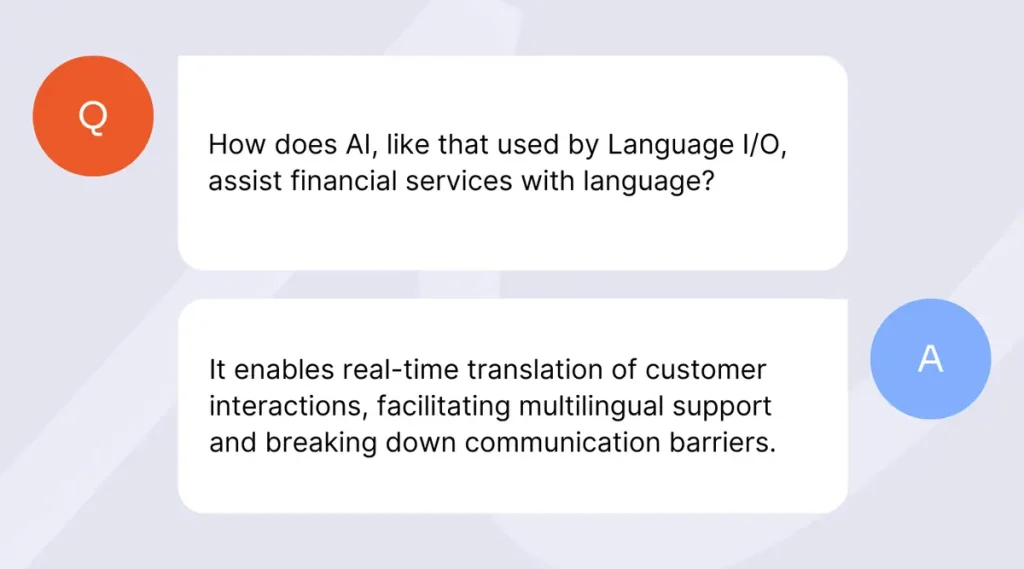
Conversational AI is making financial services accessible to a global audience. With AI-driven translation solutions like Language IO, banks can provide multilingual support, ensuring that customers can interact in their preferred language. Whether it’s a first-time investor in Brazil or a small business owner in Japan, AI is helping break language barriers and expand financial literacy.
Top Applications of Conversational AI in Banking & Financial Services
Conversational AI in banking and financial services can be used across a range of applications, benefiting both businesses and clients.
Transactional Assistance (Your Virtual Banker)
No one wants to call customer support just to check their account balance or transfer funds. Voice AI in banking allows customers to complete transactions, set up recurring payments, and manage their accounts—all through a simple chat or voice command.
Fraud Detection and Prevention
Banks are using AI to analyze transaction patterns in real time and detect suspicious activities before fraud occurs. Conversational AI can flag unusual spending behaviors, notify users of potential fraud, and even block transactions if necessary. This level of security means fewer headaches for customers and fewer financial losses for banks.
Customer Onboarding (Say Goodbye to Tedious Paperwork)
Opening a new bank account or applying for a financial product can be tedious. AI-powered assistants can guide new customers through Know Your Customer verification, answer onboarding questions, and ensure compliance with banking regulations—all while making the process quick and painless.
Query Analysis and Intent Detection
Financial institutions receive millions of customer inquiries every day. Conversational AI can analyze customer intent, classify queries, and provide instant responses—whether it’s about account statements, loan eligibility, or payment disputes. This reduces customer frustration and improves overall banking efficiency.
Conversational AI Technologies Used in the Financial Sector
The financial sector is able to leverage the power of conversational AI across a range of technologies.
Speech Recognition (Talking to Your Bank Just Got Smarter)
Voice AI in banking enables hands-free banking. Customers can check balances, make transactions, and get financial advice simply by speaking—an essential feature for accessibility and convenience.
Language Understanding & Processing (Smarter AI, Smarter Banking)
Thanks to natural language processing, AI can interpret complex banking jargon, detect sentiment, and provide relevant answers. Solutions like Language IO help banks translate conversations in real time, ensuring seamless multilingual support.
Knowledge Assist (AI-Powered Banking for Employees)
Conversational AI isn’t just for customers—it also helps financial professionals. AI-driven knowledge assistants can pull up policy details, compliance regulations, and customer transaction history in seconds, making banking employees more efficient.
Conversational AI vs Chatbots for Financial Services
Traditional chatbots rely on predefined scripts and fail when faced with complex queries. Today’s chatbots use conversational AI, on the other hand, to learn from interactions, adapt to customer behavior, and provide more human-like responses—making conversational AI the superior choice for financial institutions looking to improve customer engagement.
Your Global Fintech Playbook—Decoded.
The key to success is communication that feels local, no matter where you’re from.
How to Implement Conversational AI for Finance
Define Clear Objectives and Needs
Before jumping in, financial institutions must identify why they need AI. Whether it’s for fraud detection, reducing call center load, or improving multilingual support, clear goals will determine the right AI implementation strategy.
Choose the Right Technology and Vendor
Not all AI solutions are created equal. Banks must choose AI providers with experience in the financial sector. Language IO ensures that its multilingual conversational AI solutions are tailored to financial institutions’ needs and are zero-trace, meaning that no extra security risk is added.
Customize and Train AI Models
AI needs to understand banking terminology, compliance laws, and customer preferences. Training models with real-world financial data ensures more accurate responses and a better customer experience.
Leverage Conversational AI for Finance With Language IO
At Language IO, we specialize in delivering AI-driven multilingual customer support for financial institutions. Our cutting-edge solutions enable seamless, secure, and efficient banking interactions across multiple languages. Don’t let language barriers hold your bank back—embrace AI-powered financial communication today.
Final Thoughts on Conversational AI for Banking and Financial Services
Conversational AI is revolutionizing financial services by enhancing customer service, automating banking processes, and improving financial accessibility. Banks that integrate AI-driven solutions will reduce costs, increase efficiency, and deliver superior customer experiences. With multilingual support from Language IO, financial institutions can expand their global reach and serve customers more effectively.
FAQs
What are the potential challenges and limitations of implementing Conversational AI in finance? How can they be overcome?
Implementing conversational AI in finance isn’t without its hurdles. Common challenges include data privacy concerns, integration with legacy systems, and ensuring AI understands complex financial jargon.
Overcoming these issues requires a solid strategy: investing in robust data encryption, working with vendors experienced in financial integrations, and continuously training AI models on real-world financial data.
Regular testing and compliance checks are also essential to keep the technology sharp and secure.
Language IO uses state-of-the-art encryption and a pioneering zero data retention policy while strictly adhering to the industry’s security standards. This ensures you and your customers are protected.
How does conversational AI in banking enhance fraud detection and prevention?
Conversational AI acts like a digital watchdog, analyzing transaction patterns in real time. It detects unusual spending behaviors, flags potential fraud, and even prevents unauthorized transactions before they happen.
By continuously learning from transaction data, conversational AI becomes smarter over time, improving its ability to detect subtle fraud patterns that might slip past human analysts.
How does conversational AI in financial services support regulatory compliance?
Navigating financial regulations can feel like wading through a sea of red tape. Conversational AI helps by automating compliance checks, ensuring that transactions and communications adhere to legal requirements.
AI-driven systems can also provide audit trails and flag non-compliant behavior, helping financial institutions stay on top of ever-evolving regulatory landscapes.
What are the privacy concerns associated with using conversational AI in finance?
When it comes to finance, privacy is non-negotiable. The primary concerns revolve around data security, unauthorized access, and potential breaches.
To address these issues, banks need to ensure end-to-end encryption, adhere to strict data protection laws, and implement AI solutions that offer zero-trace security, ensuring customer data remains confidential and uncompromised. Language IO has these security systems and safeguards in place.
What role does conversational AI play in improving customer onboarding in financial services?
Say goodbye to the days of endless paperwork and tedious verification processes. Conversational AI streamlines onboarding by guiding customers through Know Your Customer (KYC) checks, verifying documents, and answering FAQs in real time.
This makes the onboarding experience faster, more efficient, and far more user-friendly, benefiting both the institution and its new customers.
Can conversational AI in banking assist with personalized financial planning?
Absolutely. Conversational AI can analyze individual spending patterns, investment portfolios, and savings habits to offer real-time, tailored financial advice. Whether it’s setting up a budget, providing investment suggestions, or offering saving tips, AI-driven assistants can help customers stay on track with their financial goals.
How is conversational AI in financial services transforming loan and mortgage processes?
Gone are the days of mountains of paperwork and weeks-long approval timelines. Conversational AI simplifies loan and mortgage applications by guiding users through the entire process, performing document verification, and even running credit checks in real time.
This not only speeds up approvals but also ensures a smoother, hassle-free experience for customers.
What impact does conversational AI have on customer retention in banking?
Customer satisfaction is key to retention, and conversational AI boosts it by offering instant support, personalized recommendations, and round-the-clock service.
By resolving issues quickly and providing proactive financial advice, AI-driven systems enhance the overall banking experience, making customers more likely to stick around for the long haul.
How is conversational AI being integrated with existing financial systems and infrastructure?
Integrating conversational AI with existing financial systems requires a thoughtful approach. Most banks use APIs and middleware platforms to connect AI solutions with core banking systems, CRMs, and security infrastructures.
The result? Seamless interactions where AI can access real-time data, provide personalized insights, and maintain compliance, all without disrupting existing workflows.