How AI Can Fix the 5 Biggest Pain Points in Customer Service
The truth is simple: You can’t create great customer experiences if your agents are miserable. When an agent is stressed out, jumping between six different programs, and watching the clock tick, they can’t give customers the attention they deserve. All their energy goes into just managing the technology instead of actually helping people. If we want happy customers, we need to start by making life better for agents.
By Language IO
Table of Contents
There’s something strange happening in customer service today. Companies are spending millions of dollars on customer experience technology, tracking every metric imaginable to keep customers happy. But the people actually doing the work – the customer service agents – are often stuck with terrible tools and impossible expectations. We obsess over making things perfect for customers while the agent’s day is a chaotic mess of scattered systems, unrealistic speed goals, and emotional stress.
The truth is simple: You can’t create great customer experiences if your agents are miserable. When an agent is stressed out, jumping between six different programs, and watching the clock tick, they can’t give customers the attention they deserve. All their energy goes into just managing the technology instead of actually helping people. If we want happy customers, we need to start by making life better for agents.
Our new report, Making Life Easier for the Customer and the Agent, shows exactly what’s going wrong and how to fix it. The good news? AI technology can solve these problems—not by replacing agents, but by finally giving them the support they need to do their jobs well. Here are the five biggest challenges agents face every day, and how AI can help.
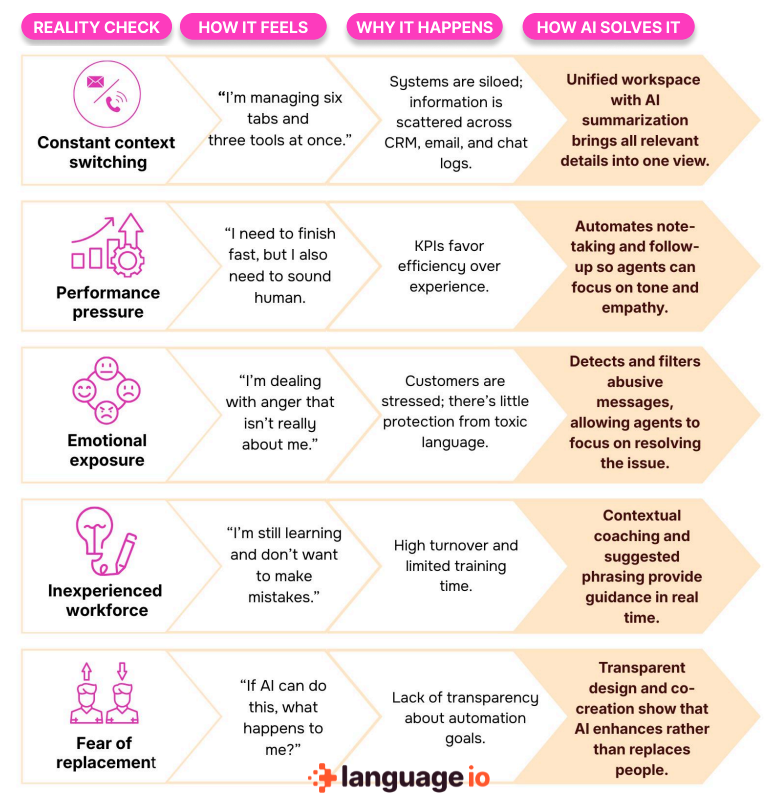
Too many systems, not enough focus.
“I’m managing six tabs and three tools at once.”
What’s Happening
Imagine trying to help someone while juggling multiple tasks at once. That’s what agents deal with constantly. To answer one question, they might need to check the customer database for account details, open a shipping tracker, search through a knowledge base for policies, and message their supervisor—all at the same time. This constant switching between programs isn’t just annoying. It’s exhausting. Studies show that when you keep jumping between different tasks, your brain gets tired fast and you start making mistakes.
Why It Matters
When information is spread across different systems, everything takes longer. You’ve probably heard an agent say “Please hold while I look that up.” What they really mean is “Please wait while I log into three different programs.” For customers, this feels frustrating. For agents, it creates constant stress that they might miss something important buried in one of their many open tabs.
How AI Helps
AI can gather information from all those different systems and put it in one place. Instead of the agent hunting through multiple programs, AI brings everything together in a single view—customer history, order details, past conversations, all of it. This means agents spend less time searching and more time actually solving problems.
Be fast AND be nice (Pick One)
“I need to finish fast, but I also need to sound human.”
What’s Happening
Agents are stuck between two impossible goals. On one hand, they’re told to be caring and patient with customers. On the other hand, they’re measured on how fast they finish each call. You can’t truly listen to someone’s problem while watching a timer tick down. It’s like being told to run a marathon while also stopping to smell the roses. No matter what they do, agents feel like they’re failing.
Why It Matters
Customers can tell when they’re being rushed. They feel it when an agent is more focused on ending the call than solving the problem. When agents prioritize speed to hit their numbers, interactions feel cold and scripted. But if they ignore the time pressure to actually help someone, they might get in trouble with their manager.
How AI Helps
Let technology handle the boring, mechanical parts. AI can automatically take notes during calls, write up summaries, and schedule follow-ups. When agents don’t have to type frantically while talking, they can actually focus on the conversation. AI takes care of the speed requirements, so agents can focus on being human.

Dealing with angry people all day
“I’m dealing with anger that isn’t really about me.”
The Reality
Customer service is emotional labor. Agents are the frontline shock absorbers for organizational failures. Whether it’s a delayed flight, a broken product, or a billing error, the agent is the face of the problem. They absorb toxicity, frustration, and sometimes abuse, often with little institutional support. Over time, this exposure leads to emotional exhaustion, compassion fatigue, and high attrition rates. We ask them to have “thick skin,” but we rarely give them armor.
The Impact
An emotionally drained agent cannot de-escalate a volatile situation. They are more likely to react defensively or check out mentally, leading to unresolved conflicts and escalated complaints. Furthermore, the psychological toll leads to increased absenteeism, which puts more pressure on the remaining team members.
The AI Solution
AI can serve as a protective layer. Real-time sentiment analysis can detect when a conversation is turning toxic and intervene. This might mean flagging a supervisor immediately or, in digital channels, filtering out abusive language so the agent sees the core issue without the vitriol. By detecting aggression early, AI helps shift the focus back to resolution, protecting the agent’s mental well-being and keeping the interaction productive.
The struggle of the inexperienced workforce
“I’m still learning and don’t want to make mistakes.”
The Reality
Contact centers are notorious for high turnover, which means a significant portion of the workforce is always new. Training helps, but no classroom simulation can prepare a new hire for the complexity of live calls. New agents often operate in a state of fear—afraid of giving the wrong answer, afraid of violating compliance rules, and afraid of sounding incompetent. This “sink or swim” environment is stressful and leads to early burnout for promising talent.
The Impact
Inconsistency is the enemy of trust. If a customer calls twice and gets two different answers because one agent was new, their confidence in the brand plummets. Inexperienced agents also tend to put customers on hold more often as they consult manuals or neighbors, extending resolution times.
The AI Solution
Think of AI as a “co-pilot” that sits next to every agent, regardless of tenure. Contextual coaching tools can listen to the conversation in real-time and surface the right answers, policy documents, or suggested phrasing exactly when needed. It turns every agent into your best agent. This isn’t just about scripting; it’s about providing a safety net that gives new hires the confidence to perform like veterans from their first week.
The existential fear of replacement
“If AI can do this, what happens to me?”
The Reality
We cannot discuss AI in the workplace without addressing the elephant in the room: job security. Headlines about automation replacing millions of jobs create a backdrop of anxiety. If an organization introduces AI tools without transparency, agents will naturally view the technology with suspicion. They may hesitate to use it or actively work around it, fearing that they are training their replacements.
The Impact
A workforce operating in fear is a workforce that does not innovate. If agents believe efficiency tools are a trap, adoption rates will lag, and morale will tank. You cannot build a future-ready support team if the team believes they have no future.
The AI Solution
The solution here is as much about culture as it is about code. The design and implementation of AI must be transparent and human-centric. The goal must be clearly communicated: AI is here to remove the drudgery, not the people. By involving agents in the “co-creation” process—asking them which tasks they hate and automating those first—leaders can demonstrate that AI is a tool for empowerment. When agents see AI handling the boring data entry so they can tackle complex problem-solving, the narrative shifts from replacement to enhancement.
Conclusion: The Augmented Agent
The contact center of the future is not an empty room of servers. It is a place where human intelligence is amplified by machine efficiency. By addressing these five pain points—context switching, performance pressure, emotional exposure, inexperience, and fear—we do more than just improve metrics. We restore dignity to the role of the customer service agent.
When we use AI to strip away the friction of bad interfaces and repetitive tasks, we uncover the true value of our human workforce: their ability to connect, empathize, and solve complex problems creatively. That is the hidden opportunity of the AI revolution. It’s not about building better bots; it’s about building better environments for our people.
It’s not about building better bots; it’s about building better environments for our people.
Discover More
-

“We support 100+ Languages” is the most dangerous sentence in customer support.
Every platform now claims to translate. Almost none can tell you what happens when it goes wrong.
-

Salesforce AI Translation Guide: Native Features vs. Dedicated AI Translation Layers
Language IO is one of the strongest AI translation solutions for Salesforce because it works directly inside Salesforce Service Cloud, supports more than 150 languages, and adds translation-specific controls that native tools and general-purpose AI may not provide.