The days of long call wait times, repetitive hold music, and frustrating customer service interactions are coming to an end—thanks to artificial intelligence (AI) call centers.
Businesses are increasingly leveraging AI-powered solutions to streamline operations, improve customer experience, and optimize agent performance.
AI call center technology is transforming customer interactions, allowing companies to provide 24/7 support, automate repetitive tasks, and enhance real-time decision-making.
In this article, we’ll break down what an AI call center is, how it works, its benefits, and the best practices for implementing contact center AI solutions effectively. Wondering how artificial intelligence is transforming contact centers? Read on.
TL;DR
- AI call centers use tools like chatbots, real-time agent assist, sentiment analysis, and intelligent routing to automate tasks, personalize service, and provide 24/7 multilingual support.
- Benefits include faster response times, lower costs, improved customer satisfaction, and more efficient, empowered human agents.
- Success depends on clear objectives, agent training, and continuous AI optimization to ensure a smooth and effective human-AI partnership.
What Is an Artificial Intelligence Call Center?
An AI contact center is a customer support operation that integrates artificial intelligence into its workflow. These AI-powered systems work alongside human agents, handling customer inquiries, automating routine tasks, and providing intelligent insights to improve overall service quality.
Unlike traditional call centers that rely solely on human agents, AI-based call centers use machine learning, natural language processing (NLP), and conversational AI to engage with customers efficiently. Whether through chatbots, virtual assistants, or real-time agent assistance, AI in call centers enhances customer interactions and reduces operational costs, and 71% of customers expect brands to deliver personalized interactions.
How Do AI Call Centers Work?
AI-powered call centers leverage advanced technologies to improve customer interactions and streamline support operations. Here’s how contact center artificial intelligence works:
1. AI Chat Routing: Faster Than Your Average Receptionist
Ever been bounced from agent to agent, each one asking for your details all over again? Yeah, we’ve all been there. AI-driven intelligent chat routing changes the game by ensuring that customer enquiries reach the right agent or department immediately.
Instead of playing a guessing game, AI evaluates factors like inquiry type, customer history, and even sentiment analysis to direct customers efficiently. And if that customer speaks a different language? Language IO steps in like a multilingual superhero, ensuring seamless translation so agents can assist without a hitch.
2. Chatbots & Virtual Assistants: The 24/7 MVPs of Customer Support
Chatbots don’t take lunch breaks. They don’t call in sick. And they certainly don’t get flustered when asked the same question for the thousandth time. AI chatbots and virtual assistants are AI call center agents that provide instant responses to common inquiries, slashing wait times and freeing up human agents for more complex cases.
3. Real-time Agent Assistance: Your Agent’s AI-Powered Sidekick
Think of AI as the world’s best co-pilot for call center agents. While the agent speaks with a customer, AI is working behind the scenes, providing real-time suggested responses, pulling up relevant customer data, and analyzing conversations for better service.
Picture an agent assisting a frustrated customer who needs troubleshooting help. AI can instantly fetch past interactions and technical documentation, and it can even suggest troubleshooting steps. Now add Language IO into the mix—if that customer is speaking French, AI translates everything on the fly so the agent doesn’t miss a beat.
4. Speech Recognition & Sentiment Analysis: Reading Between the Lines (and Tones)
Ever had a customer say “I’m fine” when they clearly aren’t? AI detects tone, sentiment, and urgency through speech recognition and sentiment analysis, allowing businesses to respond accordingly.
For instance, an AI system can detect frustration or anger in a caller’s voice and escalate the case to a senior agent before the situation boils over.
5. Automated Call Summarization: No More Dreaded Post-Call Paperwork
No one likes writing up call summaries. Fortunately, AI does. AI-powered call summarization transcribes conversations, extracts key details, and generates concise summaries, saving agents time and reducing errors.
For example, an AI system can automatically summarize a customer complaint, highlight action points, and file it within a CRM. When combined with translation technology, the AI ensures accurate multilingual summaries—so the next agent, no matter their language, can pick up where the last one left off without a language barrier in sight.
6. Predictive Analytics & Insights: AI Knows What Customers Want Before They Do
What if you could predict customer needs before they even pick up the phone? AI analyzes customer interactions to detect patterns, identify potential issues, and suggest improvements to service strategies.
For instance, if an AI system notices a surge in questions about a new product, it can proactively generate FAQs, notify agents, and even push out multilingual chatbot responses via Language IO. This proactive approach not only improves customer satisfaction but also reduces call volumes for agents.
Benefits of Using AI in Call Centers
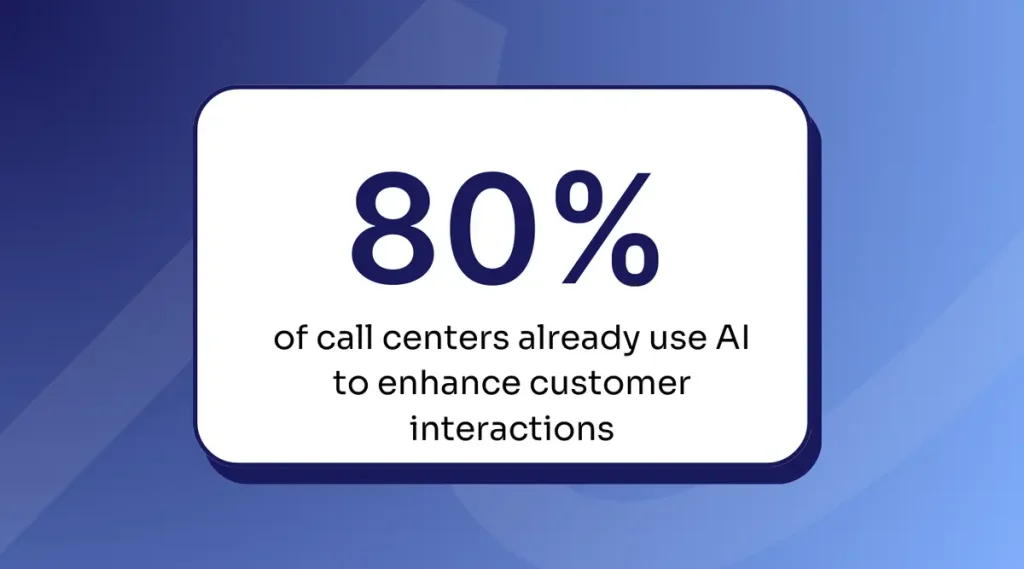
80% of call centers are already using AI-based technologies to enhance customer interactions. Let’s take a look at some of the benefits that AI call center solutions bring to both customers and human agents.
1. Improved Customer Experience: Instant Support in Any Language, Any Time
AI-powered call centers provide faster response times, personalized interactions, and 24/7 availability. Customers no longer have to wait on hold, as AI chatbots and virtual assistants handle routine inquiries instantly.
2. Optimized Workforce Efficiency: Agents Focus on What Matters
AI takes care of the tedious, repetitive inquiries—like “Where’s my refund?” or “How do I reset my password?”—so human agents can focus on complex cases requiring empathy and problem-solving skills.
3. Enhanced Call Routing & Handling: Getting It Right the First Time
No more bouncing customers from one agent to another. AI ensures that calls go to the right agent from the start based on history, intent, and even customer sentiment.
4. Cost Reduction: Doing More With Less
AI-powered automation reduces staffing costs while still improving service quality. Businesses can scale customer support without significantly increasing expenses, making AI a cost-effective solution for growing companies.
5. Multilingual Support: The Ultimate Global Customer Experience
With AI-powered translation and NLP, businesses can serve customers in multiple languages without hiring multilingual agents, expanding their global reach effortlessly.
AI Use Cases in Contact Centers
A range of industries and sectors can benefit from the power of AI in their contact centers.
1. Customer-Facing Chatbots: The First Line of Defense
Chatbots are the unsung heroes of AI-powered contact centers. They handle FAQs, track orders, and even troubleshoot minor issues before an agent ever needs to step in.
Picture a telecom company using a chatbot to assist customers with billing inquiries. The chatbot instantly provides answers, reducing call volume for human agents. When a customer asks in a different language, AI-powered translation tools ensure the chatbot replies just as accurately—eliminating language barriers.
2. Real-Time Agent Assist: The Ultimate Co-Pilot
Agents no longer have to scramble for answers. AI-driven real-time assistance provides agents with relevant customer data, recommended responses, and troubleshooting steps—all while the conversation is happening.
For example, a financial services company using AI-powered real-time assistance can instantly provide agents with fraud detection alerts when handling suspicious transactions, ensuring quicker and more accurate resolutions.
3. Intelligent Call Routing: No More “Let Me Transfer You”
No customer enjoys being transferred multiple times. AI-powered intelligent call routing ensures that each customer reaches the right department immediately by analyzing past interactions, keywords, and even sentiment in real time.
A healthcare provider using AI-driven routing can ensure that patients needing prescription refills go straight to the pharmacy department while billing inquiries go to the financial services team—streamlining operations and improving customer satisfaction.
4. Customer Sentiment Analysis: Understanding the Mood of the Call
Not all frustrated customers will say, “I’m upset.” AI-powered sentiment analysis picks up emotional cues in voice or text and adjusts responses accordingly.
For example, an airline can detect when a customer calling about a delayed flight is particularly frustrated and prioritize the call for a senior agent who can offer compensation or alternative travel arrangements.
5. Lead Qualification & Sales Optimization: AI as Your Sales Sidekick
AI doesn’t just answer calls—it can drive revenue. AI analyzes customer interactions, identifies buying intent, and helps sales teams prioritize high-value leads.
A SaaS company using AI-powered lead scoring can determine whether a caller is a potential premium subscriber and route them to a specialized sales rep for a tailored pitch, increasing conversion rates.
Beyond the Hype: The Real State of Enterprise AI u0026 Language in 2025
AI + Language Strategy: Lead or Get Left Behind
Technologies Used in AI-Based Call Centers
AI call centers aren’t just powered by magic (although it might feel that way sometimes). Behind the scenes, a mix of cutting-edge technologies work together to create seamless customer interactions. Let’s break down the key tech that makes AI-powered call centers tick.
1. Conversational AI & NLP: Teaching Machines to Talk Like Humans
At the heart of AI call centers is Conversational AI, powered by Natural Language Processing (NLP). This is the tech that enables AI to understand, process, and respond to human language in a way that feels natural—whether through chat, voice, or email.
Think of an AI-powered chatbot assisting a customer with a complicated return process. Instead of responding with robotic, pre-scripted answers, NLP ensures the bot understands the context and tailors responses accordingly.
2. Speech Recognition & Voice AI: Turning Sound Waves into Smart Responses
Ever had a conversation with Siri or Alexa? That’s speech recognition and Voice AI in action. In AI call centers, this technology transcribes and understands customer speech in real time, allowing for voice-based interactions without the need for human intervention.
Imagine a customer calling a bank’s support line to check their account balance. Instead of pressing buttons or waiting for an agent, Voice AI processes their request instantly and provides an answer within seconds.
3. Machine Learning & Predictive Analytics: AI That Knows What You Need Before You Do
AI call centers don’t just respond—they predict. Machine learning (ML) and predictive analytics allow AI to analyze past interactions, identify trends, and anticipate customer needs before they even ask.
For example, an e-commerce retailer can use predictive analytics to determine which customers are likely to ask about delayed shipments during peak seasons. AI can proactively send out updates or trigger chatbot notifications, reducing the number of inbound calls and improving customer satisfaction.
4. Intelligent IVR (Interactive Voice Response): No More Endless Button Pressing
Traditional IVR systems are infamous for sending customers into an endless loop of “Press 1 for sales, Press 2 for support…” AI-powered IVR, on the other hand, is far more advanced. Instead of forcing customers to navigate a rigid menu, AI listens to the caller’s request and instantly routes them to the correct department.
Picture a travel booking agency using AI IVR: A customer calls in and simply says, “I need to change my flight.” The system immediately understands, pulls up their reservation details, and offers solutions—no menu maze required.
5. Sentiment Analysis: The Mind-Reader of AI Call Centers
AI isn’t just about understanding words; it’s about understanding emotions. Sentiment analysis helps AI gauge whether a customer is frustrated, neutral, or happy, allowing businesses to adjust their responses accordingly.
For instance, if an AI system detects irritation in a customer’s voice (raised tone, faster speech, or certain key phrases), it can escalate the case to a human agent or provide a more empathetic response. This ensures that upset customers don’t feel like they’re shouting into the void of automation.
6. AI-Powered Data Analytics & Automation: Insights That Matter
AI doesn’t just interact with customers—it learns from every conversation. AI-powered analytics tools provide deep insights into customer behavior, pain points, and service trends, helping companies refine their strategies.
For example, a SaaS company can use AI analytics to discover that a significant portion of customer complaints revolves around a confusing billing process. With this insight, they can revamp their billing system and proactively address common pain points.
Language IO’s multilingual integration gives businesses access to the translated chat transcript available in the CRM, ensuring that insights aren’t just limited to English-speaking customers.
Best Practices for Using Contact Center AI Solutions in 2025
AI in contact centers isn’t a set-it-and-forget-it solution. To truly reap the benefits, businesses need to implement AI strategically and continuously fine-tune its performance.
Let’s dive into the best practices to ensure your AI call center runs like a well-oiled machine in 2025.
1. Define Clear Objectives: Know What You Want AI to Do (Before It Takes Over)
Jumping into AI without a game plan is like assembling IKEA furniture without instructions—frustrating and bound to end in disaster. Before integrating AI into your call center, define clear objectives that align with your business needs.
Are you looking to slash wait times? Improve first-call resolution rates? Enhance multilingual support for a global audience? Having a clear AI roadmap helps ensure that the technology works for you—not the other way around.
For example, an e-commerce brand struggling with high call volumes during peak sales seasons might implement AI-powered chatbots to handle common inquiries.
2. Provide Adequate Training & Support: AI & Agents—The Dynamic Duo
AI isn’t here to replace human agents; it’s here to make their lives easier. But to achieve a seamless AI-human collaboration, agents need proper training on how to use AI effectively.
Think of AI as an agent’s personal assistant, whispering insights in their ear like a customer service version of J.A.R.V.I.S. (minus the Iron Man suit). AI can provide real-time suggestions, pull up customer history, and automate tedious tasks—but only if agents know how to leverage it.
3. Continuously Monitor & Optimize AI Performance: AI Needs a Tune-Up, Too
AI isn’t a “set it and forget it” kind of deal. Just like a high-performance sports car, AI needs regular tune-ups to keep running smoothly. Monitoring performance ensures that it continues to meet business objectives and adapt to evolving customer needs.
Regular audits can reveal issues like inaccurate chatbot responses, flawed call routing, or gaps in sentiment analysis. AI models should be continuously updated with fresh data to improve accuracy and efficiency.
Final Thoughts: AI Is a Tool—Make Sure You Use It Right
AI in call centers is a game-changer, but only when implemented correctly. By setting clear goals, training human agents, and continuously optimizing performance, businesses can create an AI-powered contact center that is efficient, customer-friendly, and ready for the future.
And with Language IO ensuring seamless multilingual support, businesses can confidently provide AI-driven service to customers across the globe—without a language barrier in sight.
FAQs
Why are contact center AI solutions important?
AI solutions are revolutionizing call centers by making them smarter, faster, and more cost-efficient. By automating repetitive tasks—such as answering FAQs, handling order tracking, and routing calls—AI frees up human agents to focus on complex, high-value interactions that require empathy and problem-solving.
Beyond automation, AI provides real-time insights through sentiment analysis, predictive analytics, and personalized recommendations, enhancing customer satisfaction and retention. With the right AI-powered tools, businesses can scale support operations globally while reducing overhead costs and ensuring consistent service quality.
What are some examples of call center AI solutions?
Call center AI solutions come in many forms, each designed to streamline operations and enhance customer interactions:
- AI Chatbots: Instantly respond to customer inquiries, process requests, and even handle transactions without human intervention.
- Intelligent Call Routing: Directs calls to the most appropriate agent based on customer history, intent, and sentiment.
- Real-Time Agent Assist: Provides live agents with relevant customer data, suggested responses, and troubleshooting guidance during calls.
- Customer Sentiment Analysis: Identifies customer emotions to ensure appropriate responses, such as escalating frustrated customers to a senior agent.
- Automated Call Summarization: Saves agents time by transcribing conversations and generating concise, actionable summaries for future reference.
Will AI replace contact center agents?
Despite the sci-fi fears of robots taking over, AI won’t be replacing human agents anytime soon. Instead, AI serves as an advanced support system that handles routine inquiries, allowing human agents to focus on complex, emotionally sensitive, or high-stakes interactions.
For example, AI chatbots can take care of basic order tracking, while human agents handle cases requiring negotiation or deep problem-solving. AI also reduces agent burnout by minimizing repetitive tasks, ultimately leading to higher job satisfaction and lower turnover rates.
What are the main challenges of AI in contact centers?
Implementing AI in contact centers isn’t without its hurdles. Some of the biggest challenges include:
- AI Training & Fine-Tuning: AI models require continuous updates and training to improve accuracy, avoid biases, and ensure seamless interactions.
- Data Privacy & Security: AI systems process vast amounts of sensitive customer data, making compliance with regulations like GDPR and CCPA crucial.
- Integration with Existing Systems: Legacy CRM systems and outdated infrastructure can pose challenges when incorporating AI-powered solutions.
- AI-Human Collaboration: Ensuring a smooth AI-human handoff is essential so customers don’t feel like they’re trapped in an endless bot loop.
How to set up an AI-based contact center?
Setting up an AI-based contact center requires a strategic approach. Here’s how to do it effectively:
- Define Clear Objectives: Identify key goals, such as reducing response times, increasing first-call resolution rates, or expanding multilingual support.
- Choose the Right AI Technology: Select AI tools that align with business needs, such as conversational AI, predictive analytics, or intelligent IVR systems.
- Seamlessly Integrate AI: Ensure AI solutions work smoothly with existing CRM, ticketing, and workforce management systems.
- Train Agents on AI Collaboration: Educate human agents on how to use AI tools effectively for improved efficiency and customer engagement.
- Monitor & Optimize Performance: Continuously evaluate AI-driven interactions to refine processes, improve accuracy, and enhance customer experiences.
How can AI improve customer experience in call centers?
AI enhances customer experience by delivering faster, more personalized, and highly efficient service. Key ways AI improves CX include:
- 24/7 Availability: AI-powered support ensures customers receive assistance anytime, anywhere.
- Personalized Interactions: AI analyzes customer history to tailor recommendations and responses.
- Multilingual Support: With tools like Language IO, AI-powered chatbots and agents can seamlessly communicate with global customers in multiple languages.
- Efficient Problem Resolution: AI-driven insights enable faster decision-making, reducing frustration and improving satisfaction rates.
How can AI improve agent engagement in call centers?
AI isn’t just great for customers—it’s a game-changer for agents, too. By handling mundane tasks, AI allows agents to focus on more meaningful, rewarding interactions. Some key benefits include:
- Reduced Workload: AI automates repetitive inquiries, lowering stress and burnout.
- Real-Time Assistance: AI provides agents with contextual data, suggested responses, and troubleshooting help during live interactions.
- Better Performance Insights: AI-driven analytics help identify strengths and areas for improvement, leading to better coaching and career growth.
- Increased Job Satisfaction: By eliminating the monotony of repetitive queries, AI lets agents focus on complex problem-solving, making their roles more fulfilling.
How does AI impact productivity and efficiency in call centers?
AI is a productivity powerhouse for call centers, improving efficiency across the board:
- Automating Repetitive Tasks: AI chatbots and virtual assistants handle FAQs, order tracking, and simple troubleshooting, reducing agent workload.
- Enhancing Call Routing: AI directs customers to the right agent based on inquiry type, past interactions, and sentiment analysis, reducing call transfers and wait times.
- Providing Real-Time Insights: AI-powered analytics identify patterns, helping businesses optimize customer interactions and agent workflows.
- Optimizing Workforce Scheduling: AI predicts call volumes and schedules agents accordingly, ensuring the right staffing levels at all times.
By implementing AI strategically, contact centers can boost efficiency, enhance customer experiences, and create a better working environment for their agents—all while reducing costs.