Customers today expect fast, seamless service, and they don’t want to wait on hold. Call center chatbots are a strategic solution: AI-powered assistants that deliver instant, personalized support, 24/7.
Designed to reduce friction and scale efficiently, contact center chatbots now play a critical role in modern enterprise customer support.
Whether it’s resolving simple queries or intelligently routing issues to live agents, chatbots for call centers are no longer optional—they’re foundational to high-performing contact centers.
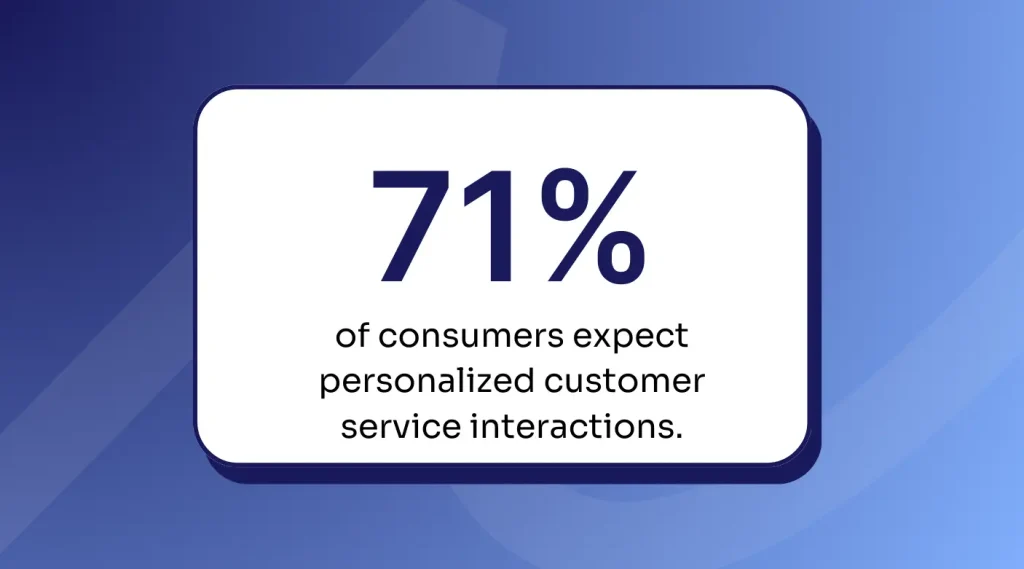
For example, 71% of consumers expect personalized customer service interactions. If this doesn’t happen, 76% of them will get frustrated. The statistics are clear: modern-day customer service support has to go the extra mile. This is where call center chatbots come into play.
In this article, we’ll explain what call center chatbots are, how they function within sophisticated enterprise ecosystems, and what it takes to build one that delivers a measurable return on investment (ROI).
TL;DR
- Call center chatbots are enterprise-grade virtual assistants that handle high volumes of queries with speed, accuracy, and brand consistency.
- They drive cost efficiency, accelerate response times, and free up human agents for complex, high-value work.
- The most effective chatbots integrate deeply with backend systems, support multilingual conversations via platforms like Language IO, and escalate complex cases without losing context.
What Are Call Center Chatbots and How Do They Work?
Call center chatbots are AI-driven platforms that simulate human conversation using advanced natural language processing (NLP) and enterprise-level integrations.
Deployed across websites, mobile apps, and messaging channels, these bots manage thousands of concurrent interactions without degradation in quality or service level.
In an enterprise context, chatbots aren’t just answering FAQs—they’re executing transactions, updating account information, booking appointments, and triaging high-value customers to skilled agents.
When fully integrated, a call center chatbot will align with broader CX strategies, scaling personalized support while reducing operational bottlenecks.
Eighty percent of call centers are utilizing AI technologies, including chatbots, to enhance their customer service experience. Your business can’t afford to be left behind the competition.
Call Center Chatbots vs. Virtual Agents: What’s the Difference?
While often used interchangeably, savvy enterprise teams distinguish between basic chatbots and virtual agents.
Chatbots typically follow predefined workflows to manage repetitive, structured tasks.
Virtual agents, enhanced by AI and continuous learning models, handle dynamic, context-rich conversations across voice, text, and digital channels.
In an enterprise call center, both are critical components—chatbots optimize volume, while virtual agents drive deeper engagement and customer lifetime value.
Benefits of Call Center Chatbots
Artificial intelligence call center chatbots offer a wide range of advantages, from improving customer satisfaction to reducing costs—let’s take a closer look at how they create value.
1. Instant Query Resolution & Reduced Customer Call Time
Chatbots are invaluable, especially during call center call spikes. They eliminate queue times by providing immediate, relevant responses to routine inquiries.
They deflect thousands of basic tickets, allowing agents to concentrate on strategic interactions that require human nuance and judgment.
For example, bots integrated with CRM platforms can instantly update customer profiles, check loyalty program status, or troubleshoot device issues—without waiting on human input.
The result? Reduced Average Handle Times (AHT), Increased First-Contact Resolution (FCR), and improved Net Promoter Scores (NPS).
2. 24/7 Availability Across Time Zones
Global enterprises operate around the clock—and so must their support systems.
Chatbots ensure that customers in any geography can get service on their schedule, not yours.
Deploying AI across regions and languages through tools like Language IO allows enterprises to maintain brand integrity, deliver native-language support, and avoid the pitfalls of inconsistent third-party BPOs.
This true 24/7 multilingual coverage is now a competitive necessity, not a luxury.
3. Personalized, Context-Aware Interactions
Modern AI chatbots aren’t generic—they’re deeply personalized.
By integrating with enterprise CRMs, ERPs, and analytics platforms, chatbots can greet customers by name, reference past purchases, recommend next steps, and even proactively resolve known issues.
Leveraging multilingual capabilities via Language IO not only enables communication in the customer’s native language but also ensures brand consistency through its customizable glossary. This feature allows enterprises to define key terminology, tone, and product-specific language, making translations more aligned with brand voice and values. As a result, interactions feel more personalized and authentic, strengthening global brand loyalty and customer trust.
4. Lower Operational Costs with Greater Scalability
Strategic chatbot deployment drives sustainable cost savings without compromising CX quality.
Unlike traditional staffing models, chatbots scale instantly to meet seasonal peaks, product launches, or crisis surges—all without overtime costs, onboarding expenses, or quality drops.
For senior enterprise leaders managing P&L and CSAT simultaneously, this is a major efficiency win.
5. Consistency, Compliance, and Brand Control
In regulated industries, chatbots ensure every customer receives accurate, compliant, approved messaging.
Unlike human agents, they don’t have bad days, forget talking points, or drift off-script.
With multilingual support platforms like Language IO integrated, enterprises can confidently deliver accurate, brand-consistent responses globally, critical for industries like finance, healthcare, and insurance.
Unleash Conversational AI: Rapidly Expand into Global Markets and Unlock the Future of Customer Support
Unlock practical insights on reducing support operations costs by up to 60% with conversational AI.
Applications of AI Contact Center Chatbots
AI-powered chatbots aren’t just for answering questions—they’re transforming how enterprises handle everything from scheduling to onboarding.
1. Appointment Scheduling
Enterprise-grade bots integrate directly with back-office systems to schedule, modify, or cancel appointments in real time.
This reduces operational strain, minimizes human error, and improves the end-customer experience across healthcare, financial services, and professional services sectors.
2. Troubleshooting & Technical Support
Rather than clogging up L1 tech queues, chatbots guide users through intelligent troubleshooting workflows, escalate tickets only when human expertise is needed, and prepopulate incident data for faster resolution.
When enhanced with multilingual capabilities—such as those provided by Language IO—these bots can operate seamlessly in over 150 languages, allowing global enterprises to deliver consistent technical support across markets without expanding language-specific teams.
This not only improves Mean Time to Resolution (MTTR) but also ensures human engineers focus solely on critical, high-impact issues.
3. Customer Onboarding
Effective onboarding chatbots transform Day 1 customer experiences.
By walking users through account setup, initial configurations, or product tutorials, bots improve early engagement metrics and reduce churn risk.
For SaaS and financial enterprises, this translates into faster time-to-value and higher retention rates.
4. Agent Training and Internal Support
Internal knowledge bots dramatically accelerate new agent ramp times.
Rather than burdening supervisors, chatbots provide real-time, contextual guidance based on the latest playbooks, escalation paths, and knowledge articles.
This is particularly impactful in high-growth or high-turnover environments, ensuring consistent quality from day one.
5. Feedback Collection
Chatbots capture immediate, in-the-moment feedback without disrupting customer journeys.
Embedded post-interaction surveys help organizations surface emerging pain points, assess agent and bot performance, and prioritize CX improvements faster.
Senior leaders use this real-time VoC (Voice of Customer) data to drive continuous optimization efforts.
Core Capabilities of Modern Call Center Chatbots
To understand what sets today’s chatbots apart, we’ll look at the core features that make them indispensable in modern customer service environments.
1. Seamless Integration With Business Systems
The best enterprise chatbots aren’t standalone—they are ecosystem players.
They integrate into CRMs like Salesforce, helpdesks like Zendesk, and backend ERPs to execute tasks, retrieve data, and update customer records autonomously.
This drives faster case resolutions, higher agent efficiency, and better end-user satisfaction.
Chatbots don’t operate in isolation—they often work hand in hand with AI-powered site search. By drawing from the same centralized knowledge base, both channels ensure customers can either self-serve directly through search or escalate into conversational support without losing context.
2. Smooth Handoff to Human Agents
High-performing chatbots know their limits.
When escalation is required, they pass full conversation context, customer history, and metadata to human agents, ensuring a frictionless customer journey.
No customer should ever have to repeat their story—this is table stakes for modern enterprise CX.
3. Multichannel and Multilingual Support
Today’s customers use chat, mobile apps, SMS, and social media—often simultaneously.
Enterprise chatbots must maintain conversation continuity across all these channels, preserving context and delivering consistent experiences.
Multilingual support, powered by Language IO, enables enterprises to serve customers in 100+ languages without scaling human language teams through multilingual call center outsourcing, expanding reach without bloating overhead.
How to Build an Effective Chatbot for a Call Center
Building a great chatbot takes more than just good tech—here’s what it really takes to design, optimize, and scale one that works for your customers and your business.
Prioritize Customer-Centric Design
When building a chatbot for an enterprise call center, customer-centric design must be the foundation. Too often, chatbots are built around internal processes rather than customer needs, leading to confusing, frustrating experiences.
A truly effective chatbot speaks in the customer’s language—not technical jargon—and anticipates common friction points in the journey. It offers intuitive options, uses natural, conversational phrasing, minimizes clicks, and most importantly, makes it easy to escalate to a live agent when necessary.
Well-designed bots guide users seamlessly toward resolution without creating dead ends or forcing them through irrelevant decision trees.
Enterprises that prioritize user experience in their chatbot design consistently see higher adoption rates, faster issue resolution, and improved CSAT scores.
Implement Ongoing Training and Optimization
A chatbot’s value doesn’t peak at launch; it must evolve continuously to stay relevant. Enterprise-grade bots should be treated as living products that require ongoing optimization cycles based on real-world usage data.
This means feeding the chatbot new customer queries, analyzing failed interactions, incorporating updated policies, and even adjusting to seasonal trends or product changes. Regular transcript reviews, AI model retraining, and proactive fine-tuning ensure that the chatbot’s accuracy, relevance, and customer satisfaction steadily improve over time.
Enterprises that fail to invest in continuous training risk creating static bots that frustrate users and quickly become outdated, undermining broader CX goals.
A commitment to ongoing improvement transforms a chatbot from a basic support tool into a dynamic competitive advantage.
Integrate Deeply Across Systems
A chatbot operating in a silo can only deliver limited value; true transformation happens when it integrates deeply across the enterprise technology stack.
Leading chatbots connect seamlessly to CRMs, ticketing platforms, knowledge bases, inventory systems, billing software, and scheduling tools.
This connectivity empowers the bot to resolve complex queries autonomously, such as processing refunds, modifying shipping addresses, checking order statuses, or escalating high-priority tickets with full context.
Enterprises should prioritize platforms that offer robust APIs, real-time data access, and secure backend integrations.
The more touchpoints the chatbot has, the more actions it can complete without human intervention, dramatically improving operational efficiency, customer satisfaction, and ROI.
Start Focused, Then Expand
Building an enterprise chatbot is a strategic initiative, and success often hinges on starting with a narrow, well-defined scope. Rather than trying to automate everything at once, organizations should launch with high-impact use cases, such as order tracking, password resets, or appointment scheduling, that deliver immediate, visible value.
Early wins build internal momentum, prove out the technology, and generate crucial learning that informs future expansion. Once the chatbot demonstrates success in targeted areas, enterprises can systematically scale to more complex, cross-functional workflows, such as technical support triage, proactive customer engagement, or loyalty program management.
A phased approach minimizes risk, optimizes resource allocation, and ensures that chatbot growth aligns with evolving customer expectations and business goals.
Key Takeaways
Call center chatbots are not just tools—they’re strategic assets for enterprise CX leaders.
When deployed correctly, they drive operational efficiency, global scalability, and customer satisfaction at scale.
AI not only enhances the customer experience; it also helps customer service representatives. Sixty-four percent of customer service agents who utilize AI claim that it helps them deliver personalized service.
With proper design, continuous optimization, and integration of multilingual capabilities like Language IO, enterprises can deliver personalized, secure, brand-consistent experiences around the world.
The future of customer support isn’t just human or AI—it’s a seamless partnership between the two.