Let’s be honest—customer service has come a long way from the days of long wait times, elevator music, and the dreaded “your call is very important to us” lie.
Now, businesses have a secret weapon: conversational AI. This isn’t just some sci-fi fantasy; it’s real, it’s here, and it’s transforming the way companies interact with their customers.
If your business isn’t leveraging conversational AI yet, you’re basically sending smoke signals while your competitors are firing off encrypted texts.
In this article, we’ll be covering everything around conversational AI for customer service and what you need to know.
TL;DR
- 24/7 Availability: AI-powered support ensures customers get help anytime, improving response times and boosting satisfaction.
- Multilingual Support: Tools like Language IO enable seamless global communication in over 150 languages.
- Operational Efficiency: Automates routine inquiries, freeing human agents for complex issues and improving productivity.
- Enhanced Data Insights: Gathers and analyzes customer interaction data to help businesses refine strategies and improve experiences.
What Is Conversational AI?
Picture having a customer service agent who’s available around the clock. They’re there for you 24-7, 355 days a year, and can confidently chat in over 150 languages.
That’s conversational AI for you. It’s a blend of natural language processing (NLP) and machine learning that enables machines to engage in human-like dialogues.
From answering queries about your latest gadget to helping you reset that elusive password, conversational AI is the tireless assistant every business dreams of.
The Growing Role of Conversational AI in Customer Service
Gone are the days of frustrating attempts to get through to customer support on the phone. Remember the days when getting customer support meant navigating through a labyrinthine phone menu, only to be put on hold with elevator music? Those days of confusing phone menus and endlessly being put on hold are fading faster than a Snapchat message, thanks to conversational AI.
Businesses are integrating AI-driven chatbots and virtual assistants into their customer service frameworks, offering instant responses and personalized interactions. These digital dynamos handle a multitude of tasks, from processing returns to providing product recommendations, all while collecting valuable data to enhance future customer interactions. And unlike human agents, they don’t have bad days, need lunch breaks, or struggle with a queue of frustrated customers.
Conversational AI isn’t just about replacing traditional support—it’s enhancing it. AI-powered tools can recognize returning customers, recall past interactions, and provide seamless, context-aware assistance. For example, if a customer previously contacted support about a delayed shipment, the AI can proactively update them on the package’s status the next time they engage.
A prime example of this transformation is in the retail sector, where AI-driven chatbots are helping customers find the perfect products, apply discounts, and even initiate returns without ever speaking to a human. According to Gartner, by 2027, chatbots and virtual assistants will become the primary customer service channel for a quarter of organizations worldwide.
Similarly, in the healthcare industry, AI-powered virtual assistants are reducing patient wait times by providing appointment scheduling and answering frequently asked medical questions.
Language IO takes this a step further by ensuring these AI systems are polyglots. With our solutions, your AI can seamlessly switch from English to Spanish to Mandarin, catering to a global audience without missing a beat. This is a game-changer for multinational businesses, e-commerce platforms, and global customer support teams, ensuring that language is no longer a barrier to exceptional service.
5 Benefits & Examples of Using Conversational AI for Customer Support
Using conversational AI for customer support benefits both organizations and their clients. Customer satisfaction is significantly enhanced, as is the business’s efficiency and reputation. Here are five benefits of using conversation AI for customer support with examples.
1. Constant & Immediate Availability
The internet never sleeps, and neither should your customer support. Conversational AI ensures your customers receive assistance at any hour, be it a midnight shopping spree or a dawn inquiry about breakfast cereals. This 24/7 availability enhances customer satisfaction and fosters loyalty.
Take the example of a tech-savvy insomniac who encounters an issue with their smart home device at 3 AM. Instead of waiting for business hours, they can engage with your AI assistant, who promptly guides them through a solution, turning a potential frustration into a delightful experience.
2. Multilingual Support at No Extra Costs
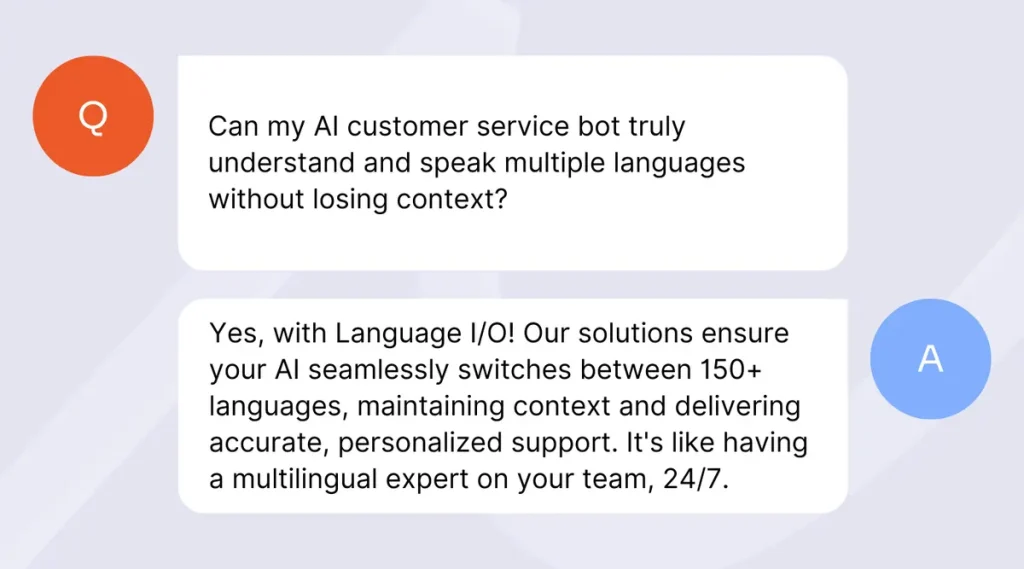
Expanding into international markets? Conversational AI has you covered. With the prowess of Language IO, your AI can fluently interact with customers in over 150 languages, eliminating the need for a battalion of multilingual agents.
Imagine you have a customer in Paris who prefers assistance in French. Your AI, equipped with Language IO’s translation capabilities, seamlessly converses en français, making the customer feel right at home.
3. Improved Operational Efficiency
Time is money, and conversational AI saves both. By automating routine inquiries, your human agents can focus on complex issues that require a personal touch. This division of labor streamlines operations and boosts productivity.
Perhaps you’re an e-commerce platform that receives numerous questions about order statuses. The AI handles these effortlessly, freeing human agents to assist with more intricate concerns, such as troubleshooting payment issues.
4. Reduced Support Volume
By addressing common questions and concerns, conversational AI reduces the influx of support tickets, ensuring that pressing matters receive prompt attention.
Take, for example, a telecom company that implements an AI assistant to handle routine billing inquiries. The introduction of conversational AI will lead to a significant drop in call center volume and shorter wait times for customers with complex issues.
5. Enhanced Data Analytics
Conversational AI doesn’t just talk the talk; it walks the walk by gathering and analyzing data from customer interactions. This treasure trove of information helps businesses understand customer behavior, preferences, and pain points, informing strategies for improvement.
According to McKinsey, AI-driven analytics provide valuable insights into customer sentiment and behavior, helping companies refine their support strategies.
For example, a gaming company can analyze AI-driven chat logs to discover that players frequently ask about a specific game feature. This insight prompts the development team to create a tutorial, enhancing user experience.
5 Examples of Conversational AI in Customer Service
Conversational AI in customer service covers a broad range of applications. Let’s take a look at five examples of these.
1. Chatbots
Chatbots are one of the most common applications of conversational AI. These virtual assistants pop up on websites, ready to answer customer questions, guide users through processes, and even facilitate transactions. They help businesses provide instant customer support while reducing the workload on human agents.
Take, for example, an online clothing retailer that uses a chatbot to assist shoppers with size recommendations, order tracking, and return processing. Instead of waiting for an email response, customers get immediate assistance, enhancing their overall shopping experience.
2. Voice Assistants
Voice assistants take customer support to the next level by enabling hands-free interactions. These AI-powered tools, such as Amazon’s Alexa or Apple’s Siri, allow users to make inquiries, set reminders, and control smart devices simply by speaking.
One example of where voice assistants can be integrated into its customer support system is a telecom provider. Here, customers can check their data usage, pay bills, and troubleshoot connectivity issues using voice commands. This reduces the need for customers to navigate complex menus and improves satisfaction.
3. Agent Assistance Bots
Unlike customer-facing chatbots, agent assistance bots work behind the scenes to support human representatives. These bots provide real-time recommendations, retrieve customer data, and suggest appropriate responses, making human agents more efficient and effective.
Imagine a financial services company that equips its customer support team with an AI-powered assistance bot. When a customer calls in about a suspicious transaction, the bot instantly pulls up the transaction history, relevant fraud policies, and suggested next steps, allowing the agent to provide quick and accurate resolutions.
4. AI-Powered Email Assistants
Email remains a major channel for customer service, and AI-powered assistants are making it more efficient. These tools can automatically categorize emails, draft responses, and escalate issues based on priority, reducing response times and improving service quality.
Take, for example, a SaaS company that uses an AI email assistant to handle incoming customer inquiries. The AI sorts emails into categories like billing, technical support, and feature requests, drafting personalized responses for common queries while flagging complex issues for human agents.
5. Social Media Messaging Bots
Customers often turn to social media for quick responses to their questions and concerns. AI-powered messaging bots help brands engage with customers on platforms like Facebook Messenger, WhatsApp, and Twitter, providing real-time support where users already spend their time.
An example of this is if a global airline integrates a social media chatbot to assist passengers with flight status updates, baggage policies, and check-in procedures. Travelers receive instant responses, reducing call center congestion and improving the airline’s customer service reputation.
Industries That Use Conversational AI for Customer Service
Conversational AI can be effectively utilized across a range of industries and sectors to enhance customer service and support.
1. Travel
The travel industry thrives on quick responses and seamless booking experiences. AI chatbots help customers find flights, book accommodations, and resolve travel disruptions instantly, making journeys stress-free.
An airline that uses conversational AI to provide real-time flight updates, rebook canceled flights, and assist travelers in multiple languages ensures smooth communication across different time zones. Language IO ensures that these AI assistants offer precise translations, eliminating miscommunication between travelers and airlines.
2. Retail
Conversational AI enhances retail by streamlining customer support, providing product recommendations, and facilitating faster checkouts. AI-powered assistants help customers find items, process refunds, and track deliveries.
An online fashion retailer that integrates AI chatbots suggesting outfit pairings, processing returns seamlessly, and offering customer support in multiple languages through Language IO’s translation technology can expand their global reach effortlessly.
3. Fintech
Fintech companies rely on AI to provide instant account support, fraud alerts, and financial advice. AI-powered virtual assistants guide customers through transactions, security checks, and investment strategies.
Take, for example, a digital payment platform that employs AI chatbots to verify transactions, detect suspicious activities, and assist users with account issues. With Language IO’s multilingual capabilities, fintech companies ensure secure and precise customer interactions worldwide.
4. Finance
The finance industry uses conversational AI to improve customer interactions by automating queries about loans, interest rates, and investment options, making financial advice more accessible and efficient.
A financial advisory firm can use AI assistants to educate customers about different investment plans and answer tax-related queries. Language IO allows these AI assistants to provide accurate financial information to clients in their preferred language, boosting trust and engagement.
5. Gaming
Gaming companies use conversational AI to provide real-time customer support, assist with technical issues, and enhance the gaming experience by offering in-game tips and community engagement.
An online gaming platform can integrate AI-powered assistants to help players troubleshoot game crashes, provide patch updates, and moderate in-game chats. With Language IO, these AI bots communicate fluently with gamers worldwide, ensuring an inclusive and immersive experience.
6. Entertainment
Streaming services, media companies, and digital content platforms leverage conversational AI to provide customer support, manage subscriptions, and recommend personalized content.
A global streaming service can employ AI chatbots to assist users with subscription changes, troubleshoot playback issues, and provide recommendations based on viewing history. Language IO enables these chatbots to communicate with subscribers in multiple languages, ensuring seamless interactions for international audiences.
Looking for a Professional Multilingual Conversational AI Solution for Customer Service?
At Language IO, we specialize in providing cutting-edge multilingual conversational AI solutions that integrate with your existing communication tools and are tailored to your business needs.
Our technology ensures seamless and personalized customer interactions across various languages, helping you expand your global reach and enhance customer satisfaction. Learn more about how AI customer service software is transforming customer service.
Final Thoughts on Conversational AI for Customer Service
Conversational AI isn’t just a fancy tech trend—it’s a game-changer for businesses looking to streamline customer support, boost efficiency, and deliver personalized experiences. With 24/7 availability, multilingual capabilities, and data-driven insights, it’s like having a super-powered customer service team that never takes a break.
And when you integrate Language IO into the mix, your AI becomes a global communication powerhouse. So, if you’re still relying on old-school methods, it’s time to level up—because the future of customer service is here, and it’s fluent in every language.
FAQs
What are the most common approaches to deploying conversational AI for voice?
The most common approaches include cloud-based APIs, on-device processing, and hybrid models. Cloud-based solutions, like Amazon Alexa or Google Assistant, use powerful servers to handle complex language processing.
On-device processing, often used in smartphones or IoT devices, offers faster response times and increased privacy.
Hybrid models combine both approaches, using on-device processing for quick tasks and cloud computing for more advanced queries. Integration with telephony systems (like IVR) and custom voice applications are also popular for businesses looking to enhance customer service experiences.
What to look for in a conversational AI platform for customer service?
Key factors to consider include:
- Natural Language Understanding (NLU): The AI’s ability to accurately interpret customer intent
- Omnichannel Support: Seamless integration across platforms like chat, email, social media, and voice
- Customization and Scalability: Ability to tailor conversations and scale as your business grows
- Analytics and Reporting: Tools for tracking performance and customer engagement
- Security and Compliance: Adherence to data protection standards like GDPR or HIPAA
- Human Handoff: Smooth transition to human agents when necessary
Security in an AI-driven landscape
A practical guide for CX leaders
Are chatbots the same as conversational AI?
No, chatbots and conversational AI are not the same. Chatbots are often rule-based systems designed for specific tasks, like answering FAQs or guiding users through simple processes.
Conversational AI, on the other hand, uses advanced technologies like natural language processing (NLP) and machine learning to understand context, manage more complex interactions, and improve over time. While all conversational AI can function as chatbots, not all chatbots use conversational AI.
How is conversational AI different from generative AI?
Conversational AI focuses on creating human-like interactions through voice or text by understanding and responding to user input in a coherent, context-aware manner. It’s typically used in customer service, virtual assistants, and interactive applications.
Generative AI, however, refers to systems that can create new content—such as text, images, music, or code—based on training data. While conversational AI can use generative AI for responses (as seen in tools like ChatGPT), generative AI itself has broader applications beyond conversations.
Can you use ChatGPT for customer service?
Yes. However, ChatGPT and similar AI models aren’t secure and can put sensitive customer data at risk. Language IO’s platform guarantees customer security and safety through encryption and zero data retention.