How to Run a Translation POC That Actually Leads to a Decision
Most translation POCs end the same way: inconclusive results, stakeholders with different takeaways, and no clear path forward. Here’s how to run one that actually produces a decision.
By Language IO
Table of Contents
Most teams don’t notice when their proof of concept quietly turns into something else. It usually begins as a structured evaluation when a vendor is given access to a test environment, a small group of agents is brought in, and the plan is to run it for a few weeks.
Over time, that structure starts to loosen. More stakeholders want input, feedback comes in from different directions, and it becomes harder to reconcile what people are seeing. One agent says it’s faster, another says it feels off, and someone flags an issue in Japanese that no one else can reproduce.
By week five, the team isn’t closer to a decision. Instead they’re sitting on a pile of conflicting opinions. That outcome isn’t a reflection of the technology as much as it is the process.
The Real Questions Isn’t “Does It Work”?
Most translation POCs are built around a question that doesn’t need answering. Teams focus on whether a system can translate messages between languages, even though that capability is already table stakes.
Every option can produce readable output, which makes it easy to assume the problem is solved. In practice, the issue isn’t whether translation happens, but how it performs under the conditions your support team actually operates in.
What matters is whether the system can handle the reality of multiple languages with different structures, inconsistent product terminology, agents working quickly under pressure, and customers who are not writing clean, well-formed sentences. A translation that looks fine on its own can still introduce friction once it’s part of a live interaction, especially in languages where tone, formality, or dialect carry meaning beyond the literal words.
If a POC doesn’t account for that, it ends up answering a question that was never the real concern.

Where Most Teams Go Wrong: No Baseline, No Context
One of the fastest ways to undermine a POC is to skip establishing a baseline. It often feels more efficient to jump straight into testing the new system, particularly when there’s pressure to show progress quickly.
The problem is that without a clear understanding of how multilingual support performs today, there’s nothing concrete to compare against, which makes every result harder to interpret. In that environment, improvements tend to feel subjective and regressions are easy to miss.
Feedback gets filtered through individual experience rather than shared data, which makes it difficult to separate real change from perception. The teams that get meaningful signals out of a POC take a different approach.
They start by pulling a few hundred real support interactions and looking closely at what’s already happening: where certain languages consistently take longer, where escalations tend to cluster, and what agents do when they don’t trust a translation.
In most organizations, that last behavior is already happening informally. Agents copy and paste into other tools, rephrase responses, or avoid certain interactions altogether. That context shapes how every result in the POC should be interpreted, because without it, you’re effectively comparing against a moving target.
A “Clean” Test Environment Give You the Wrong Answer
As the POC gets underway, there’s a natural tendency to smooth out the environment so the system performs well. Glossaries get simplified, edge cases are filtered out, and the setup is controlled in a way that makes early results look consistent.
While that approach can make the rollout feel more stable, it also removes the exact conditions that tend to cause problems later. Real support environments are rarely clean. Customers send long, emotional messages, mix languages, use slang, and reference product details inconsistently. Agents are working quickly and don’t have the time to second-guess every translation they see.
A system that performs well under curated conditions can still struggle once that variability is introduced, which is why those conditions need to be part of the evaluation.

Teams that get real value from a POC resist the urge to optimize the setup. They use their actual glossary, even if it’s incomplete, and they run real tickets instead of controlled samples. They also limit how much they prepare agents in advance, because any friction in adoption is part of the evaluation itself.
Subjective Feedback Is Where POCs Start to Drift
By the midpoint of most POCs, the conversation often starts to lose structure. Instead of focusing on concrete observations, feedback becomes more general and harder to act on. The system feels faster, the translations seem better, and there’s a sense that things are improving, but no one can clearly point to where or by how much. At the same time, isolated issues tend to carry more weight than they should, simply because they stand out.
This is where the evaluation either tightens or begins to unravel. The teams that stay on track shift the discussion away from impressions and toward specific, repeatable signals. They look at how handle time compares to the baseline they established earlier, track where escalation rates change, and document examples where the translation clearly improved or degraded an interaction.
They also make a point to test scenarios that are easy to overlook but common in practice, such as technical explanations, emotionally charged complaints, or messages that include abusive language the agent can’t interpret. Those situations are often where systems struggle, and they rarely show up in controlled demos. Testing them directly provides a clearer view of how the system will perform once it’s in production.
Agent Feedback Only Matters If It’s Specific
Agent feedback plays a critical role in a POC, but only if it’s grounded in actual usage. Broad questions like “Do you like it?” tend to produce surface-level answers that don’t reveal much about how the system will perform over time. Preference alone doesn’t indicate whether agents will trust the system when interactions become more complex or high-stakes.
More useful feedback comes from asking agents to describe specific moments where the system either helped or created friction. When those examples are tied to real interactions, patterns start to emerge. Certain languages may perform consistently well, while others introduce subtle issues that build over time. Terminology may hold in shorter exchanges but begin to drift in longer conversations, especially when context becomes more complex.
That level of detail makes it possible to distinguish between issues that can be addressed and limitations that are inherent to the approach. Without it, feedback remains too general to support a confident decision.

A POC Without a Decision Date Isn’t a POC
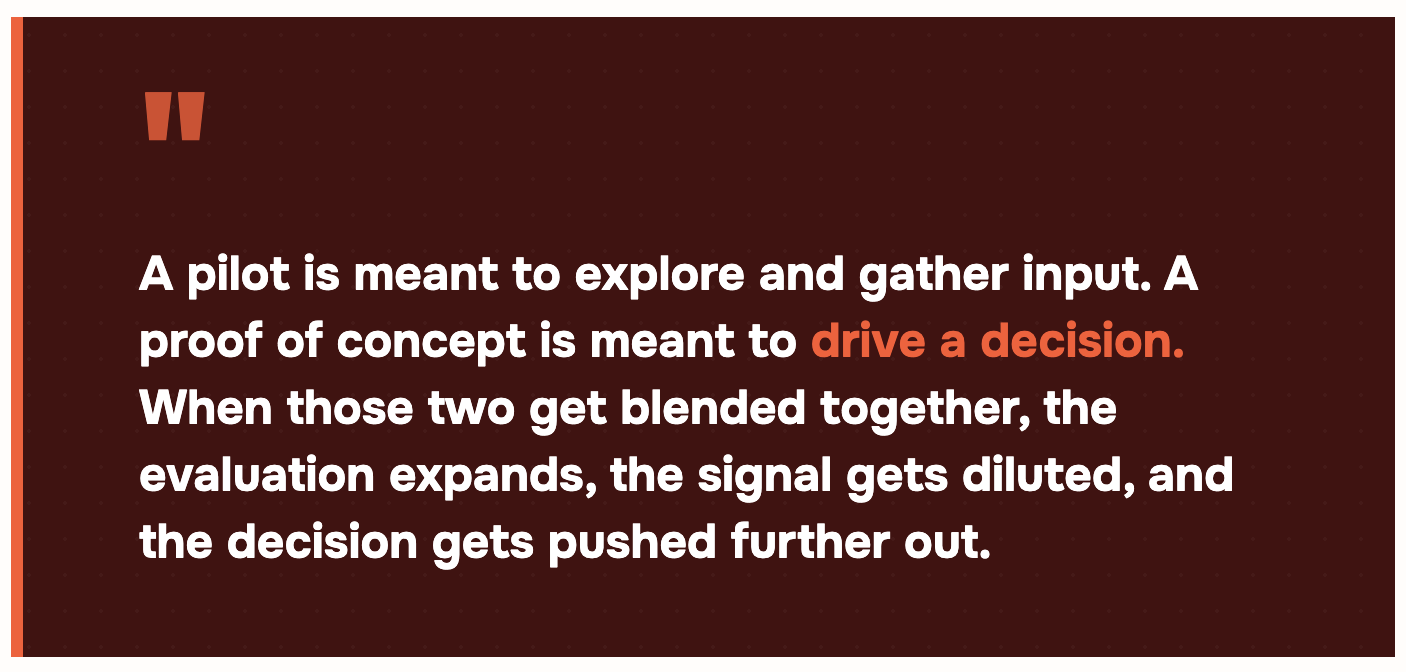
One of the clearest signs that a POC is drifting is that the end date keeps moving. There’s always a reasonable explanation: more data would help, another language should be tested, or a configuration tweak might improve the results. While each of those points is valid on its own, together they shift the process back into exploration mode.
Teams that reach a decision approach this differently. They set the end date at the beginning and treat it as fixed, which forces clarity around what the POC is meant to achieve. Success criteria are defined upfront, and the focus stays on collecting the data needed to support a decision rather than expanding the scope. That constraint creates a natural point where the organization has to decide whether the evidence is sufficient to move forward.
Without that discipline, the evaluation continues to expand and gradually loses its purpose.
What a Good POC Actually Produces
A successful POC doesn’t prove that a solution is perfect. Instead, it makes the tradeoffs visible in a way that’s grounded in real usage. By the end of a well-run evaluation, the team understands how the system performs across the languages that matter most, where it improves speed, where it introduces risk, and how agents interact with it under real conditions.
Just as importantly, the team has seen where the system breaks. Not in theory, but in practice, based on actual interactions from their own environment. That visibility is what enables a decision to happen, because it replaces assumptions with evidence and makes the implications of each option clear.
Why This Matters More Than the Tool You Choose
Most organizations don’t get stuck because they chose the wrong option. They get stuck because they never created the conditions to evaluate their options clearly in the first place. Without structure, the evaluation produces more noise than signal, which makes it difficult to move forward with confidence.
A well-run POC changes that dynamic by grounding the conversation in real data from your own environment. It replaces abstract discussions with concrete examples and shortens the distance between evaluation and decision. Instead of debating what might happen, the organization is responding to what it has already observed.
That shift becomes more important as complexity increases. When you’re dealing with multiple languages, higher volumes, and more nuanced interactions, translation stops being a simple feature and starts functioning as a system your team depends on. Making the right decision at that point requires an evaluation process that reflects that reality.
Discover More
-
Why “Just Use an LLM” Breaks Down in Real Customer Support
Every enterprise exploring AI for customer support eventually arrives at the same fork in the road. One path leads toward building something internally with a model like Gemini or ChatGPT. The other relies on whatever translation capability is already bundled inside the CRM or CCaaS platform. Engineering teams assume the problem is mostly API calls…
-
You’re Solving the Wrong Problem
You have done the right things. You built the training programs. You created escalation paths. You brought in consultants and rolled out resilience curricula and made sure every agent knew what to do when a customer crossed the line. The intentions were good. The investment was real. And your burnout rate is still 59 percent.