Large language models have dramatically improved machine translation capabilities by learning to understand context, idioms, and cultural nuances rather than just performing word-for-word translations.
Unlike earlier statistical translation systems, LLMs can maintain consistency across long passages, preserve tone and style, and handle specialized technical or literary content with impressive accuracy.
The models have become particularly good at understanding the intent behind idiomatic expressions and finding appropriate equivalent phrases in target languages rather than producing awkward literal translations.
This article will explain their key features, best uses, and future possibilities.
What Are Large Language Models?
Large Language Models (LLMs) are advanced artificial intelligence systems that process and generate human-like text by recognizing patterns in language.
These models are trained on vast amounts of text data using deep learning techniques, particularly transformer architectures, which allow them to learn the statistical relationships between words and phrases.
During training, LLMs learn to predict the next word in a sequence by analyzing billions of examples, developing an implicit understanding of grammar, facts, and even some reasoning capabilities.
The models work by processing input text through multiple layers of neural networks, where each layer captures different aspects of language, from basic syntax to complex semantic relationships.
Context is crucial for LLMs because they interpret and generate text based on the surrounding information provided – just as humans understand words differently depending on their context, LLMs rely heavily on contextual information in their input prompts and training data to produce meaningful and appropriate responses.
This makes them effective in many applications, from text generation to machine translation.
LLMs develop their understanding of linguistic nuances and complexities through exposure to diverse examples of human communication during training.
As they process vast amounts of text, they learn to recognize subtle patterns in how words change meaning based on tone, cultural context, and social situations.
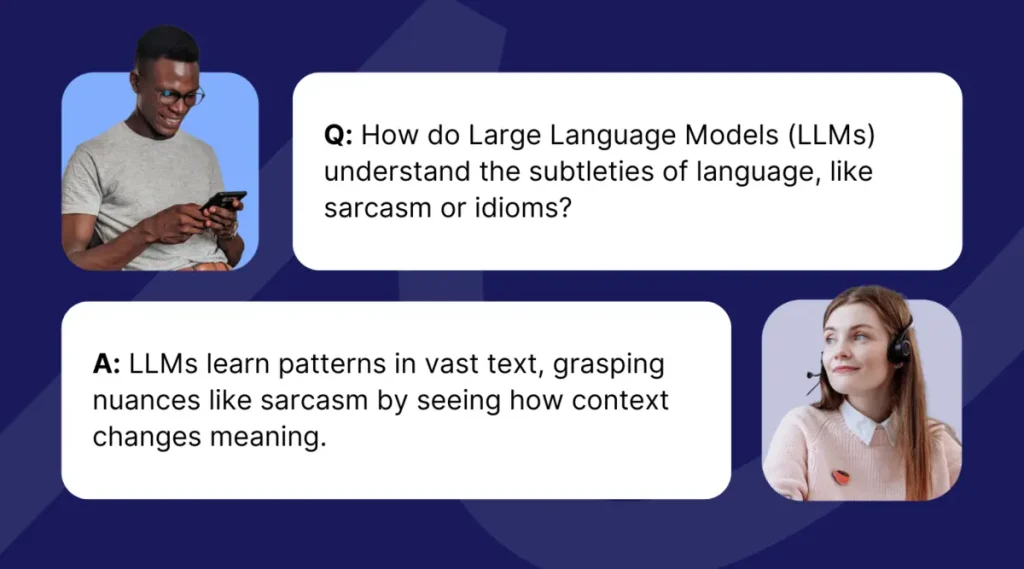
They begin to grasp concepts like sarcasm, humor, and metaphor by observing how these elements appear in different contexts and how they modify the literal meaning of words.
The models can identify emotional undertones in language by learning the associations between certain word choices, sentence structures, and the emotional content they convey.
They also develop an understanding of idiomatic expressions, regional variations in language use, and how context can completely transform the interpretation of a phrase.
This sophisticated pattern recognition allows LLMs to go beyond simple word-for-word translation and engage with the rich, layered nature of human communication.
However, their understanding remains fundamentally pattern-based rather than rooted in lived experience.
LLMs are integrated into various modern tools and applications across different sectors. Search engines use them to understand user queries better and provide more relevant results.
5 Benefits Of Using A Large Language Model For Translation
Large language models (LLMs) make translations faster, more accurate, and easier to use. They bring many benefits. They better understand context and handle many languages in one tool.
1. Enhanced Accuracy
LLMs enhance translation accuracy through several sophisticated mechanisms beyond traditional word-for-word translation approaches. By understanding context at a deeper level, they can capture the source text’s intended meaning and cultural nuances.
For example, when translating idiomatic expressions, LLMs can recognize when a literal translation would be inappropriate and instead generate an equivalent phrase with the same meaning in the target language. They also maintain consistency throughout longer texts by remembering previous context and terminology choices.
LLMs are particularly effective at handling technical terminology and specialized vocabulary because they recognize domain-specific language patterns and maintain appropriate formality levels. Their ability to process entire sentences and paragraphs as cohesive units helps them preserve grammatical relationships and sentence structure natural to the target language rather than producing awkward direct translations.
Additionally, LLMs can adapt to different writing styles and tones, ensuring that formal documents remain formal and casual conversations stay casual in the translated version. This contextual awareness also helps them resolve ambiguities in languages where words can have multiple meanings, choosing the most appropriate translation based on the surrounding text and overall context of the document.
2. Multilingual Capabilities
LLMs handle multiple languages through their comprehensive training on diverse linguistic data sets and their ability to recognize underlying patterns across different language systems. During training, these models are exposed to text in numerous languages, allowing them to develop representations of how other languages express similar concepts.
They learn to identify common linguistic structures and patterns that exist across languages, such as subject-verb relationships, tense marking, and word order rules. This cross-lingual understanding enables them to transfer knowledge between languages, so insights learned from one language can help process another.
Modern LLMs can seamlessly switch between languages within the same conversation because they maintain a unified internal representation of language concepts rather than treating each language as a separate system. They can recognize when language switching occurs and maintain coherent understanding across these transitions.
The models also learn to handle different writing systems, character sets, and text directionality, making them capable of processing languages as diverse as English, Mandarin, Arabic, and Hindi. Their ability to identify language patterns helps them work even with languages that were less represented in their training data. However, their proficiency typically correlates with the training data available for each language.
3. Contextual Understanding
LLMs provide contextual understanding by analyzing relationships between words and concepts within the given text. When analyzing text, LLMs don’t just look at words in isolation – they consider how each word relates to every other word in the context window, allowing them to grasp both immediate and broader context.
For example, in understanding the word “bank,” an LLM would analyze surrounding words and phrases to determine whether it refers to a financial institution or the edge of a river. The models maintain this contextual awareness throughout longer conversations or documents by keeping track of previously mentioned information, recurring themes, and established references.
Their transformer architecture allows LLMs to handle long-range dependencies, meaning they can connect information mentioned far apart in the text. This enables them to maintain coherence in extended discussions, understand references to earlier points, and provide responses that consider the full context of a conversation. The models also learn to recognize different types of context – from formal academic discussions to casual conversations – and adjust their understanding and responses accordingly. This contextual awareness extends to understanding implied information, helping them grasp subtleties like tone, intent, and unstated assumptions that human readers naturally pick up on.
4. Scalability
LLMs are particularly valuable for scaling machine translations due to their key advantages. At a fundamental level, their ability to handle multiple languages simultaneously means a single model can translate between numerous language pairs, eliminating the need for separate models for each language combination. This drastically reduces the infrastructure and maintenance requirements compared to traditional translation systems.
5. Speed and Efficiency
LLMs significantly improve translation speed and efficiency through several key mechanisms. They can process multiple sentences simultaneously rather than translating word by word, allowing for rapid parallel processing of large texts.
In practical terms, this means LLMs can translate entire documents in seconds or minutes rather than hours while maintaining consistency throughout. Their ability to handle multiple language pairs within a single model eliminates the overhead of switching between different translation systems. This is particularly efficient for organizations dealing with content in multiple languages, as they can use one system rather than managing separate translation pipelines for each language pair.
The efficiency gains also come from a reduced need for human post-editing. Because LLMs understand context and maintain consistency in terminology and style, they produce more accurate initial translations that require less correction. Their ability to learn from patterns means they can adapt to specific terminology and writing styles, becoming more efficient at handling domain-specific content over time. This reduces the back-and-forth typically needed to refine translations, streamlining the overall translation workflow.
Unleash Conversational AI: Rapidly Expand into Global Markets and Unlock the Future of Customer Support
Join us for a Masterclass: Unlock practical insights on reducing support operations costs by up to 60% with conversational AI.
Different Approaches To Large Language Models Translation
Large Language Models (LLMs) use various methods to improve machine translation. These methods include prompting and fine-tuning. Another approach is zero-shot translation. Knowing these different approaches can help you conduct your own machine translation evaluation.
Challenges Of Large Language Models In Machine Translation
Large Language Models (LLMs) hold great promise. But, they face big challenges in machine translation. Addressing these challenges is crucial for improving translation quality and reliability. How different LLMs handle these challenges is also important in choosing the best LLM for translation.
1. Computational Resources
LLMs need extensive computational power. These models need powerful GPUs and lots of memory. This makes them too expensive for small organizations. This high cost can slow the translation of massive text blocks.
2. Data Quality and Biases
The quality of data used to train LLMs plays a critical role. Poor-quality data can lead to bad translations. Also, biases in the training data can skew the model’s translations. This can perpetuate stereotypes.
3. Context Sensitivity
Handling context is critical in translations, especially for longer texts. LLMs often struggle to maintain context in long texts. This can lead to disjointed translations. Ensuring coherence and consistency is a persistent issue.
4. Resource Languages vs. Low-Resource Languages
LLMs perform better with languages that have abundant data resources. Low-resource languages, which lack extensive training data, often experience lower translation quality. Balancing the accuracy of translation across diverse language pairs remains a challenge.
5. Fine-Tuning and Customization
Fine-tuning and customizing an LLM is like teaching a skilled language expert to specialize in your specific field or way of communicating. Imagine you have a general-purpose translator who’s good at many languages, but you want them to excel at translating medical documents specifically.
The process starts by collecting examples of the language and content you want the model to handle – in this case, medical terminology and documentation. These examples are carefully selected to represent the specific style, terminology, and formats that you want the model to learn.
The model then goes through additional training using these examples, learning to recognize and apply the patterns specific to your needs. It’s similar to giving your translator focused practice with medical texts so they become more familiar with medical terms and writing styles.
During this process, the model maintains its general language understanding while developing expertise in your specific area. The model can also be taught to follow specific formatting rules, use preferred terminology, or maintain particular writing styles. This customization helps the model become more accurate and reliable for your particular needs, much like a translator who has specialized in your industry and understands exactly how you want your content handled.
6. Ethical and Privacy Concerns
Data privacy should be considered as LLMs are trained on vast amounts of text, including sensitive personal information, copyrighted material, or confidential data. When using LLMs for translation or content generation, there’s a risk that private information could be inadvertently exposed or retained within the system. It is important to understand how each model uses data for training; this should be something you ask any AI company you work with about.
Bias is another crucial issue, as LLMs can perpetuate and amplify societal biases in their training data, potentially leading to unfair or discriminatory outputs in different languages and contexts.
7. Linguistic Nuances
Capturing linguistic nuances for training an LLM requires a sophisticated approach to data collection and processing that goes beyond simple word-to-word relationships. The training process must incorporate diverse examples of language use that showcase how meaning changes with context, tone, and cultural background. This includes gathering samples of formal and informal language, regional variations, idioms, humor, and cultural references that demonstrate how the same words can carry different meanings in different situations.
The training data needs to include examples of subtle emotional undertones, sarcasm, metaphors, and other figurative language that humans naturally understand but machines traditionally struggle with. It’s also crucial to include examples of how context modifies meaning – for instance, how professional jargon differs across industries or how the exact phrase might be interpreted differently in various cultural contexts.
The training must account for how language evolves, incorporating contemporary usage patterns and emerging expressions. This requires continuously updating training data to reflect current language use while maintaining an understanding of historical contexts. Additionally, the training must capture paralinguistic elements like emphasis, tone, and subtext that are often conveyed through word choice and sentence structure rather than explicit statements.
Final Thoughts on LLMs in Machine Translation
Large Language Models represent a transformative advancement in artificial intelligence, fundamentally changing how we process and interact with language.
These sophisticated systems, trained on vast amounts of data, demonstrate remarkable capabilities in understanding context, handling multiple languages, and facilitating efficient translations.
LLMs excel particularly in translation tasks, where their contextual understanding and ability to process multiple languages simultaneously have revolutionized machine translation, making it faster, more accurate, and more scalable than ever before.
Their ability to grasp linguistic nuances, maintain consistency across long texts, and adapt to different domains makes them invaluable tools for global communication.
FAQS
What are the benefits of using an LLM for translation?
LLMs excel at translation through their powerful contextual understanding, enabling them to capture meaning rather than just converting words. They maintain consistency across long documents by remembering terminology choices and context from previous sections. Their ability to handle multiple language pairs in a single model makes them highly efficient and scalable, eliminating the need for separate translation systems for each language combination.
The quality improvements come from their grasp of nuances and cultural context – they can recognize idioms, adjust formality levels, and preserve the intended tone of the original text. They can adapt to different domains like legal or medical terminology for specialized content while maintaining appropriate technical language throughout.
From an efficiency standpoint, LLMs process translations in parallel rather than sequentially, dramatically reducing translation time for large documents. They can handle multiple file formats and automatically preserve document formatting, streamlining the workflow. Their ability to learn from patterns means they become more effective at handling specific types of content over time.
Most importantly, LLMs can leverage knowledge between languages, helping improve translations even for languages with limited training data. This makes them particularly valuable for expanding translation capabilities to serve a broader range of languages and communities.
How do translation LLMs handle low-resource languages?
Translation LLMs handle low-resource languages through several sophisticated approaches. First, they utilize transfer learning, where knowledge gained from processing high-resource languages can be applied to understand similar patterns in low-resource languages, particularly among languages that share linguistic features or come from the same language family. For example, patterns learned from Spanish might help process Catalan or Portuguese, even with limited training data for these languages.
The models also employ few-shot and zero-shot learning techniques, allowing them to make reasonable translation attempts even with minimal direct training examples. They achieve this by recognizing universal linguistic patterns and applying them to new language contexts. Cross-lingual embeddings play a crucial role, creating a shared semantic space where words and concepts from different languages can be mapped together, helping the model bridge gaps in direct translation pairs.
Data augmentation techniques are often used to expand the available training data for low-resource languages artificially. This might involve back-translation, where content is translated from the low-resource language to a high-resource one and back again, creating additional training examples. Another approach is to use parallel texts from religious or legal documents, often available in many languages, providing reliable training data even for languages with limited digital presence.
Multilingual models also benefit from language clustering, which groups similar languages and shares learned features. This helps in bootstrapping capabilities for low-resource languages by leveraging knowledge from their better-resourced relatives. However, challenges remain in achieving the same level of translation quality as with high-resource languages, and ongoing research focuses on developing more effective methods for improving low-resource language support.