Google Translate has become the pocket translator for millions of students, travelers, and late-night texters trying to decode what their international crush just said. It’s free, it’s fast, and it’s surprisingly good at helping you order tapas in Madrid or figure out if that German menu item is actually pork.
But that begs the question: is Google Translate accurate? The short answer is: sort of. Google Translate is great when the stakes are low such as casual conversations, school homework, or translating a funny meme. But when it comes to enterprise translation — conversations with your customers, medical instructions, or roadside assistance — trusting it blindly can pose risks to your business that consumers and travelers do not have.
In this blog, we’ll break down how Google Translate works, where it shines, and where it struggles. We’ll also explore its accuracy by language, and why businesses should think twice before putting their global customer communication in its hands.
TL;DR: Google Translate Accuracy at a Glance
- Is Google Translate accurate?
Yes — for casual use. No — for enterprise. - Where it works well:
Great for students, travelers, and quick low-stakes translations (menus, signs, memes, homework). - Where it falls short:
Not reliable for customer engagement, legal, medical, financial, or technical content where accuracy, tone, and compliance matter. - Accuracy by language:
- Spanish, French, Italian, German: generally strong, but idioms and regional slang cause errors.
- French Canadian: regional vocabulary (e.g., cellulaire vs. portable) can lead to confusion.
- Japanese & Korean: politeness levels, context, and word order often trip it up.
- Chinese: Mandarin vs. Cantonese differences, plus character complexity, reduce accuracy.
- Russian: cases and word order can flip meaning.
- English: widely supported, but regional English (Romanian, Indian, British vs. American) still creates misfires.
- Spanish, French, Italian, German: generally strong, but idioms and regional slang cause errors.
- Enterprise vs. consumer:
Enterprises need glossaries, style guides, and secure workflows. They also need translation engines that handle slang, jargon, and abbreviations — and that offer redundancy if one model goes down. Google Translate doesn’t provide this. - Bottom line:
Google Translate is great for casual use. But for enterprises, Google Translate is not accurate enough. Businesses need purpose-built solutions to ensure translations are reliable, secure, and aligned with brand voice.
How Google Translate Works (and Why It’s Not 100% Accurate)
Before we dive into accuracy, it helps to know what’s going on under the hood. Google Translate uses neural machine translation (NMT) — basically, a giant AI brain trained on billions of sentences across the internet. Instead of translating word by word (like the old days), it looks at context and predicts the most likely meaning of a phrase.
Sounds smart, right? It is. That’s why many people ask “how good is Google Translate?” or even “is Google Translate 100% true?”. The answer: no. It’s not 100% right, and it’s not designed to be. Think of it more like that friend who always has an answer — usually close enough to get the gist, but not someone you’d want arguing your case in court.
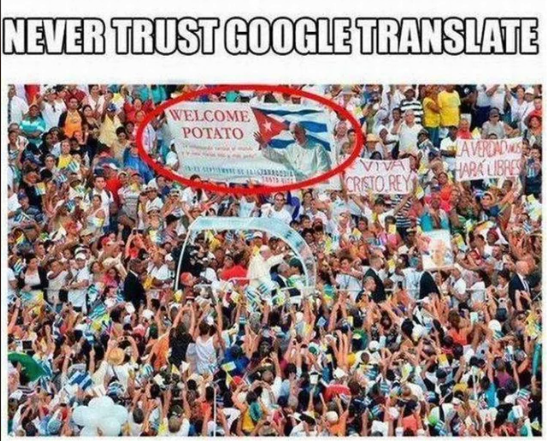
Has Google Translate improved over the years? Definitely. Early versions gave us some comedy gold (“the potato is my father” is a classic mistranslation meme). Today, it’s far more reliable for casual use. But improvement doesn’t mean perfection, especially in specialized or high-stakes scenarios.
Google Translate Accuracy by Language
When people ask “is Google Translate accurate?” The most honest answer is: it depends on the language. Some are much easier for the system to handle, while others are trickier because of grammar, formality, context, or writing systems. Let’s look at a few of the most common ones:
Spanish
For everyday situations, it does a decent job. If you type “Where is the train station?” it’ll get you to the right platform. But idioms or regional slang can throw it off. For example, the phrase “estar como una cabra” literally translates to “to be like a goat,” but really means “you’re a little crazy.”
Regional variety also matters. Spanish in Mexico, Argentina, and Spain can differ dramatically. A simple word like “straw” is pajita in Spain, but in parts of Latin America that word has a very different (and inappropriate) meaning. Google Translate usually defaults to Castilian Spanish, which can confuse Latin American readers.
French
So, is Google Translate accurate for French? Similar story to Spanish — the basics are solid, but the details can get messy. French is notorious for gendered nouns and subtle differences. For example, “Avoir le cafard”” literally means “To have the cockroach,” but in slang it can mean “To feel down or depressed.”. Getting that wrong could make it sound bizarre or insulting if you tell your customers they have cockroaches. That’s why people often ask how accurate Google Translate is for French, and the real answer is: it depends how precise you need to be.
Regional variety adds another wrinkle. Canadian French (Québécois) isn’t just a quirky accent — it has different vocabulary, expressions, and even grammar. In Paris, “cell phone” is téléphone portable; in Quebec, it’s cellulaire. Google Translate often defaults to European French, which can make a Canadian reader raise an eyebrow or chuckle. Having studied in Louisiana, I can also say that watching a Parisienne try to understand Cajun French at Mardi Gras is rather entertaining.
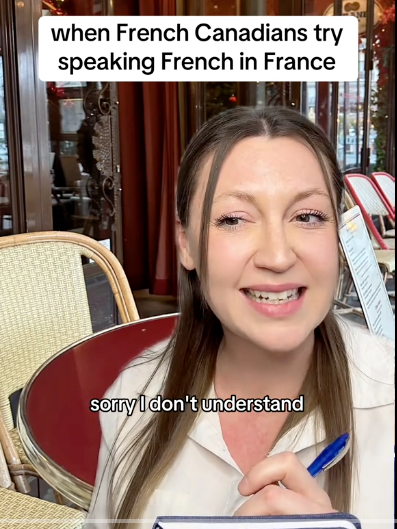
This becomes especially tricky in customer engagement across regions. Imagine a French company running a global support hub. A Senegalese French speaker might describe a technical issue using words unfamiliar to a Parisian agent, while a Quebecois customer might use slang that Google Translate renders incorrectly. The translation may look correct in Parisian French but come across as dismissive or confusing to the actual customer. In CX, that small slip can create frustration and make the brand look out of touch.
Japanese
Japanese is one of the trickiest languages for machine translation. Japanese uses three writing systems (hiragana, katakana, kanji), and meaning often relies heavily on context. That’s already a challenge for AI.
But the real stumbling block is formality and politeness levels. Japanese has multiple registers — casual, polite, honorific — and choosing the wrong one can change the entire tone of your message. For example, the simple phrase “eat” could be taberu (casual), tabemasu (polite), or meshiagaru (honorific). Google Translate usually picks a middle-ground version, which might sound too casual in a business email or too formal in a text to a friend.
This means Google Translate often gets the words right but the tone completely wrong — something a native speaker notices immediately. So while it can help a student decode a homework passage, it’s risky for professional or customer-facing communication.
Chinese
Is Google Translate accurate for Chinese? The answer: it depends on which Chinese you mean.
Simplified Mandarin (the official language of mainland China) is what Google Translate usually defaults to. For simple sentences, it’s serviceable. But because Simplified Mandarin relies on characters with multiple meanings, things often get muddled. For instance, “我请你吃饭” should mean “I’ll treat you to dinner,” but Google Translate might spit out “I invite you to eat rice.” Technically not wrong — but also not quite what you meant.
Then there’s Traditional Chinese, widely used in Hong Kong, Macau and Taiwan. While Google Translate supports it, the system often mixes it up with Simplified Mandarin, leading to awkward phrasing. Cantonese has unique characters and expressions that don’t exist in Simplified Mandarin, which machine translation frequently mishandles.
Finally, Chinese writing is highly context-dependent. Without knowing the situation (formal vs casual, business vs family), Google Translate often picks the most literal version. That’s why a phrase that feels fine in a text thread might come across as robotic or even rude in a professional setting.
The relationship between dialects and writing systems can also be confusing. While a Mandarin speaker in Beijing would typically use Simplified Mandarin, and a Cantonese speaker in Macau would use Traditional Chinese, a Taiwanese Mandarin speaker would also use Traditional Chinese.
So while Google Translate is helpful for travelers navigating menus or signs, relying on it for customer support or business deals in Chinese is like relying on emojis to close a contract — you might get the gist, but you won’t look professional.
German
German is easier for machine translation than with Japanese or Korean, but still far from perfect. German grammar is highly structured, with cases that affect nouns, articles, and adjectives, and Google Translate often simplifies these in ways that sound unnatural to native speakers. Add in compound words — Germany’s favorite linguistic invention — and the cracks show quickly. A single term like Geschwindigkeitsbegrenzung (“speed limit”) or Krankenhausverwalter (“hospital administrator”) might get split apart into literal pieces, which conveys the gist but strips away precision.
This becomes especially problematic in technical or legal contexts, where compound terms aren’t just stylistic, but essential for clarity. In engineering documents, a mistranslated compound word could change the specification of a part. In contracts, a slight grammatical slip could affect interpretation of liability or responsibility. Google Translate captures the broad strokes, but “close enough” doesn’t work when compliance, safety, or legal risk is involved.
For casual use — reading a menu in Berlin or sending a quick note to a friend — Google Translate is handy. But when accuracy and nuance matter, especially in enterprise settings, its limitations become obvious.
Russian
For Russian, Google Translate may be decent for short, simple sentences, but unreliable for anything nuanced.
The first challenge is cases. Russian has six grammatical cases, which change the endings of nouns and adjectives depending on their role in the sentence. For example: я люблю собаку (“I love the dog”) vs. собака любит меня (“the dog loves me”). Both contain “dog” (sobaka), but in different forms. Google Translate sometimes stumbles here, mixing up who is doing the action and who is receiving it — which can completely flip the meaning.
The second issue is word order flexibility. Russian allows for multiple word orders to emphasize different parts of a sentence. Native speakers hear these differences immediately, but Google Translate often flattens everything into the most literal structure. The result: the meaning is preserved, but the nuance and emphasis disappear.
There’s also tone and formality. Like Japanese and Korean, Russian has informal (ты) and formal (вы) ways of saying “you.” Google Translate usually defaults to вы, which is polite but can sound distant or overly formal with friends or family.
Finally, cultural context matters. A phrase like ни пуха ни пера literally translates to “neither down nor feather,” but it’s actually a way to wish someone good luck. A literal Google Translate rendering would leave most learners scratching their heads.
So while Google Translate can help you follow the gist of a Russian news article, it’s not reliable for professional communication. In customer support or legal contracts, even a small case-ending mistake could lead to big misunderstandings.
Korean
The truth is that Korean is one of the hardest languages for machine translation. A big reason is the built-in politeness levels. A simple verb like “to go” can be gada (plain), gayo (polite), or kaseyo (honorific). Google Translate usually picks the middle option, which may sound fine in some cases but can feel awkwardly stiff with friends or insufficiently respectful in business.
Word order also causes problems. Korean follows a subject-object-verb structure, unlike English’s subject-verb-object. So a phrase like “The worker installed the part” looks more like “Worker part installed.” Humans get it; algorithms often scramble the flow, especially in longer technical sentences.
Then there’s context. Korean words often carry multiple meanings that only make sense when paired with the right situation. For example, “기” (gi) might mean “energy,” “machine,” or “record.” Without context, Google Translate can pick the wrong one entirely.
Now imagine this in a manufacturing setting. A line such as “The machine must be shut down immediately if a part overheats” could get muddled — with the word for “machine” or “part” swapped or softened, leading to dangerous misinterpretation. Fine for casual chatting, but unacceptable when worker safety or equipment reliability is on the line.
This is why Google Translate accuracy for Korean is notoriously low. The language demands nuance that algorithms aren’t yet able to consistently deliver, making it risky for enterprise or technical use.
Italian
Italian is generally easier for machine translation than Japanese, Korean, or Russian. For basic phrases, it does well — “Dov’è il bagno?” (Where’s the bathroom?) will come through just fine. But Italian, like French and Spanish, is rich with idioms and cultural expressions. Phrases like “Acqua in bocca” (literally “Water in your mouth,” meaning “don’t say a word”) or “Essere come il prezzemolo” (literally “to be like parsley”) meaning “to be everywhere”) get flattened into nonsensical literal translations.
The risk becomes clear in customer engagement. Imagine an Italian customer writing, “Il pacco non è arrivato, e sono davvero arrabbiato” (“The package hasn’t arrived, and I’m really upset”). Google Translate may render this literally, but miss the emotional tone. A brand might respond too formally, too casually, or without enough empathy — creating friction instead of resolution. In customer experience, these nuances are everything.
English
It might sound strange to ask, is Google Translate accurate for English? After all, English is often the default language for business. But the reality is more nuanced. Because English is so widely used, Google Translate has an enormous training dataset for it, which usually means higher accuracy. Still, the tool often struggles with idioms, tone, and specialized vocabulary.
The bigger challenge comes in global customer support environments. Many contact centers are based in countries like Romania, the Philippines, or India, where English is spoken fluently but differently. Local idioms, grammatical structures, and even spelling conventions (color vs. colour) can trip up Google Translate when it tries to normalize everything into “standard English.”
Imagine a Romanian agent writing to a U.S. customer: “We will revert shortly.” Perfectly natural in Eastern European business English, but to an American customer it might sound confusing — like they’re about to undo something. Google Translate doesn’t catch these subtleties; it just spits out what looks like correct English.
So even in the most resourced language, Google Translate accuracy isn’t 100% true. It smooths things into “good enough” English, but in customer service, “good enough” can easily become confusing or tone-deaf.
Connected Conversations: The Enterprise Playbook for Scalable, Secure Multilingual Voice Support
Learn how to scale real-time voice support across 25+ languages without hiring, waiting, or losing the human touch.
Where Google Translate Works Well
After looking at all these tricky examples, you might be wondering: how good is Google Translate for everyday use? The truth: it’s actually fantastic — as long as the stakes are low.
- Students: Need to check your Spanish homework or figure out what that Shakespeare quote looks like in Japanese? Google Translate can give you a fast confidence check.
- Travelers: Ordering tapas in Madrid? Navigating a train station in Tokyo? Google Translate is a lifesaver for menus, signs, and simple questions.
- Casual conversations: Want to text your French friend “good luck” before their exam? Even if it comes out as “into the wolf’s mouth,” they’ll get the point (and probably laugh).
- Entertainment: Translating memes, song lyrics, or random phrases is where Google Translate shines — and where being “a little wrong” is part of the fun.
So, is Google Translate reliable? Yes — when you’re not relying on it for precision, compliance, or brand voice. It’s like a friendly neighbor who speaks “okay-ish” versions of 100 languages. Great for directions, risky for contracts.
Quick Checklist: When to Use Google Translate vs. When to Avoid
Great For
- Travel basics (menus, signs, directions)
- Quick, low-stakes communication
- Language learning practice
- Decoding casual content (social media, memes, song lyrics)
Not Great For
- Customer support and CX communications
- Legal, medical, or financial documents
- Technical manuals, safety instructions, or compliance content
- Marketing copy or brand messaging
Where Google Translate Falls Short
After all this praise, let’s address the elephant in the room: why is Google Translate not accurate for enterprise use? The short answer: it wasn’t designed to be. Google Translate is a consumer tool, built to help individuals get the gist of text quickly. It’s not optimized for accuracy, consistency, or security — all things enterprises can’t compromise on.
Here’s where problems show up most:
- Customer Experience (CX)
Customers don’t just want their words translated — they want to feel heard. If a frustrated Spanish customer writes, “Estoy muy molesto con este retraso,” Google Translate may render it as “I am very annoyed with this delay.” Technically correct, but it flattens the tone. An agent’s response might come across as robotic, failing to show empathy. One missed nuance can escalate frustration instead of resolving it. And these mistranslations can cost you millions of dollars in wasted agent time, repeat calls and ultimately customer churn.
- Legal, Medical, and Financial Content
In these industries, accuracy isn’t optional. A mistranslated dosage instruction or contract clause isn’t just embarrassing — it’s dangerous or even legally binding. Google Translate doesn’t guarantee 100% right results, and “close enough” could cost millions. - Technical and Manufacturing Documentation
As we saw with Korean or German, highly specific terms often get mangled. In manufacturing, a mistranslated instruction could lead to safety hazards or faulty equipment. Even a small error in terminology can snowball into major consequences. - Brand Voice and Consistency
Global brands spend years refining tone and terminology. Google Translate doesn’t preserve that — it just finds the statistically most likely translation. Your polished marketing tagline might come out sounding flat, awkward, or unintentionally funny in another language.
This is why Google Translate accuracy percentage might be “good enough” for a traveler but disastrous for a business. When you’re dealing with regulated industries, customer trust, or global brand reputation, “almost right” simply isn’t right enough.
Accuracy Metrics: Has Google Translate Improved?
So far, we’ve seen that Google Translate can be both helpful and hilarious. But what about hard numbers? People often search for things like “Google Translate accuracy percentage” or “accuracy of Google Translate” — and while exact numbers vary by study, the story is consistent: it’s improving, but it’s not perfect.
Other industry analyses show similar patterns:
- European languages (Spanish, French, Italian, German): generally higher accuracy because they’re closer to English in structure and have more training data available.
- Asian languages (Japanese, Korean, Chinese): lower accuracy due to context-heavy grammar, politeness levels, and character-based scripts.
- Russian and Arabic: moderate accuracy, but with frequent errors in tone and word order.
So, has Google Translate improved? Absolutely. Neural machine translation has made it faster and more accurate than ever before. But the accuracy of Google Translate depends on the language — and even at its best, it’s not “100% true” or “100% right.”
For enterprises, that matters. Because a 70% translation on a menu is fine… but a 70% translation when you have a customer stranded because their flight has been delayed and their hotel has been cancelled can result in an angry customer or worse them being left in a dangerous situation.
Enterprise vs. Consumer Use: Why Businesses Need More Than Google Translate
At this point, it’s clear that the answer to “is Google Translate accurate?” depends on the stakes. For consumers, students, or travelers, it’s more than good enough. But for enterprises, the risks outweigh the convenience.
Here’s why businesses need more than Google Translate:
- Glossaries & Terminology Management
Enterprises rely on consistent terminology across industries and products. A bank, for example, can’t afford for “checking account” to be translated three different ways in Spanish. Enterprise translation solutions use custom glossaries to ensure key terms are always translated the same way, every time. Google Translate doesn’t do that. - Style Guides & Brand Voice
Your brand isn’t just what you say, it’s how you say it. Enterprises use style guides to maintain tone, whether it’s friendly, formal, or technical. Google Translate has no concept of tone — it simply picks the statistically most likely phrasing. That’s fine for a menu; not fine for a global ad campaign. - Slang, Abbreviations, and Jargon
Customers don’t write like textbooks — they write like humans. They use slang, acronyms, typos, and shorthand (“u r gr8 but app is borked”). Enterprise-grade translation platforms normalize these quirks and map them correctly, so your support team sees the real meaning, not a garbled guess. Google Translate often misses this entirely. - Compliance & Security
Legal, medical, and financial industries need translations that meet regulatory standards and protect customer data. Enterprise translation platforms offer secure workflows, audit trails, and compliance-ready outputs. Google Translate? It’s a public tool with no guarantees. - Availability & Redundancy
Even the best AI models can go down. Enterprise providers (like Language IO) don’t just use one engine — they leverage multiple models, switching seamlessly if one fails. If you’re a stranded traveler, a five-minute outage is an inconvenience. If you’re a global business with thousands of live support chats, it’s catastrophic. - Context-Aware Translation
Enterprise-grade solutions take context into account — pulling from translation memories, integrating with support systems, and aligning with industry standards. Google Translate can tell you what words mean, but not what they should mean in your specific business context.
Conclusion: Is Google Translate Accurate Enough?
So, is Google Translate accurate? The answer is yes — but only for the right use case. It’s fast, free, and great for travelers, students, and anyone who just needs to get the gist. It’s reliable enough to order a dinner in Paris (if you don’t mind the waiter’s reaction) or figure out whether that German sign says “caution” or “proceed”.
But for enterprises, Google Translate is not accurate enough. Businesses can’t afford mistranslations that flatten tone, miss slang, or garble industry jargon. They can’t risk outages from a single translation engine. And they certainly can’t gamble with customer trust, compliance, or brand voice.
That’s why enterprises need purpose-built translation solutions — with glossaries, jargon optimization, multiple model redundancy, and secure workflows. Tools like these ensure translations are not just “good enough,” but consistent, compliant, and context-aware.
In short: Google Translate is a fantastic consumer tool. But for enterprise translation, “almost right” isn’t right enough.