Why the Default CRM Translation Solution Breaks Down in Global Customer Support
Today’s generative AI models have revived the assumption that “if it sounds good, it must be correct.” But the reality is that translation accuracy depends heavily on context, not just linguistic ability.

By Heather Shoemaker, CEO
Table of Contents
Over the past few years, real-time translation has quietly become a default feature in many enterprise platforms. Turn on a toggle in your CRM, and suddenly your agents can communicate with customers in dozens of languages.
On the surface, this seems like a miracle. Global support is solved. But there’s a catch.
Most of these built-in translation features rely on general-purpose machine translation engines—typically neural machine translation (NMT) models such as Amazon Translate or generic large language models (LLMs). These systems were designed to translate everyday language, not the specialized, high-stakes conversations that happen in customer support.
And when they’re applied without context or training, the result is often something much more expensive than a simple translation error.
It’s a misunderstanding between your company and your customer.

Translation Sounds Fluent — But Fluency Isn’t the Same as Accuracy
Nearly One-Third of Support Messages Require Context
At Language IO, we analyzed a decade of real-time customer support translations across enterprise companies. One finding stood out immediately:

These are the messages that carry the actual meaning of the conversation—product names, account terminology, technical troubleshooting instructions, or industry jargon. Even more striking, 65% of those messages require more than one glossary term to be applied simultaneously.
Without that contextual knowledge, translation systems often guess. And when AI guesses, it tends to produce something that sounds fluent but subtly alters the meaning.
To illustrate this, consider a fictional game card translated into Chinese:
谷渡憎恨兽
When translated back into English through different AI systems, the result might be:
- “Gudu Hate Beast”
- “Valley-Crossing Hatred Beast”
While it’s technically fluent, it’s completely wrong. Literal translations of invented or specialized terms simply don’t work, no matter how powerful the model is.
You might dismiss this example because your support team doesn’t use fictional game terminology. But even simple everyday phrases can fail when translated without context.
Consider the phrase “My card goes off at the pump.”
In a recent support interaction involving Malay and English, Amazon Translate produced the following translation:
English:
My card goes off at the pump.
Amazon Translate:
Kad saya dimatikan di pam.
This translates literally to:
“My card was turned off at the pump.”
While grammatically understandable, the translation completely misses the real meaning of the customer’s issue: that the card was declined.
A more accurate translation would be:
Kad saya tidak diterima di pam minyak
or
Kad saya ditolak di pam minyak
Small contextual errors like this can quickly derail a support conversation.
Let technology handle the boring, mechanical parts. AI can automatically take notes during calls, write up summaries, and schedule follow-ups. When agents don’t have to type frantically while talking, they can actually focus on the conversation. AI takes care of the speed requirements, so agents can focus on being human.
Why Default CRM Translation Struggles at Scale
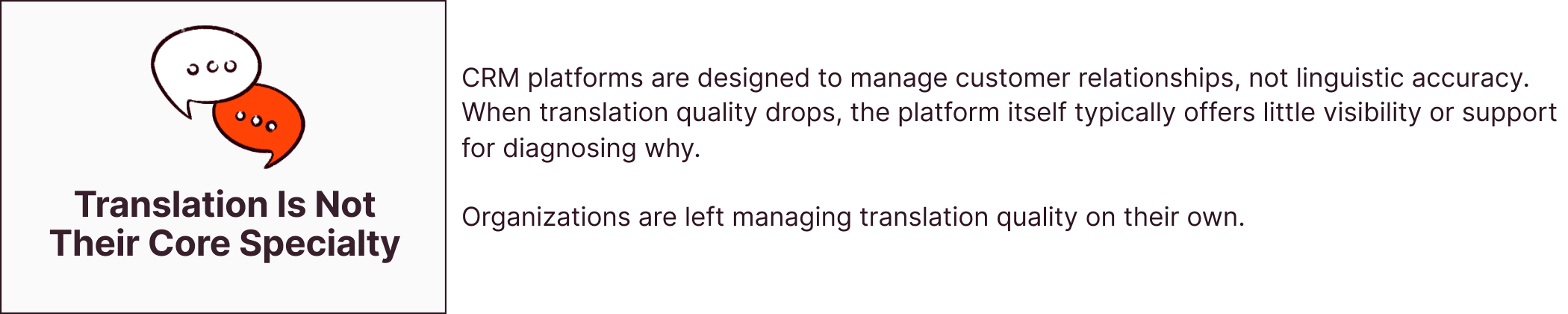
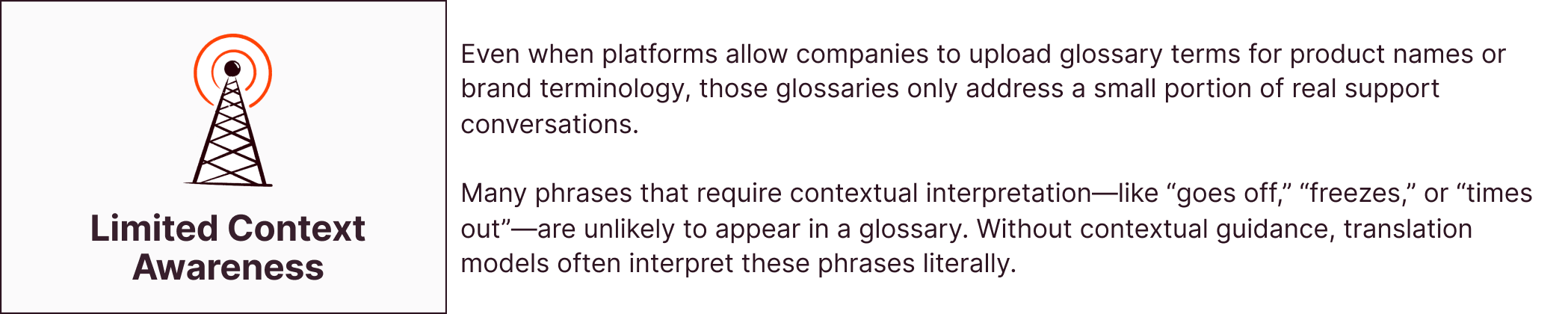
Built-in translation tools serve an important purpose. They allow companies with relatively simple multilingual needs to quickly translate messages without deploying additional software. But that simplicity comes with tradeoffs. Most native CRM translation systems share several structural limitations.
The Hidden Cost: Misunderstood Conversations
Not All Translation AI Is the Same
Enterprise Translation Requires More Than One Model
Translation quality varies widely depending on the languages involved. A model that performs extremely well for English-Spanish may perform significantly worse for English-Japanese or English-Arabic.

This is why enterprise translation systems increasingly rely on model orchestration rather than a single AI model.
Instead of assuming one engine can handle every language equally well, a multi-model system dynamically selects the most fluent translation model for each language pair.
As companies expand globally, these differences become increasingly visible. The model that works well for one region may perform poorly for another, making dynamic model selection critical for maintaining consistent translation quality.
Enterprise Translation Systems Must Be Model-Agnostic
Customer Conversations Are Not Just Text
Translation Is Becoming Infrastructure
Customer support, translation isn’t just about converting words. It’s about ensuring that two people who speak different languages actually connect.
Discover More
-

“We support 100+ Languages” is the most dangerous sentence in customer support.
Every platform now claims to translate. Almost none can tell you what happens when it goes wrong.
-

Salesforce AI Translation Guide: Native Features vs. Dedicated AI Translation Layers
Language IO is one of the strongest AI translation solutions for Salesforce because it works directly inside Salesforce Service Cloud, supports more than 150 languages, and adds translation-specific controls that native tools and general-purpose AI may not provide.