
ChatGPT has taken the digital world by storm, automating everything from essay writing to coding. But can ChatGPT translate languages? Simply put, yes, it can. But can it really handle the nuanced, multilingual conversations enterprise businesses depend on? That question gets more complicated the deeper you go.
It’s time to retire the myth that free, generic AI tools are good enough for global customer communication.
Just because something is ‘smart’ doesn’t mean it’s suitable. Enterprises shouldn’t be settling for translations that ‘mostly make sense’—not when your brand reputation is on the line.
This article looks at ChatGPT and translation. It unpacks the strengths, the flaws, and the enterprise use cases where ChatGPT’s translation capabilities might surprise you—or fall short.
TL;DR
- ChatGPT can translate languages, but it’s not enterprise-ready without extra layers:
- It handles many languages fluently and conversationally.
- It falters with slang, brand-specific terms, and messy user input.
- Context-aware platforms like Language IO fix what ChatGPT misses.
- Best use: paired with tech that understands your brand and customers.
Can ChatGPT Translate Languages?
Can you use ChatGPT to translate languages? Absolutely. Can it translate them with nuance, cultural intelligence, and the ability to decipher slang-riddled customer chats? That’s where things start to get murky.
Can ChatGPT translate English to Spanish? How many other languages can you translate with ChatGPT? Like Google Translate or DeepL, ChatGPT can process multilingual input and generate real-time translations. It can handle back-and-forth between dozens of language pairs, including English-to-Spanish, French-to-German, and Mandarin-to-Portuguese. So yes, ChatGPT can do translation.
Along with customer chat, can ChatGPT translate documents? Yes. But just because it can doesn’t mean it should, especially for customer support or business-critical communications.
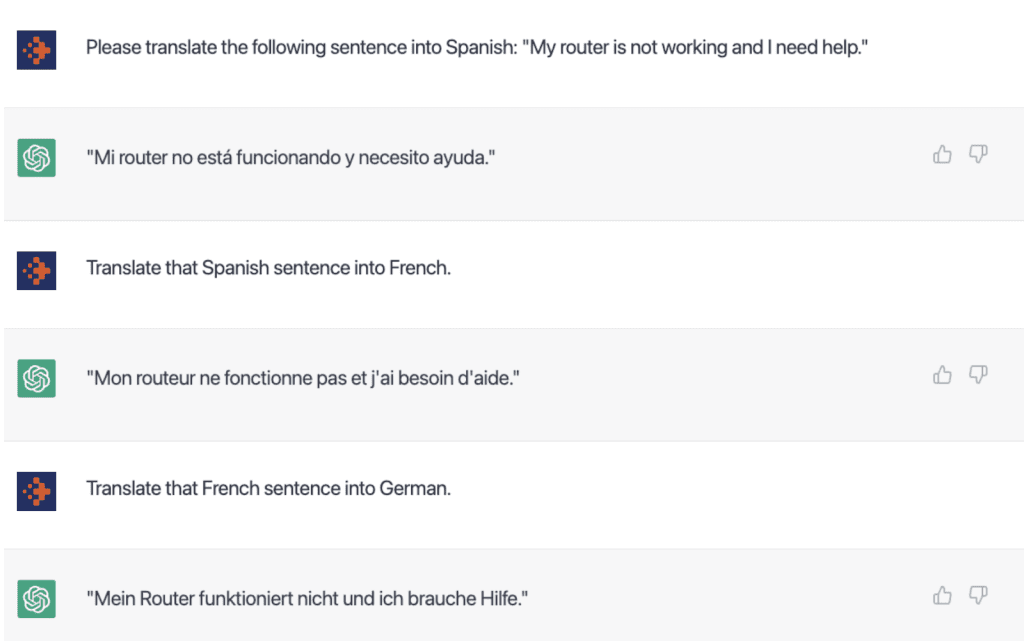
The below example shows GPT translating a sentence from English to Spanish, then Spanish to French, then French to German.
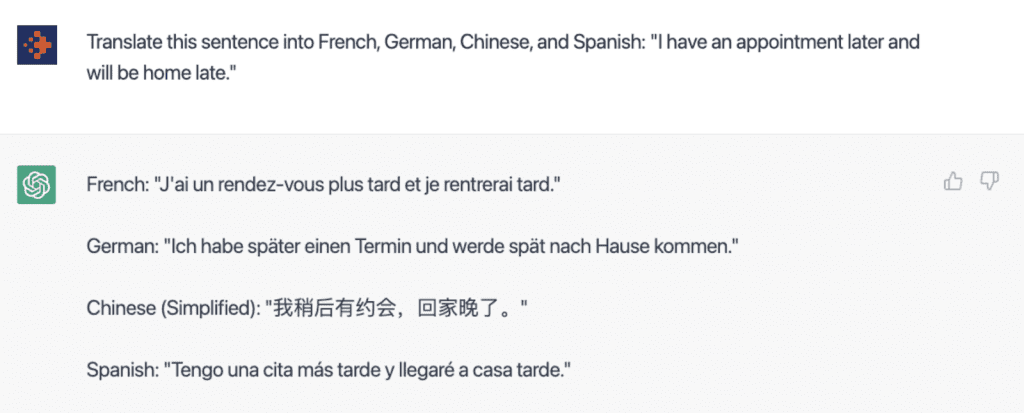
ChatGPT can also translate content into multiple languages at once. This essentially automates the process of translating content into multiple languages via Google Translate, which requires toggling the target language each time.
As a result, translating content into multiple languages at once is much more efficient in ChatGPT than it is in Google Translate.
Is ChatGPT a Good Translator?
How good is ChatGPT at translating? ChatGPT’s translation quality has created quite a stir in the language and localization community. Most recently, Tencent compared the quality of translations from ChatGPT against leading machine translation technologies, including Google Translate and DeepL.
What this initial study found is that ChatGPT performs at a level on par with these other translators, particularly when translating between European languages for which there is a significant amount of data.
However, like other publicly available translation engines, ChatGPT struggles when tasked with low-resource languages, for which the corpus of data to reference is smaller. Further, the analysis concluded that ChatGPT’s handling of informal or user-generated content, such as that seen in Reddit comments, left much to be desired.
As Andrew Ng, AI pioneer and co-founder of Google Brain, noted, “Agentic machine translation has huge potential.” This hints at the promise of AI systems that can adapt and reason more deeply about the text they’re processing—something today’s models, including ChatGPT, are only beginning to approach.
Ultimately, the findings boil down to an unsurprising conclusion: when trained on similarly massive datasets, an NLP tool like ChatGPT can produce roughly the same quality of translations as other such NLP-based translation engines.
Whether or not any of this makes ChatGPT a “good” translator is more complicated, however, and boils down to the intended use case of its translations.
Leveraging AI to expand globally while protecting your brand and customers
The AI boom is coming for every industry. How do global brands and retailers join this revolution, while prioritizing security and customer loyalty?
Pros and Cons of ChatGPT Translations
Is ChatGPT good at translation? Using ChatGPT for translation comes with both pros and cons. Let’s take a look at these in turn.
Pros of Using ChatGPT to Translate
- Real-time response: Fast, often instant multilingual conversions.
- Multilingual capability: Can translate into multiple languages at once.
- Flexible formats: Works across documents, chats, emails, and more.
- AI-powered fluency: Often captures natural language flow better than rigid MT engines.
Cons of Using ChatGPT for Translation
- No domain-specific context: Without glossaries or industry training, results can be wildly off.
- Struggles with slang, typos, and acronyms: “Ganafor” becomes “winery” instead of “ganador.”
- Unreliable with low-resource languages: Performance drops for languages with sparse training data.
- No understanding of brand voice: Translations can misalign with brand tone and customer expectations.
- Not integrated into customer service solutions: Using it adds extra time to resolving customer concerns.
- Data security concerns: All data in public models is stored and used for training the model, putting customer/company data at risk.
Is ChatGPT a Good Translator?
Short answer: It depends.
Long answer: ChatGPT is a decent translator for general content.
But ask it to translate a slang-filled, typo-riddled customer support message about promo codes? That’s when things unravel.
As the British language writer David Crystal once said, “Language changes, and translation must change with it.” ChatGPT isn’t quite there yet when it comes to user-generated chaos.
How to Use ChatGPT for Translation
Getting the best results from ChatGPT means treating it more like a collaborative assistant than a magic box. You can’t simply paste a block of messy text and expect perfection, especially in multilingual business contexts.
In 2023, Gartner predicted that by the following year, 40% of enterprise applications would have embedded conversational AI, up from less than 5% in 2020.
This shift underlines just how quickly AI tools like ChatGPT are becoming embedded in everyday business operations, but also highlights the need to implement them with structure and intent.
If you’re using ChatGPT for translation, do the following:
Step 1: Set the Scene
Before providing the text, briefly describe the scenario. For example:
“This is a customer support message for a sports betting app. Please translate it into Spanish using industry-specific language.”
Step 2: Clean the Input
Fix major typos or unclear phrasing in the original message if possible. If the content is customer-generated, expect ambiguity and plan to QA the result.
Step 3: Define the Target
Specify the desired tone (formal/informal), locale (e.g., Mexican Spanish vs. Castilian), and medium (e.g., app UI, customer email, knowledge base).
Step 4: Validate and Iterate
Feed the translation back through the model for confirmation or ask it to explain the translation. Where possible, have a human review before publishing.
3 Best Practices for Successful ChatGPT Language Translation
How accurate is ChatGPT translation? The truth is, it’ll never be perfect. However, you can increase the success of the translation by following these three best practices.
1. Use Contextual Prompts
ChatGPT thrives when given situational awareness. Include the source and intended audience in your prompt. Instead of saying, “Translate this,” say:
“Translate this product return message from a frustrated customer into French for a support agent.”
2. Leverage Named Entity Awareness
Brands, products, and acronyms often get misinterpreted. Use prompt instructions like: “RG refers to Roland-Garros, and Rafa means Rafael Nadal.”
3. Avoid Ambiguity and Compound Languages
If your source message includes a mix of languages (e.g., Spanish with an English term at the end), clarify upfront. Even better, pre-tag words you don’t want translated or that are brand-specific
According to Gartner, real-time translation is considered a ‘calculated risk’ in AI customer service use cases due to its high value but lower feasibility. That’s why layering AI with domain-specific context and human quality assurance isn’t just helpful—it’s essential.
Enterprise-grade MT solutions do this automatically. With ChatGPT, you’ll need to engineer it yourself.
Google Translate vs. ChatGPT: Which Is Better?
Google Translate has the edge in terms of reliability for standard, low-context translations. It’s built for speed and simplicity and offers a slick interface with automatic language detection and pronunciation guides. However, it can feel robotic and lacks flexibility for more complex or nuanced input.
ChatGPT, meanwhile, is better when you want translation wrapped in natural conversation. Need to translate an entire onboarding email in a friendly tone across three languages? ChatGPT will often sound more human.
But both platforms lack critical enterprise features: data security, glossary enforcement, tone consistency, and error handling in real-world use. That’s why businesses looking to scale global support need more than translation—they need contextual intelligence layered on top.
Are ChatGPT Translations Reliable for Use in Business or Customer Service?
The use of real-time translation technology in a business capacity has proven to be extremely beneficial for organizations with global audiences. Rather than hiring a full team of fluent speakers to cover every possible language that customers may speak, translation technology enables global brands to use their existing team of speakers, whether they be monolingual (e.g., English-only) or limited to a set of languages, to communicate with customers in virtually any language. This reduces the cost of providing multilingual support while boosting customer satisfaction—a win-win. However, to maintain effectiveness, it’s essential to follow translation quality best practices.
Given these benefits, businesses are asking: Can ChatGPT be used to fulfill this role?
Our answer is: no, not without additional technology layered on top of it to provide context.
To explain, here is an example of a real customer support chat that a business in the sports betting industry received, and how ChatGPT translated it.

ChatGPT’s translation is almost incomprehensible, particularly in the setting of sports betting. For a customer support agent who is potentially managing multiple chats at once, such a confusing translation may completely disrupt their workflow or require additional assistance from another support team member, leading to inefficiencies across the team.
Let’s break down why this message was so difficult for ChatGPT to translate:
1. Misspellings:
There are two distinct misspellings in the customer’s query. “Ganafor” should be “ganador,” meaning winner; while “iltima” should be “última,” meaning last. ChatGPT was able to understand “iltima” anyway and translated it as “final,” but was stumped by “ganafor” and translated it as “winery.”
2. Colloquialisms:
The Spanish-speaking customer used two instances of Spanish slang. Referring to the French Open, the customer said “RG” — an acronym for “Roland-Garros,” the name by which the French Open goes in most languages other than English. In the translation, “rg” is nowhere to be seen, so even someone who is familiar enough with the industry to recognize that “RG” means French Open wouldn’t be able to make that connection. Then, we see the customer also used the term “rafa” to refer to Rafael Nadal. ChatGPT did at least translate this to Rafael, which would likely help the agent know that the customer is referring to Nadal.
3. Multiple languages:
For an extra challenge, the customer threw in an English word at the end of their Spanish message: “free.” Parsing the use of multiple languages in content can be a challenge for human translators, so it’s no surprise that it could also trip up AI. Here, ChatGPT mistranslated this usage of “free” as “fee.”
So what is the customer actually trying to say? Interpreted properly, the customer’s message is: “I have redeemed the promo code for the French Open winner with Rafael Nadal, and you have not given me the latest free [reward].”
Here is how Language IO’s technology, which takes into account brand- and industry-specific jargon, translated the sentence:

Because Language IO technology has a glossary in place to pick up on phrases that demand context, this translation is much clearer about what the customer is trying to accomplish. This example highlights the importance of understanding AI translation limitations, especially when customer satisfaction and accuracy are on the line.
In this scenario, ChatGPT suffers from the same issues as other MT engines. Without added context, the engine doesn’t know how to handle “tricky” terminology such as slang and misspellings. Considering that messages from customers are often riddled with improper grammar and slang, as well as brand- or industry-specific jargon and acronyms, relying on a translation engine that can’t determine context is going to lead customer service conversations down the wrong path.
It’s important to note that this isn’t strictly a ChatGPT issue. Any other generative AI tool, such as Google Bard, will fall short in the same ways.
Why “Good Enough” Translation Isn’t Good Enough Anymore
AI translation doesn’t fail because it’s not fast or fluent—it fails because it doesn’t understand context.
When your customer says, “Rafa won RG and I haven’t gotten my free,” they’re not testing grammar—they’re testing your tech stack’s ability to understand them.
This is where ChatGPT, like many AI tools, hits its limits. Not because it’s unintelligent, but because it’s generic by design. That’s fine for a travel blog. It’s not fine for customer support, fintech, gaming, or regulated industries where context is everything.
Enterprise-grade translation isn’t just about converting words across languages. It’s about:
- Interpreting user-generated chaos (slang, acronyms, typos, half-sentences).
- Preserving brand voice and regulatory precision across markets.
- Scaling globally without sacrificing trust or tone.
That’s not something ChatGPT can do on its own—nor should it.
The real innovation isn’t in building a better generic translator. It’s in layering contextual intelligence over the best LLMs on the market—so that what your customer says, and what your brand means, stay aligned.
Language IO doesn’t replace ChatGPT. We make it enterprise-ready.
The Best Alternative to ChatGPT for Customer Service Translation
Because ChatGPT’s translations lack the necessary context required for successful use in customer service conversations, customer-centric organizations should find a solution that adds context.
At Language IO, we have built our technology to do just that. By aggregating the world’s leading translation engines, which, like ChatGPT or Google Bard, are trained on massive amounts of data, we are able to generate the best-in-class translation for each language pair and customer use case. We then add critical context via glossary imposition, which ensures that acronyms, misspellings, slang, and industry- or brand-specific terminology are handled properly.
ChatGPT’s technology is revolutionary, and the use of AI in this manner will only continue to increase in relevance. But without the ability to properly parse high-context user queries, global enterprises will be better served by technology that takes into account the nuances of conversational text. That’s why forward-thinking companies are increasingly turning to purpose-built customer service translation solutions.
To learn more about how Language IO can give your support team the ability to provide multilingual support at a reduced cost, reach out to us or request a demo.
Does ChatGPT Translate Languages? Key Takeaways
Can ChatGPT do translation? Yes, ChatGPT can translate languages, but it’s not suited for mission-critical customer interactions without help. It’s a valuable tool when used correctly, especially in low-risk environments or as part of a larger translation strategy.
However, for brands that prioritize voice, accuracy, and global customer satisfaction, using context-enriched solutions is the winning move. This involves leveraging machine translation technology that selects the most suitable AI models in real-time.
That’s where Language IO comes in—we integrate the power of generative AI with industry-specific glossaries, real-time context handling, and support for multilingual customer interactions. Want translations that protect your brand while scaling your support operations? Request a demo from Language IO and see the difference.