
For a while, the pitch on ChatGPT was that one model could do everything: draft the email, write the code, answer the ticket, translate the conversation. Translation was the first claim to wobble, and not because the model is weak. Translation is a chain of decisions, and a general model guesses at most of them.
Every message forces choices the words alone don’t settle. Formal or familiar, usted or tú? Which Spanish: Mexico, Spain, Argentina? Is “you” one person or a room? Is that product name a word to translate or a term to leave alone? A model that doesn’t know your brand, your customer, or the rest of the thread answers each one with the most likely default, then states it fluently. That’s ChatGPT translation accuracy in a sentence: confident guesses where you needed informed ones.
The gap stays invisible until someone who knows the domain reads the output. Fluent text reassures a casual reader. A localization manager or a compliance officer sees the dropped brand term, the formality that’s wrong for the market, the gender the model invented. Expertise turns “sounds right” into “is wrong.”
So how accurate is ChatGPT translation? Good enough to order dinner abroad or clear a few routine messages. Not good enough, on its own, to run regulated support, hold one brand voice across markets, or stand up in an audit. What follows: where ChatGPT translation accuracy holds, where it breaks, how it compares with DeepL and Language IO, and a checklist to test any AI translation tool before it reaches a customer.
TL;DR
- Can ChatGPT translate? Yes,it does a solid consumer-grade job on low-stakes messages in common languages, and gets less reliable as the stakes rise or the language gets rarer.
- How accurate is ChatGPT translation? Reliable on clean, general text. Shaky the moment a message needs judgment it can’t supply: your brand terms, the right level of formality, the regional variant of the language, the gender or tense the source leaves open.
- Why it fails for business: a general model guesses at those choices and delivers each one fluently, so wrong reads as smoothly as right. That’s a problem for regulated support, brand consistency, and anything that has to survive an audit.
- The fix: add context, terminology, and security on top of the best engines. That’s what Language IO does.
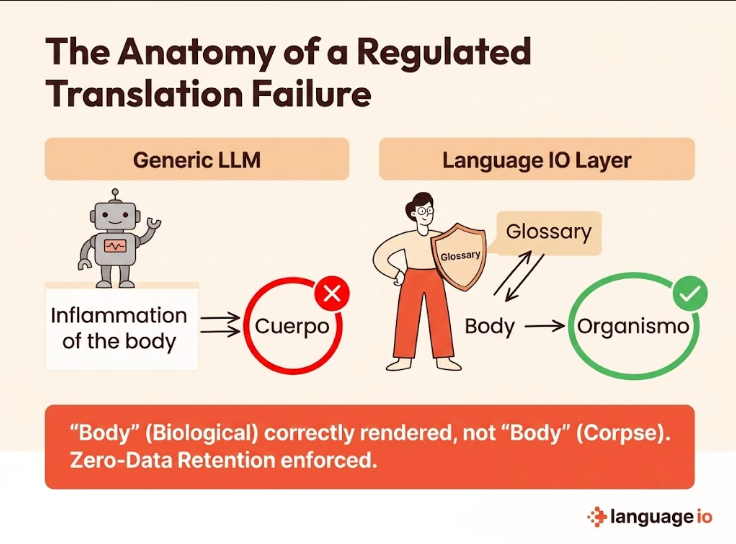
How accurate is ChatGPT translation?
Two things set ChatGPT translation accuracy: how common the language pair is, and how much the message leans on context the model doesn’t have. The first you can look up. The second is where enterprise translation actually lives.
On common, high-resource pairs like English and Spanish, ChatGPT performs about as well as a dedicated machine translation engine on clean text. Third-party research on AI translation performance puts numbers to that. Rarer pairs carry less training data, and quality falls. That part is predictable.
Context is the harder axis, because accuracy in translation isn’t one score. It’s a stack of separate decisions, and the model resolves every one of them, usually with no idea it’s making a choice.
Take formality. Spanish marks it with usted or tú, German with Sie or du, and Japanese runs a whole register system in keigo. Choose wrong and a support reply lands cold, or too familiar for the market. ChatGPT picks a default, with no way to know whether this customer is a stranger or a regular, or which register fits your brand.
Then locale. “Translate to Spanish” hides a question the model answers for you: which Spanish? Mexican, Castilian, and Argentine Spanish differ in vocabulary and tone. Same for Brazilian against European Portuguese, or French against Québécois. A generic pick satisfies no specific market.
Then the blanks the source leaves open. Is “you” one person or a room? Does a noun go masculine or feminine when the original never said? The model fills each blank with the likeliest answer, which is not the same as the right one for your customer.
And brand. Product names, feature names, and the terms that should stay fixed or stay in English. Without your glossary, the model translates what it should leave alone and guesses where it should defer.
None of these surface as garbled text. They surface as fluent output that’s quietly wrong in a way only someone who knows the language, the market, or the brand will catch. ChatGPT translation accuracy reads high right up until you measure it against what the message actually needed.
Can ChatGPT translate languages?
Yes, though “languages” isn’t one capability. Coverage is uneven, and the unevenness is predictable.
ChatGPT is strongest between high-resource languages, the ones with enormous amounts of text and translation data behind them: English, Spanish, French, German, Portuguese. Between those, on clean input, it’s fluent and usually right. It can also translate a single source into several of them at once, faster than switching targets one at a time in a standard translator.
Quality thins along two lines. First, low-resource languages. Much of Africa and South Asia, along with most Indigenous languages, sits on a fraction of the training data, so the model sees fewer examples and makes more mistakes. Sometimes it routes the translation through English on the way to the target, compounding the error at each hop.
Second, structural distance. Spanish and Italian share vocabulary and word order, which makes them easy. Pairs that sit far apart in grammar or script, English and Arabic or English and Japanese, ask the model to rebuild the sentence from the ground up, and that’s where agreement and honorifics slip. Languages that pack meaning into word endings, like Finnish and Turkish, hand it more chances to get the grammar wrong.
So ChatGPT can translate languages. It just doesn’t translate all of them equally well, and the gap opens widest where your data is thinnest. Whether it should handle a given job is a separate question, and documents demand more.
Can ChatGPT translate documents?
Yes, and it will hand you a readable draft in seconds. That speed hides problems that never surface in a one-off message, because a document isn’t just a longer chat. It’s longer, more structured, and usually more confidential, and each of those cuts against a general model.
Start with what leaves the building. To translate a document, you paste its contents into the tool, and in consumer ChatGPT that text can be stored and used to train the model. For a contract, a patient record, or an internal policy, that one act can breach a confidentiality obligation you’re legally bound to keep. Translation quality is beside the point if the file should never have gone there. The data question gets its own section below, but for documents the exposure starts the moment you paste.
Then structure. A document is headings, tables, footnotes, numbered clauses, and a layout that carries meaning. Paste it in and you get text back with most of that stripped away. Someone rebuilds the formatting by hand, and every manual step is a fresh chance to misplace a clause or drop a row.
Then length. Long documents run past the model’s input window, so they get chunked, and chunking breaks memory across the seams. A term defined on page 2 gets translated one way there and another on page 30. A forty-page agreement needs “the Disclosing Party” rendered identically forty times, and a general model won’t promise you that.
For anything headed to a regulator or a counterparty, you also need the paper trail: what was translated, reviewed by which person, in which version. Raw ChatGPT keeps none of it. That’s the line between a draft you tinker with and a document you can defend.
So ChatGPT can translate documents. Whether it should touch yours depends on what’s inside them and who has to stand behind the result.
The enterprise risks behind fluent output
There are two ways an AI translation can fail you. One is getting a sentence wrong. The other is getting sentences right but failing as a system: output you can’t reproduce, can’t audit, or can’t trust with your data. The second kind is what makes a general model unfit for enterprise support, and it holds even when the translations look clean.
Reproducibility, first. Send the same message twice and you can get two different translations, and the model you tested this quarter behaves differently next quarter with no changelog. For a disclosure or a contract clause, “it depends on the run” is a compliance failure. You can’t sign off on an engine you can’t repeat.
Invention. A general model can add meaning the source never carried or quietly drop meaning it did, then read smoothly either way. Older machine translation engines rarely made things up. An LLM will, and it does it in confident prose that gives a reviewer no reason to look twice.
Which is the next problem: the model never tells you when it guessed. There’s no flag on the sentence it was unsure about. A human translator marks a query. This one just commits. So the errors that ship are the ones that looked exactly as certain as everything around them.
Then the input itself. Customer messages aren’t clean text, and if one contains a line that reads like an instruction, a general model can follow it instead of translating it. That’s an accuracy bug and a security hole in the same message.
Your formatting is at risk too. Product strings and templated replies carry variables and placeholders, the {{first_name}} and %s that make a message render. A general model treats them as words and translates or drops them, and a broken placeholder ships an empty bracket to a customer.
Then data, the one that outranks the rest. In consumer tools the text you paste can be stored and used to train the model. For customer data in a regulated industry, that single fact ends the discussion, before quality is even on the table.
That’s why security can’t be a setting you switch on at the end. Language IO runs on Zero Data Retention: content is translated and nothing is kept. We connect only to models that hold to that policy, and we carry ISO 27001, ISO 42001, SOC 2, HIPAA, and GDPR compliance. Reading well and passing an audit are different tests. Most tools clear the first and fail the second.
Is your AI translation enterprise-ready? A checklist
ChatGPT can clear a few of these. No general model clears all of them. Run any tool you’re considering, including the one your team is already pasting into, against this list before it touches a customer.
Does it understand your content?
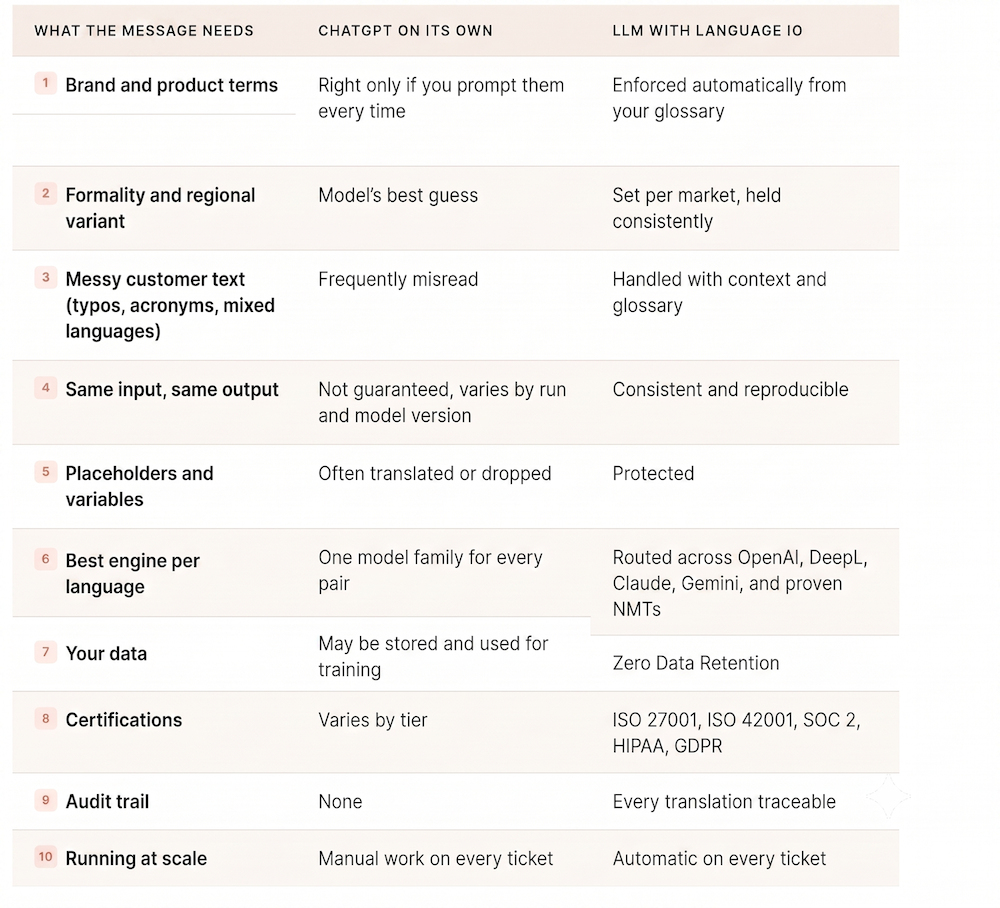
- Can it enforce your glossary and keep product names fixed without re-prompting every time?
- Does it hold the right formality and the right regional variant for each market, not a generic default?
- Can it handle the way customers actually write: misspellings, acronyms, two languages in one message?
Can you run it as a system?
- Does the same input return the same translation every time, and stay stable across model updates?
- Does it protect variables and placeholders instead of translating or dropping them?
- Does it plug into your live channels, chat, email, ticketing, and voice, or is it a separate window your agents paste into?
- Does it hold up at production volume, with pricing you can forecast, not per-use costs that spike with your ticket count?
- Is there a human review path before high-stakes text goes out?
Is your data safe?
- Is your text kept out of model training, with retention you can actually verify?
- Can you control where data is processed, and prove it to an auditor?
- Does it carry the certifications your industry requires: ISO 27001, ISO 42001, SOC 2, HIPAA, GDPR?
If a tool misses even a few, you don’t have an enterprise translation system. You have a helpful assistant, and a helpful assistant is not who you want answering a regulated customer.
How to improve ChatGPT translation accuracy
If you’re using ChatGPT for lower-risk work, a few habits raise the quality. Describe the scenario and audience before you paste the text. Fix obvious typos in the source. Name the tone and locale, Mexican Spanish rather than Castilian. Pre-tag brand terms you don’t want translated. Put a fluent human on anything customer-facing, and run the output through a repeatable check on translation quality.
Every one of those is manual, and every one is per message. That’s the catch. The habits that make ChatGPT translation accuracy acceptable on ten messages are the same habits that make it unworkable on ten thousand.
Run the numbers on a real support operation. Thousands of tickets a day, a dozen or more languages, every ticket needing the scenario set, the locale chosen, the brand terms tagged, and a bilingual reviewer on the way out. You’re not prompting a chatbot anymore. You’re staffing a translation department: computational linguists to build and maintain the glossaries, locale specialists for each market, linguistic QA to catch the quiet errors, and an evaluation setup that tells you when a model update silently changed the output. That’s a standing function with real headcount, and prompting was supposed to let you skip it.
This is the gap purpose-built technology closes. It turns that expertise into infrastructure that runs on every ticket automatically: glossaries enforced without re-typing, the right engine chosen per language pair, consistency held across every message, and real-time translation accuracy inside the channels your agents already work in. The linguists still matter. Their work just stops being something you redo by hand on every message.
How Language IO makes ChatGPT translation accuracy enterprise-ready
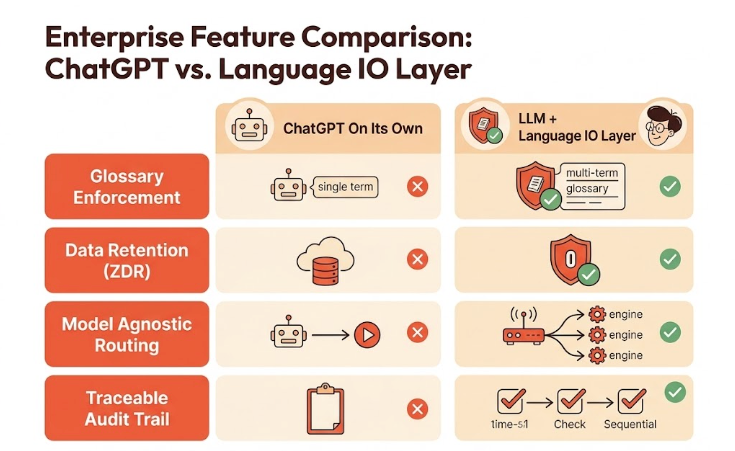
Language IO doesn’t replace the best models. It puts them to work together. No single engine wins at everything: one leads on Japanese, another on legal German, a proven neural engine still beats the newer models on a specific pair. Language IO reads each piece of content and routes it to the engine most likely to get it right, so you get OpenAI’s models, DeepL’s next-gen model, Claude, and Gemini, alongside proven neural machine translation engines, without betting your operation on any one of them. When a better model ships, it joins the lineup and you re-integrate nothing.
Model selection is half of it. The other half is the expertise that aligns those models to your business. Language IO’s linguists build and tune the glossaries that keep your product names, brand voice, and industry terms right across every language, and the glossary sharpens as it runs. This is the standing translation function the manual approach forces you to staff, built into the product and applied to every ticket: terms enforced, formality and locale handled, output held consistent, no bilingual reviewer retyping the same corrections on message after message.
All of it runs under Zero Data Retention, with ISO 27001, ISO 42001, SOC 2, HIPAA, and GDPR compliance behind it. That’s translation you can put in front of customers, auditors, and your own brand team without flinching. Request a demo and run it against your own support messages.

FAQs
Questions? We’ve got answers. ChatGPT translation accuracy
How accurate is ChatGPT translation?
It depends on the language and the stakes. On common language pairs and clean text, ChatGPT translation accuracy is high. On real customer messages, with slang, brand terms, formality, and mixed languages, it drops, because the model guesses at choices it has no context to make. It’s fine for low-stakes translation and unreliable, on its own, for regulated or brand-critical work.
Can ChatGPT translate documents for business?
It can produce a fast draft, but business use adds requirements it doesn’t meet on its own: consistent terminology across long files, preserved formatting, and confidentiality. Pasting a contract or a customer record into a consumer tool can also expose data that shouldn’t leave your control. For business documents, pair the model with technology that enforces your glossary, keeps output consistent, and retains no data.
Can ChatGPT translate for enterprises?
Not on its own. Enterprises need consistent, repeatable output, an audit trail, data security, and translation built into live support channels, and ChatGPT provides none of these by default. Enterprises get there by adding context, terminology, and Zero Data Retention security on top of the best models, which is what Language IO does.
Is ChatGPT translation accurate enough for regulated industries?
On its own, no. Regulated work needs reproducible output, a traceable record, and data that is never stored or used for training, and a general model gives you none of the three. Its fluent output can also hide the kind of error a compliance reviewer needs to catch. Regulated teams need translation they can repeat and defend, not just read.
Can ChatGPT translate languages in real time?
Yes. ChatGPT generates translations quickly across dozens of language pairs, in real time. Speed isn’t the enterprise gap, though. Consistency, terminology control, channel integration, and security are what separate a fast answer from one you can put in front of a customer.
How do I improve ChatGPT translation accuracy?
Give it context before you translate: the scenario, the audience, the tone, and the locale. Fix typos in the source, tag the brand terms you don’t want translated, and have a fluent speaker review anything customer-facing. These habits help at small volumes. Across thousands of messages, you need that context built in automatically rather than typed on every request.