
Artificial intelligence has made significant strides in recent years, leading to the development of sophisticated tools and applications. Among these are AI agents, which represent a leap forward in how tasks can be automated and managed.
An AI agent is a software program capable of performing tasks autonomously on behalf of users or systems, interacting with environments to achieve goals with minimal human oversight.
In this article, the capabilities, uses, and implications of AI agents in today’s technological landscape will be explored, providing insights into how they transform work and everyday life.
TL;DR
- AI agents are autonomous systems that can interact with users through various interfaces like chat, voice, and AR/VR technologies. These agents function independently without needing continuous oversight.
- AI agents leverage large language models (LLMs) to process and generate responses. They use these capabilities to access and update information continuously.
- AI agents are utilized in customer support, virtual assistance, and more, enabling smart technology that is user-centric and accessible.
- These agents are built on two primary frameworks—physical architectures, such as robotic components, and digital architectures, like software-based agents.
What Are AI Agents?
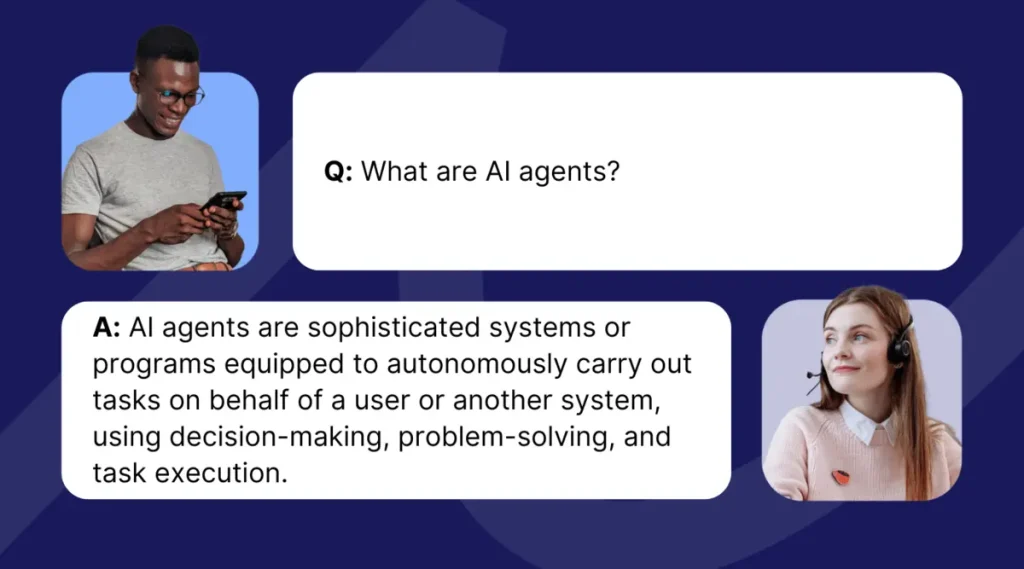
AI agents are sophisticated systems or programs equipped to autonomously carry out tasks on behalf of a user or another system. Their core capabilities include decision-making, problem-solving, and task execution utilizing available tools.
An agent in AI often features an agent architecture, which may be digital or physical. Digital agents function within software environments, while physical agents may include robots with actuators, motors, and sensors.
AI agents interact with their environments by collecting data, processing inputs, and executing actions to achieve predetermined goals. This interaction can occur through various interfaces such as chat, voice, or immersive technologies like AR/VR.
In practical terms, AI agents are frequently used in customer service as chatbots or in smart home systems like virtual assistants that manage home devices. Industries such as healthcare, finance, and customer service increasingly harness these agents for their ability to perform complex tasks efficiently.
How Do AI Agents Work?
AI agents function by automating complex tasks, using advanced technologies to interpret and respond to data inputs. They employ machine learning methods to discern patterns and make decisions without explicit programming for each task.
An AI agent typically begins with a user-defined goal. This goal shapes its plan and directs subsequent actions.
As part of their functionality, AI agents often involve components like natural language processing (NLP) and real-time data analysis, enhancing their ability to comprehend and respond to human inputs.
Key Technologies and Processes:
- Large Language Models (LLMs): These models help AI agents generate responses by processing extensive datasets, enabling them to engage intelligently in diverse scenarios.
- Feedback Systems: Incorporating feedback mechanisms allow these agents to refine their outputs continually. They learn from interactions, acquiring knowledge to improve performance in future tasks.
- Backend Collaborations: They integrate knowledge from various sources, filling information gaps and supporting complex problem-solving.
With these components, AI agents act autonomously, processing vast amounts of information to deliver relevant outcomes effectively. Through their structured workflow, they optimize tasks, ensuring that the end results align with the users’ objectives.
4 Benefits Of Using AI Agents
AI agents can automate repetitive tasks, freeing employees to focus on more strategic initiatives. In businesses, they handle tasks like scheduling, data entry, and customer interactions, increasing efficiency. This leads to quicker turnaround times and reduces the margin for human error.
Enhanced performance is another advantage. AI agents work tirelessly without fatigue, ensuring tasks are completed consistently. They adapt and improve over time through machine learning, leading to better decision-making and resource management. This consistent performance can be critical in environments where reliability is essential.
AI agents offer an improvement in the quality of responses. With their ability to process and analyze large amounts of data, AI agents provide accurate and timely information. For customer support, this means providing tailored solutions that enhance customer satisfaction and loyalty.
Scalability is a significant benefit. As businesses grow, AI agents easily adapt to increased workloads without requiring extensive resources. This flexibility helps organizations scale their operations smoothly, ensuring they can meet market demands and maintain competitiveness.
8 Types Of AI Agents
1. Simple Reflex Agents
Operate purely on present conditions. They act based on current perceptions without relying on prior experiences. This makes them straightforward but limited in complex environments.
2. Model-Based Reflex Agents
Improve decision-making by incorporating past information. They use models to predict future states, enhancing their ability to handle more intricate scenarios compared to simple reflex agents.
3. Goal-Based Agents
Function with specified objectives guiding their actions. By considering potential outcomes, they aim to achieve set goals, making them suitable for tasks that require strategic planning.
4. Learning Agents
Adapt their actions by acquiring new knowledge from the environment. Through continuous interaction, they modify their behavior to enhance effectiveness, making them versatile in dynamic settings.
5. Hierarchical Agents
Structure decision processes across multiple levels. Each level addresses different problem aspects, enabling efficient management of complex tasks with guidance from higher to lower levels.
6. Autonomous AI Agents
Operate independently without human intervention. They make decisions based on learned rules and data, which is vital for tasks requiring continuous real-time decision-making.
7. Generative AI Agents
Create new content or solutions using learned patterns. These agents are increasingly prevalent in creative fields, generating text, images, and other media.
8. AI Sales Engineer Agents
AI sales engineers specialize in supporting sales and customer success teams by serving as real-time technical copilots.
They listen to live conversations, interpret questions, and provide accurate, contextual answers.
Beyond calls, they generate post-call insights like competitor mentions, product gaps, and highlight reels, ensuring knowledge is shared across the organization.
AI Agents Examples
AI agents are transforming various industries with their advanced capabilities, performing specific tasks efficiently to offer increased productivity and improved user experiences.
In customer service, AI-powered chatbots provide multilingual support, handling numerous conversations simultaneously and being available 24/7. For example, Language IO’s solutions enable chatbots to communicate in multiple languages, reducing wait times and enhancing customer satisfaction.
In healthcare, virtual assistants like Devin provide users with medical information and medication reminders. By leveraging natural language processing, they engage in real-time conversations, enhancing patient support.
In the automotive industry, AI agents are exemplified by autonomous driving technologies such as Waymo. These self-driving cars utilize AI to navigate complex urban environments safely and efficiently.
In software development, tools like GitHub’s Copilot assist developers by suggesting code completions and debugging guidance. This AI agent leverages machine learning models trained on vast repositories of code to enhance programming productivity.
In e-commerce, AI agents personalize customer interactions, facilitating tasks like order placement and providing real-time shipping updates, thereby streamlining the shopping experience.
In finance, AI agents aid in fraud detection by analyzing transaction patterns to identify anomalies, improving security and protecting consumers from potential financial threats.
Smart home systems also benefit from AI agents; for example, intelligent thermostats learn user habits to optimize energy use, enhancing convenience and efficiency in residential settings.
Security in an AI-driven landscape
A practical guide for CX leaders
How To Build And Implement AI Agents: 5 Tips For Success
1. Define Requirements
Establish clear objectives and requirements for the AI agent. This includes understanding the target users and setting specific tasks the agent should accomplish. For example, if the AI agent is designed for customer support, identify specific tasks such as answering FAQs, assisting with order tracking, or handling basic troubleshooting. Understanding the target users, such as their preferred communication channels or common pain points, helps shape the agent’s design. A retail company, for instance, might prioritize an AI agent that seamlessly integrates with its e-commerce platform to enhance the customer experience.
2. Assess Risks
Evaluate potential risks associated with deploying the AI agent. Consider factors like system errors, data breaches, and unintended consequences. A comprehensive risk assessment can mitigate potential challenges. For instance, if the agent relies on customer data, consider the implications of data breaches or mismanagement. An e-commerce platform deploying an AI chatbot must ensure the bot doesn’t inadvertently expose customer purchase histories or payment details. Conducting thorough testing and implementing fail-safe mechanisms can mitigate these risks. Additionally, prepare a contingency plan to handle scenarios where the AI agent fails or provides incorrect responses.
3. Integration
Ensure seamless integration with existing systems. Compatibility with current infrastructure is crucial for smooth operation. This might require custom solutions or updates to existing technologies to achieve optimal performance. For example, integrating an AI agent with a CRM platform like Salesforce might require custom APIs or middleware to facilitate data exchange. A healthcare provider using an AI scheduling assistant must ensure it works with existing electronic health record (EHR) systems for accurate appointment booking. Successful integration minimizes disruptions and maximizes the agent’s utility.
4. Action Log
Implement a robust logging mechanism to track the agent’s actions and decisions. This helps in troubleshooting and auditing the agent’s activities, providing transparency in its operations. For example, an AI-powered recommendation system can log suggestions it makes and the rationale behind them, which helps identify errors or refine its algorithms over time. In a financial services context, maintaining a detailed action log ensures compliance with regulatory requirements and provides a clear audit trail in case of disputes. Transparency builds trust and facilitates troubleshooting when needed.
5. Data Privacy and Security
Prioritize data privacy and security. This involves setting up encryption protocols and access controls to protect sensitive information. Regular audits can help identify and address vulnerabilities promptly. For example, an AI assistant handling sensitive customer information should implement end-to-end encryption and strict access controls to prevent unauthorized access. A company deploying an AI recruitment tool must anonymize candidate data to avoid bias or misuse. Regular security audits and compliance with standards like GDPR or HIPAA help ensure the system’s resilience against breaches. By safeguarding data, businesses build trust with their users and stakeholders.
Final Thoughts On AI Agents
AI agents represent a transformative leap in technology, combining advanced decision-making, problem-solving, and task execution capabilities. These agents’ ability to adapt and improve over time makes them invaluable in dynamic environments, from customer support to healthcare and beyond.
At Language IO, we empower businesses to translate their AI support agents into 155+ languages in under 24 hours. By leveraging our self-improving glossaries and seamless integration with platforms like Salesforce, Zendesk, and Oracle, we ensure that AI agents communicate consistently and accurately across all languages. This rapid deployment capability allows businesses to maintain their brand voice, support global customers effectively, and adapt quickly to evolving market demands.
By integrating AI agents with robust privacy measures and seamless system compatibility, businesses can harness their full potential while addressing risks effectively. When built and implemented thoughtfully, with clear objectives and an emphasis on data security, AI agents can revolutionize how tasks are performed, driving innovation and efficiency in ways previously unattainable.
FAQs
What Industries Benefit The Most From Agents In AI?
Industries like healthcare, finance, and customer service gain significantly from AI agents. In healthcare, AI agents assist in diagnostics and patient care management. Finance sectors utilize them for fraud detection and personalized financial advice, enhancing efficiency and security. Customer service is transformed through AI-driven chatbots that provide 24/7 support, improving response times and customer satisfaction. These applications demonstrate the versatility and impact of AI agents across various sectors.
What Are The Key Components Of AI Agent Architecture?
AI agent architecture consists of several critical components, including sensors, effectors, and decision-making modules. Sensors allow agents to perceive their environment by collecting data. Effectors enable the agent to interact with its surroundings and execute tasks. The decision-making module processes sensor data to decide on the best actions to achieve its objectives. These components work together to enable the agent’s functionality and adaptability.
What Are The Key Principles That Define AI Agents?
AI agents operate based on autonomy, adaptability, and learning. Autonomy enables them to function with minimal human intervention, making independent decisions. Adaptability allows them to adjust actions based on changes in the environment. Learning is key, as they improve their performance through feedback, enhancing their capability over time. These principles underpin the behavior and effectiveness of AI agents in various applications.
How Many Types Of Agents Are Defined In Artificial Intelligence?
Artificial intelligence defines several types of agents, ranging from simple reflex agents to complex learning agents. Simple reflex agents operate based on predefined rules. Model-based agents consider environmental changes and their effects. Goal-based agents pursue specific objectives, while utility-based agents weigh action outcomes to maximize utility. Lastly, learning agents improve their decision-making through experience, demonstrating a range of complexity and capability in AI.
Is ChatGPT An AI Agent?
ChatGPT functions as an AI language model rather than a full-fledged AI agent. Unlike traditional AI agents, it primarily focuses on generating human-like text based on input prompts. While it can handle various conversational tasks, it lacks direct interaction with real-world environments and does not autonomously make decisions or take actions beyond text generation. Thus, it occupies a distinct role within the AI ecosystem.
Are GPTs AI Agents?
Generative Pre-trained Transformers (GPTs) are AI models specialized in generating text but do not qualify as fully autonomous AI agents. They lack sensory inputs and effectors necessary for environmental interaction. GPTs excel in understanding and generating text, making them invaluable for language-based applications. However, they do not independently execute or decide on actions, distinguishing them from AI agents with broader operational capabilities.
Are Autonomous AI Agents Sentient?
Autonomous AI agents are not sentient. Sentience implies consciousness and self-awareness, which current AI technology does not possess. While AI agents can perform complex tasks and adapt to environments, these abilities result from programmed algorithms and machine learning, lacking any form of consciousness or subjective experience. Their operations are mechanical and deterministic, devoid of emotional or self-aware characteristics.
What Is The Future Of AI Agents? Will They Take People’s Jobs?
The future of AI agents is marked by increased integration and functionality across industries.
While they may automate some low-skill jobs, they also create opportunities for new roles focusing on innovation, oversight, and AI development.
Companies and workers might need to adapt skills to collaborate with AI, emphasizing roles in management, creativity, and ethical governance to harness AI agents’ full potential without significant job displacement.
Do AI Agents Perpetuate Bias And Discrimination?
AI agents can inadvertently perpetuate bias and discrimination if trained on biased data. The algorithms reflect inherent biases present in data, potentially leading to unfair decisions or actions.
Addressing this involves careful data selection, ongoing bias detection, and implementing corrective measures in AI systems. For multilingual AI agents, it is particularly critical that the source data is translated properly in a culturally sensitive and unbiased way. Accurate, context-aware translations ensure that no unintended biases are introduced during the language adaptation process.
Developers must responsibly train AI agents on unbiased data and prioritize equitable and fair outcomes across all applications to mitigate these risks effectively.
What Happens When An AI Agent Makes A Mistake? Who’s To Blame?
When an AI agent makes a mistake, responsibility often lies with the developers, operators, or organizations overseeing its deployment.
Errors usually result from flaws in data, algorithms, or implementation.
Establishing accountability frameworks and rigorous testing processes is critical to minimize risks and ensure systems are reliable.
Clear guidelines and policies help in addressing liability and taking corrective action when AI-induced errors occur.